{"title":"Heart failure–cardiogenic shock: A need for time-dependent quality indicators","authors":"Nuccia Morici, Federico Pappalardo","doi":"10.1002/ejhf.3058","DOIUrl":null,"url":null,"abstract":"<p>Standing before the Royal College of Surgeons in 2006, surgeon J.K. Styner emotionally recounted the tale of his wife's death and his children's injuries in an airplane crash in Nebraska in 1976. This tragedy was the starting point for ‘recognition of a need for change’. A miracle occurred as a result of the wounds of Styner and his family: Advanced Trauma Life Support was born, a common ‘language used by groups, enabling efficient, effective assessment and stabilization… as a coiled spring that is released’.<span><sup>1</sup></span> The concept of timely identification and treatment of time-dependent disorders in medicine has spread beyond trauma to cardiac arrest, acute myocardial infarction, stroke, sepsis and toxicology.</p><p>Nevertheless, this goal is still being missed in the management of heart failure–cardiogenic shock (HF-CS). A different pathophysiological derangement, with congestion and mild hypoperfusion leading the primary clinical picture, usually induces a false sense of reassurance.<span><sup>2</sup></span> According to the updated Society for Cardiovascular Angiography and Interventions (SCAI) classification, SCAI B HF-CS usually develops in non-intensive care settings, where low-dose inotropes are often administered without testing if hypoperfusion occurs and without considering the most appropriate ‘exit strategies’.</p><p>Is this different from Styner's ‘lack of a delivery system’ in the management of trauma? Available data have already shown the detrimental effects of all the vasoactive inotropic agents and have even shown that these patients will seldom achieve native heart recovery: their lives will be most probably saved by the access to heart replacement therapies (HRTs: heart transplant or left ventricular assist device). Evidence from single-centre cohort studies suggests the potential benefit of intra-aortic balloon pump (IABP) implantation and invasive monitoring with pulmonary artery catheter (PAC) in this setting.<span><sup>3</sup></span> But are we willing and ready to immediately implant a PAC and/or an IABP in an SCAI B patient with mild or no vasoactive support? Of interest is whether physicians taking care of this type of patient fully agree with the equipoise of testing this approach, and whether the logistics of centralization allow timely referral. SCAI B HF-CS patients are usually prioritized differently to other cardiac patients when admitted to an intensive care unit and strong evidence from well-conducted, robust randomized studies is needed to demonstrate the benefits of the approach suggested above and to overcome clinician inertia.</p><p>An interconnected continuum of patient care and awareness of the evolving destiny of SCAI B CS calls for rethinking of a new process of longitudinal interdisciplinary care. Our group has shown that 47% of SCAI B patients will deteriorate within the first 24 h after CS diagnosis and that this process is captured by parameters that require intensive care monitoring, such as central venous pressure and lactates.<span><sup>4</sup></span> With this in mind, we also recognize that, in the present era, access to therapies is provided only for the higher SCAI stages, when the patient is sicker.</p><p>In this regard, optimal systematic care would break down the barriers of interoperable communication between teams, disjointed transfers between services, unnecessary and time-consuming re-evaluation and transitional pauses in time-dependent circumstances, deficiencies in cross-disciplinary education and significant variability in patient care practices. In Europe, this is easily captured by the lack of critical care cardiology education, generating a gap in the spectrum of opportunities that is provided to patients as long as they are admitted to a cardiac care or a general intensive care pathway. Ultimately, every healthcare provider should be engaged along the continuum of interconnected care of CS to ensure that SCAI B patients access critical care.</p><p>Triage of this subgroup of patients should also encompass identification of major comorbidities or associated issues that might contraindicate HRT, to avoid futility; this is pivotal so that systems with limited resources are not overwhelmed. The numbers of older HF patients needing acute care is constantly increasing. The early identification of those patients who may benefit most from a more intensive management and/or who may be good candidates for HRT is of paramount importance, together with identification of futility in the significant proportion of elderly and fragile patients with multiple comorbidities.</p><p>This task would be a priority of the ‘cardiogenic shock teams’ that are being advocated. The success of this strategy has the metrics of reduction in the delay in intervention, which on clinical grounds means the identification of CS at lower SCAI stages and less need for biventricular support.</p><p>Ultimately, ‘proximity outcomes’ should be incorporated in the value of treatments for these patients, as long as survival at 30 days is not a holistic outcome (we endorse the role of CS therapies as a bridge to the next treatment, mostly in acutely decompensated patients). SCAI B patients, as patients not at risk of imminent death, especially might benefit from interventions that also cover the broad spectrum of accompanying illness (deconditioning, malnutrition, polyneuropathy, pressure sores and, ultimately, infections) that play a pivotal role in their mid-term quality of life and eventually survival (<i>Figure</i> 1).</p><p>Accordingly, the ongoing Pulmonary Artery Catheter in Cardiogenic Shock Trial (PACC; NCT05485376) and the Altshock-2 (NCT04295252) study will thoroughly assess the effectiveness of managing an invasive diagnosis with a PAC and the therapeutic strategy of IABP implantation in earlier stages of HF-CS. The cost of modern intensive care units is enormous and to sharpen the effectiveness of our interventions, the involved groups must have a common focus, with inter-setting training and knowledge promoted. This approach will allow more SCAI B patients to be admitted, including those who have not received guideline-directed medical therapy or device therapy previously. These therapies will be optimized before HRT is considered.</p><p>Heart replacement therapy comes with a high cost to society. There are ethical considerations related to implementing extremely costly therapy on a few patients with a severe prognosis when many with much better prognoses can be treated (and saved) with optimal use of resources.</p><p>It is anticipated that future trials will demonstrate the effects of temporary mechanical circulatory supports or invasive monitoring, resulting in an impactful clinical message. Completing ongoing trials and planning further trials with effective adaptative designs are mandatory steps to building strong evidence. From this perspective, the patient journey must be shared and thoughtfully defined.</p><p><b>Conflict of interest</b>: none declared.</p><p>[Correction added on 15 January 2024, after first online publication: Conflict of interest section has been added to this version.]</p>","PeriodicalId":164,"journal":{"name":"European Journal of Heart Failure","volume":"25 12","pages":"2105-2106"},"PeriodicalIF":10.8000,"publicationDate":"2023-10-12","publicationTypes":"Journal Article","fieldsOfStudy":null,"isOpenAccess":false,"openAccessPdf":"https://onlinelibrary.wiley.com/doi/epdf/10.1002/ejhf.3058","citationCount":"0","resultStr":null,"platform":"Semanticscholar","paperid":null,"PeriodicalName":"European Journal of Heart Failure","FirstCategoryId":"3","ListUrlMain":"https://onlinelibrary.wiley.com/doi/10.1002/ejhf.3058","RegionNum":1,"RegionCategory":"医学","ArticlePicture":[],"TitleCN":null,"AbstractTextCN":null,"PMCID":null,"EPubDate":"","PubModel":"","JCR":"Q1","JCRName":"CARDIAC & CARDIOVASCULAR SYSTEMS","Score":null,"Total":0}
引用次数: 0
Abstract
Standing before the Royal College of Surgeons in 2006, surgeon J.K. Styner emotionally recounted the tale of his wife's death and his children's injuries in an airplane crash in Nebraska in 1976. This tragedy was the starting point for ‘recognition of a need for change’. A miracle occurred as a result of the wounds of Styner and his family: Advanced Trauma Life Support was born, a common ‘language used by groups, enabling efficient, effective assessment and stabilization… as a coiled spring that is released’.1 The concept of timely identification and treatment of time-dependent disorders in medicine has spread beyond trauma to cardiac arrest, acute myocardial infarction, stroke, sepsis and toxicology.
Nevertheless, this goal is still being missed in the management of heart failure–cardiogenic shock (HF-CS). A different pathophysiological derangement, with congestion and mild hypoperfusion leading the primary clinical picture, usually induces a false sense of reassurance.2 According to the updated Society for Cardiovascular Angiography and Interventions (SCAI) classification, SCAI B HF-CS usually develops in non-intensive care settings, where low-dose inotropes are often administered without testing if hypoperfusion occurs and without considering the most appropriate ‘exit strategies’.
Is this different from Styner's ‘lack of a delivery system’ in the management of trauma? Available data have already shown the detrimental effects of all the vasoactive inotropic agents and have even shown that these patients will seldom achieve native heart recovery: their lives will be most probably saved by the access to heart replacement therapies (HRTs: heart transplant or left ventricular assist device). Evidence from single-centre cohort studies suggests the potential benefit of intra-aortic balloon pump (IABP) implantation and invasive monitoring with pulmonary artery catheter (PAC) in this setting.3 But are we willing and ready to immediately implant a PAC and/or an IABP in an SCAI B patient with mild or no vasoactive support? Of interest is whether physicians taking care of this type of patient fully agree with the equipoise of testing this approach, and whether the logistics of centralization allow timely referral. SCAI B HF-CS patients are usually prioritized differently to other cardiac patients when admitted to an intensive care unit and strong evidence from well-conducted, robust randomized studies is needed to demonstrate the benefits of the approach suggested above and to overcome clinician inertia.
An interconnected continuum of patient care and awareness of the evolving destiny of SCAI B CS calls for rethinking of a new process of longitudinal interdisciplinary care. Our group has shown that 47% of SCAI B patients will deteriorate within the first 24 h after CS diagnosis and that this process is captured by parameters that require intensive care monitoring, such as central venous pressure and lactates.4 With this in mind, we also recognize that, in the present era, access to therapies is provided only for the higher SCAI stages, when the patient is sicker.
In this regard, optimal systematic care would break down the barriers of interoperable communication between teams, disjointed transfers between services, unnecessary and time-consuming re-evaluation and transitional pauses in time-dependent circumstances, deficiencies in cross-disciplinary education and significant variability in patient care practices. In Europe, this is easily captured by the lack of critical care cardiology education, generating a gap in the spectrum of opportunities that is provided to patients as long as they are admitted to a cardiac care or a general intensive care pathway. Ultimately, every healthcare provider should be engaged along the continuum of interconnected care of CS to ensure that SCAI B patients access critical care.
Triage of this subgroup of patients should also encompass identification of major comorbidities or associated issues that might contraindicate HRT, to avoid futility; this is pivotal so that systems with limited resources are not overwhelmed. The numbers of older HF patients needing acute care is constantly increasing. The early identification of those patients who may benefit most from a more intensive management and/or who may be good candidates for HRT is of paramount importance, together with identification of futility in the significant proportion of elderly and fragile patients with multiple comorbidities.
This task would be a priority of the ‘cardiogenic shock teams’ that are being advocated. The success of this strategy has the metrics of reduction in the delay in intervention, which on clinical grounds means the identification of CS at lower SCAI stages and less need for biventricular support.
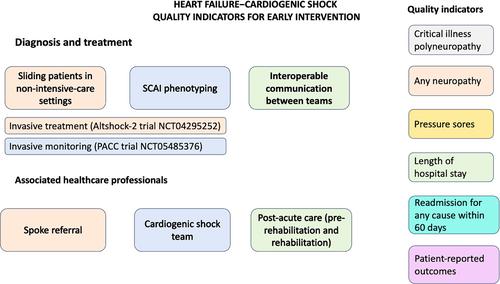
Ultimately, ‘proximity outcomes’ should be incorporated in the value of treatments for these patients, as long as survival at 30 days is not a holistic outcome (we endorse the role of CS therapies as a bridge to the next treatment, mostly in acutely decompensated patients). SCAI B patients, as patients not at risk of imminent death, especially might benefit from interventions that also cover the broad spectrum of accompanying illness (deconditioning, malnutrition, polyneuropathy, pressure sores and, ultimately, infections) that play a pivotal role in their mid-term quality of life and eventually survival (Figure 1).
Accordingly, the ongoing Pulmonary Artery Catheter in Cardiogenic Shock Trial (PACC; NCT05485376) and the Altshock-2 (NCT04295252) study will thoroughly assess the effectiveness of managing an invasive diagnosis with a PAC and the therapeutic strategy of IABP implantation in earlier stages of HF-CS. The cost of modern intensive care units is enormous and to sharpen the effectiveness of our interventions, the involved groups must have a common focus, with inter-setting training and knowledge promoted. This approach will allow more SCAI B patients to be admitted, including those who have not received guideline-directed medical therapy or device therapy previously. These therapies will be optimized before HRT is considered.
Heart replacement therapy comes with a high cost to society. There are ethical considerations related to implementing extremely costly therapy on a few patients with a severe prognosis when many with much better prognoses can be treated (and saved) with optimal use of resources.
It is anticipated that future trials will demonstrate the effects of temporary mechanical circulatory supports or invasive monitoring, resulting in an impactful clinical message. Completing ongoing trials and planning further trials with effective adaptative designs are mandatory steps to building strong evidence. From this perspective, the patient journey must be shared and thoughtfully defined.
Conflict of interest: none declared.
[Correction added on 15 January 2024, after first online publication: Conflict of interest section has been added to this version.]
期刊介绍:
European Journal of Heart Failure is an international journal dedicated to advancing knowledge in the field of heart failure management. The journal publishes reviews and editorials aimed at improving understanding, prevention, investigation, and treatment of heart failure. It covers various disciplines such as molecular and cellular biology, pathology, physiology, electrophysiology, pharmacology, clinical sciences, social sciences, and population sciences. The journal welcomes submissions of manuscripts on basic, clinical, and population sciences, as well as original contributions on nursing, care of the elderly, primary care, health economics, and other related specialist fields. It is published monthly and has a readership that includes cardiologists, emergency room physicians, intensivists, internists, general physicians, cardiac nurses, diabetologists, epidemiologists, basic scientists focusing on cardiovascular research, and those working in rehabilitation. The journal is abstracted and indexed in various databases such as Academic Search, Embase, MEDLINE/PubMed, and Science Citation Index.



 京公网安备 11010802042870号
京ICP备2023020795号-1
京公网安备 11010802042870号
京ICP备2023020795号-1

 分享
分享
 求助内容:
求助内容: 应助结果提醒方式:
 扫码关注我们
