Sedigheh Rafiei Tabatabaei, Marjan Tariverdi, Abdollah Karimi, Ali Nazari-Alam, Hannan Khodaei, Leila Azimi
{"title":"Sequence-type diversity of invasive Streptococcus pneumoniae isolates in Iran among children under 15 years of age.","authors":"Sedigheh Rafiei Tabatabaei, Marjan Tariverdi, Abdollah Karimi, Ali Nazari-Alam, Hannan Khodaei, Leila Azimi","doi":"10.3205/dgkh000445","DOIUrl":null,"url":null,"abstract":"<p><strong>Background: </strong>Infection with viruses, bacteria, or other pathogens can lead to inflammation of the meninges. Finding the pathogen and identifying the most common type is necessary for each country. Using multi-locus sequence typing (MLST), the aim of this study was to determine the genetic relationship among <i>S. pneumoniae</i> isolated from CSF in children with bacterial meningitis.</p><p><strong>Materials and methods: </strong>: Fourteen isolates of <i>S. pneumoniae</i> from CSF in children with bacterial meningitis were included in this study. The seven housekeeping genes, primer, and analysis of the sequencing used in MLST were extracted from PubMLST.</p><p><strong>Results: </strong>The sequencing analysis showed four MLST types in the studied strains. The most frequent type is ST13649 and the least frequent are ST708 and ST285.</p><p><strong>Conclusion: </strong>Finding the bacterial sequence types (ST) enables comparing the ST in different, especially neighbouring, countries.</p>","PeriodicalId":12738,"journal":{"name":"GMS Hygiene and Infection Control","volume":"18 ","pages":"Doc19"},"PeriodicalIF":1.6000,"publicationDate":"2023-09-07","publicationTypes":"Journal Article","fieldsOfStudy":null,"isOpenAccess":false,"openAccessPdf":"https://www.ncbi.nlm.nih.gov/pmc/articles/PMC10566012/pdf/","citationCount":"0","resultStr":null,"platform":"Semanticscholar","paperid":null,"PeriodicalName":"GMS Hygiene and Infection Control","FirstCategoryId":"1085","ListUrlMain":"https://doi.org/10.3205/dgkh000445","RegionNum":0,"RegionCategory":null,"ArticlePicture":[],"TitleCN":null,"AbstractTextCN":null,"PMCID":null,"EPubDate":"2023/1/1 0:00:00","PubModel":"eCollection","JCR":"Q3","JCRName":"PUBLIC, ENVIRONMENTAL & OCCUPATIONAL HEALTH","Score":null,"Total":0}
引用次数: 0
Abstract
Background: Infection with viruses, bacteria, or other pathogens can lead to inflammation of the meninges. Finding the pathogen and identifying the most common type is necessary for each country. Using multi-locus sequence typing (MLST), the aim of this study was to determine the genetic relationship among S. pneumoniae isolated from CSF in children with bacterial meningitis.
Materials and methods: : Fourteen isolates of S. pneumoniae from CSF in children with bacterial meningitis were included in this study. The seven housekeeping genes, primer, and analysis of the sequencing used in MLST were extracted from PubMLST.
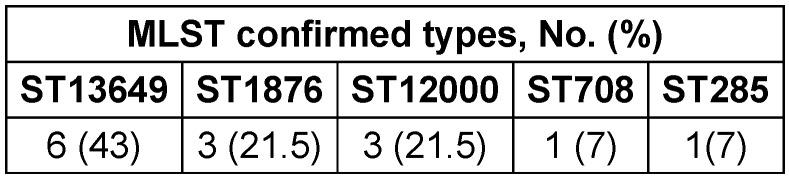
Results: The sequencing analysis showed four MLST types in the studied strains. The most frequent type is ST13649 and the least frequent are ST708 and ST285.
Conclusion: Finding the bacterial sequence types (ST) enables comparing the ST in different, especially neighbouring, countries.






 京公网安备 11010802042870号
京ICP备2023020795号-1
京公网安备 11010802042870号
京ICP备2023020795号-1

 分享
分享
 求助内容:
求助内容: 应助结果提醒方式:
 扫码关注我们
