{"title":"Polarizing Plates: Both Omnivores and Vegans Represent In-Group Foods With Eating Simulations.","authors":"Tess Davis, Libby Harkins, Esther K Papies","doi":"10.1177/01461672231202276","DOIUrl":null,"url":null,"abstract":"<p><p>In two pre-registered experiments, we assessed how people cognitively represent meat and plant-based foods, to examine processes underlying dietary polarization in society. Food descriptions from U.K.-based omnivores (<i>N<sub>Exp. 1</sub></i> = 109; <i>N<sub>Exp. 2</sub></i> = 436) and vegans (<i>N<sub>Exp. 1</sub></i> = 111; <i>N<sub>Exp. 2</sub></i> = 407) were coded for features about consumption and reward (e.g., \"rich,\" \"indulgent,\" and \"treat\") or features independent of the consumption situation (e.g., \"healthy,\" \"protein,\" and \"eco-friendly\"). Participants used more consumption and reward features for diet-congruent dishes (meat dishes for omnivores and plant-based dishes for vegans) than for diet-incongruent dishes (vice versa). Omnivores focused on abstract, long-term consequences of plant-based foods, whereas vegans focused on the socio-political associations with meat foods. Consumption and reward features also positively predicted attractiveness ratings, the likelihood of ordering a dish, and eating intentions. These findings indicate the cognitive processes of polarized dietary groups that may hinder the mainstream transition to more sustainable food choices.</p>","PeriodicalId":19834,"journal":{"name":"Personality and Social Psychology Bulletin","volume":" ","pages":"742-758"},"PeriodicalIF":2.9000,"publicationDate":"2025-05-01","publicationTypes":"Journal Article","fieldsOfStudy":null,"isOpenAccess":false,"openAccessPdf":"https://www.ncbi.nlm.nih.gov/pmc/articles/PMC11930636/pdf/","citationCount":"0","resultStr":null,"platform":"Semanticscholar","paperid":null,"PeriodicalName":"Personality and Social Psychology Bulletin","FirstCategoryId":"102","ListUrlMain":"https://doi.org/10.1177/01461672231202276","RegionNum":2,"RegionCategory":"心理学","ArticlePicture":[],"TitleCN":null,"AbstractTextCN":null,"PMCID":null,"EPubDate":"2023/10/12 0:00:00","PubModel":"Epub","JCR":"Q1","JCRName":"PSYCHOLOGY, SOCIAL","Score":null,"Total":0}
引用次数: 0
Abstract
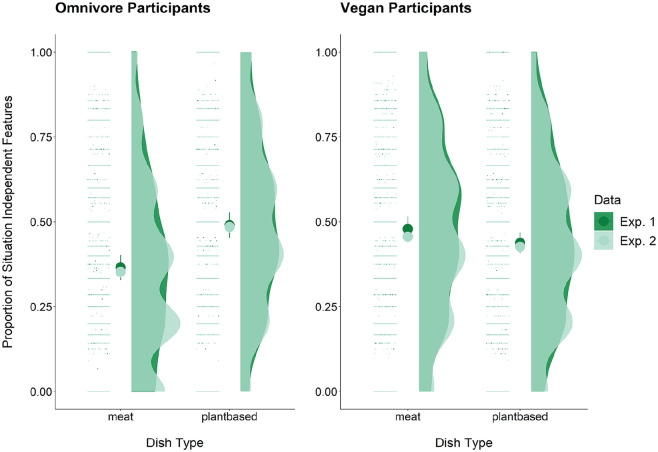
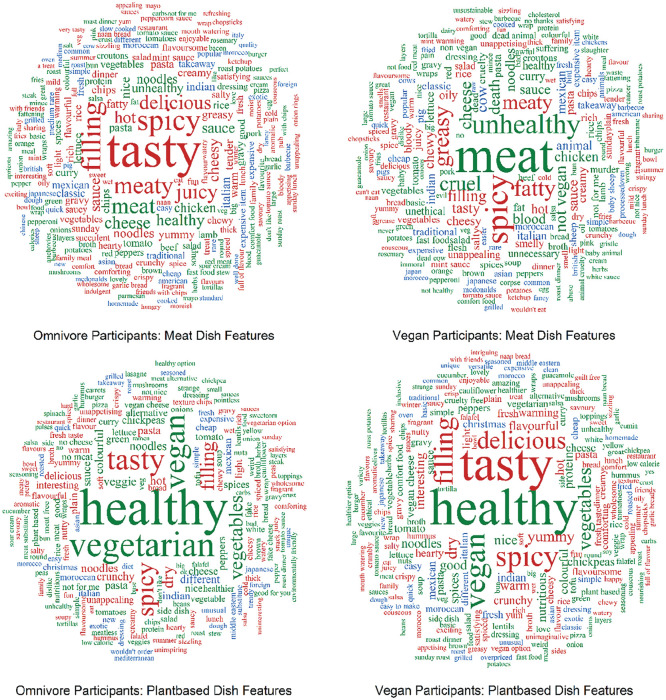
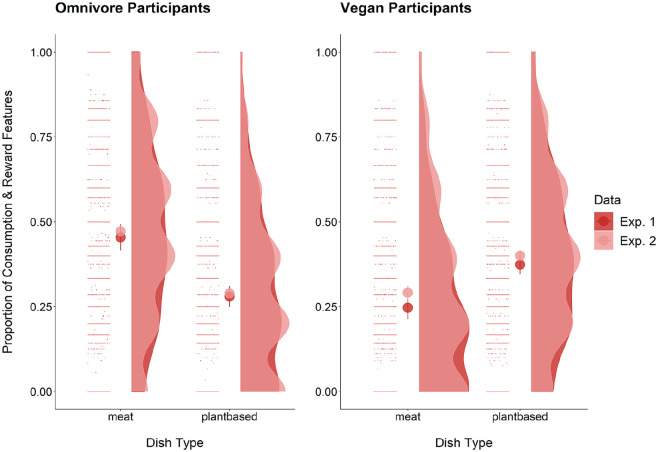
In two pre-registered experiments, we assessed how people cognitively represent meat and plant-based foods, to examine processes underlying dietary polarization in society. Food descriptions from U.K.-based omnivores (NExp. 1 = 109; NExp. 2 = 436) and vegans (NExp. 1 = 111; NExp. 2 = 407) were coded for features about consumption and reward (e.g., "rich," "indulgent," and "treat") or features independent of the consumption situation (e.g., "healthy," "protein," and "eco-friendly"). Participants used more consumption and reward features for diet-congruent dishes (meat dishes for omnivores and plant-based dishes for vegans) than for diet-incongruent dishes (vice versa). Omnivores focused on abstract, long-term consequences of plant-based foods, whereas vegans focused on the socio-political associations with meat foods. Consumption and reward features also positively predicted attractiveness ratings, the likelihood of ordering a dish, and eating intentions. These findings indicate the cognitive processes of polarized dietary groups that may hinder the mainstream transition to more sustainable food choices.
期刊介绍:
The Personality and Social Psychology Bulletin is the official journal for the Society of Personality and Social Psychology. The journal is an international outlet for original empirical papers in all areas of personality and social psychology.




 京公网安备 11010802042870号
京ICP备2023020795号-1
京公网安备 11010802042870号
京ICP备2023020795号-1

 分享
分享
 求助内容:
求助内容: 应助结果提醒方式:
 扫码关注我们
