{"title":"Task-Irrelevant Features in Visual Working Memory Influence Covert Attention: Evidence from a Partial Report Task.","authors":"Rebecca M Foerster, Werner X Schneider","doi":"10.3390/vision3030042","DOIUrl":null,"url":null,"abstract":"<p><p>Selecting a target based on a representation in visual working memory (VWM) affords biasing covert attention towards objects with memory-matching features. Recently, we showed that even task-irrelevant features of a VWM template bias attention. Specifically, when participants had to saccade to a cued shape, distractors sharing the cue's search-irrelevant color captured the eyes. While a saccade always aims at one target location, multiple locations can be attended covertly. Here, we investigated whether covert attention is captured similarly as the eyes. In our partial report task, each trial started with a shape-defined search cue, followed by a fixation cross. Next, two colored shapes, each including a letter, appeared left and right from fixation, followed by masks. The letter inside that shape matching the preceding cue had to be reported. In Experiment 1, either target, distractor, both, or no object matched the cue's irrelevant color. Target-letter reports were most frequent in target-match trials and least frequent in distractor-match trials. Irrelevant cue and target color never matched in Experiment 2. Still, participants reported the distractor more often to the target's disadvantage, when cue and distractor color matched. Thus, irrelevant features of a VWM template can influence covert attention in an involuntarily object-based manner when searching for trial-wise varying targets.</p>","PeriodicalId":36586,"journal":{"name":"Vision (Switzerland)","volume":"3 3","pages":""},"PeriodicalIF":1.8000,"publicationDate":"2019-08-27","publicationTypes":"Journal Article","fieldsOfStudy":null,"isOpenAccess":false,"openAccessPdf":"https://sci-hub-pdf.com/10.3390/vision3030042","citationCount":"5","resultStr":null,"platform":"Semanticscholar","paperid":null,"PeriodicalName":"Vision (Switzerland)","FirstCategoryId":"1085","ListUrlMain":"https://doi.org/10.3390/vision3030042","RegionNum":0,"RegionCategory":null,"ArticlePicture":[],"TitleCN":null,"AbstractTextCN":null,"PMCID":null,"EPubDate":"","PubModel":"","JCR":"Q2","JCRName":"Medicine","Score":null,"Total":0}
引用次数: 5
Abstract
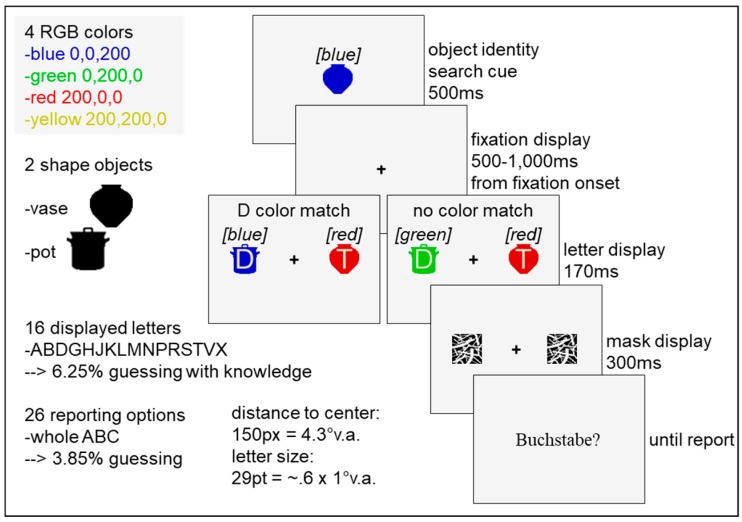
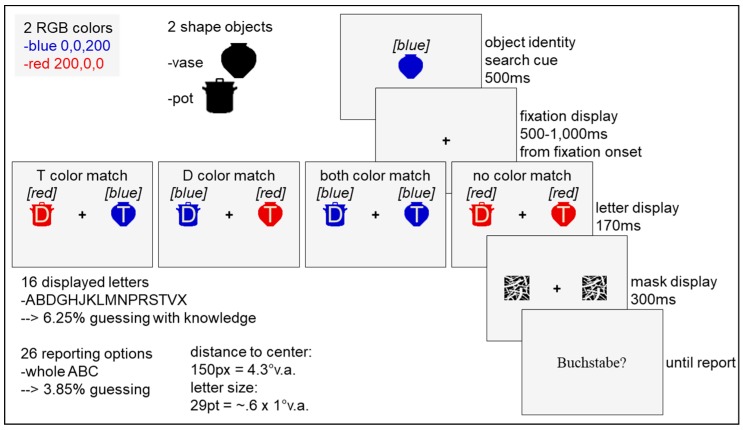
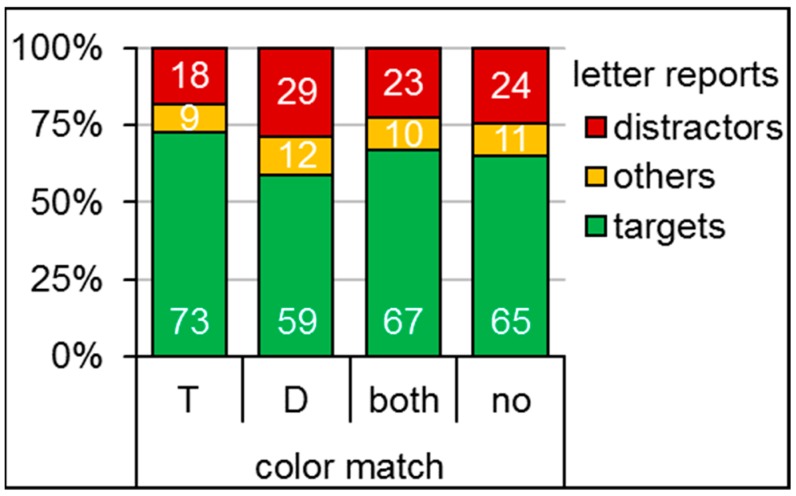
Selecting a target based on a representation in visual working memory (VWM) affords biasing covert attention towards objects with memory-matching features. Recently, we showed that even task-irrelevant features of a VWM template bias attention. Specifically, when participants had to saccade to a cued shape, distractors sharing the cue's search-irrelevant color captured the eyes. While a saccade always aims at one target location, multiple locations can be attended covertly. Here, we investigated whether covert attention is captured similarly as the eyes. In our partial report task, each trial started with a shape-defined search cue, followed by a fixation cross. Next, two colored shapes, each including a letter, appeared left and right from fixation, followed by masks. The letter inside that shape matching the preceding cue had to be reported. In Experiment 1, either target, distractor, both, or no object matched the cue's irrelevant color. Target-letter reports were most frequent in target-match trials and least frequent in distractor-match trials. Irrelevant cue and target color never matched in Experiment 2. Still, participants reported the distractor more often to the target's disadvantage, when cue and distractor color matched. Thus, irrelevant features of a VWM template can influence covert attention in an involuntarily object-based manner when searching for trial-wise varying targets.




 京公网安备 11010802042870号
京ICP备2023020795号-1
京公网安备 11010802042870号
京ICP备2023020795号-1

 分享
分享
 求助内容:
求助内容: 应助结果提醒方式:
 扫码关注我们
