Emanuel A. Fronhofer, Dov Corenblit, Jhelam N. Deshpande, Lynn Govaert, Philippe Huneman, Frédérique Viard, Philippe Jarne, Sara Puijalon
{"title":"Eco-evolution from deep time to contemporary dynamics: The role of timescales and rate modulators","authors":"Emanuel A. Fronhofer, Dov Corenblit, Jhelam N. Deshpande, Lynn Govaert, Philippe Huneman, Frédérique Viard, Philippe Jarne, Sara Puijalon","doi":"10.1111/ele.14222","DOIUrl":null,"url":null,"abstract":"<p>Eco-evolutionary dynamics, or eco-evolution for short, are often thought to involve rapid demography (ecology) and equally rapid heritable phenotypic changes (evolution) leading to novel, emergent system behaviours. We argue that this focus on contemporary dynamics is too narrow: Eco-evolution should be extended, first, beyond pure demography to include all environmental dimensions and, second, to include slow eco-evolution which unfolds over thousands or millions of years. This extension allows us to conceptualise biological systems as occupying a two-dimensional time space along axes that capture the speed of ecology and evolution. Using Hutchinson's analogy: Time is the ‘theatre’ in which ecology and evolution are two interacting ‘players’. Eco-evolutionary systems are therefore dynamic: We identify modulators of ecological and evolutionary rates, like temperature or sensitivity to mutation, which can change the speed of ecology and evolution, and hence impact eco-evolution. Environmental change may synchronise the speed of ecology and evolution via these rate modulators, increasing the occurrence of eco-evolution and emergent system behaviours. This represents substantial challenges for prediction, especially in the context of global change. Our perspective attempts to integrate ecology and evolution across disciplines, from gene-regulatory networks to geomorphology and across timescales, from today to deep time.</p>","PeriodicalId":161,"journal":{"name":"Ecology Letters","volume":"26 S1","pages":"S91-S108"},"PeriodicalIF":7.9000,"publicationDate":"2023-10-15","publicationTypes":"Journal Article","fieldsOfStudy":null,"isOpenAccess":false,"openAccessPdf":"https://onlinelibrary.wiley.com/doi/epdf/10.1111/ele.14222","citationCount":"4","resultStr":null,"platform":"Semanticscholar","paperid":null,"PeriodicalName":"Ecology Letters","FirstCategoryId":"93","ListUrlMain":"https://onlinelibrary.wiley.com/doi/10.1111/ele.14222","RegionNum":1,"RegionCategory":"环境科学与生态学","ArticlePicture":[],"TitleCN":null,"AbstractTextCN":null,"PMCID":null,"EPubDate":"","PubModel":"","JCR":"Q1","JCRName":"ECOLOGY","Score":null,"Total":0}
引用次数: 4
Abstract
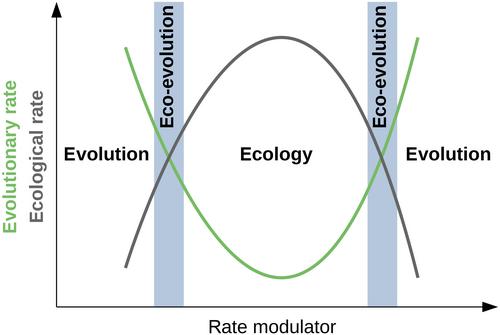
Eco-evolutionary dynamics, or eco-evolution for short, are often thought to involve rapid demography (ecology) and equally rapid heritable phenotypic changes (evolution) leading to novel, emergent system behaviours. We argue that this focus on contemporary dynamics is too narrow: Eco-evolution should be extended, first, beyond pure demography to include all environmental dimensions and, second, to include slow eco-evolution which unfolds over thousands or millions of years. This extension allows us to conceptualise biological systems as occupying a two-dimensional time space along axes that capture the speed of ecology and evolution. Using Hutchinson's analogy: Time is the ‘theatre’ in which ecology and evolution are two interacting ‘players’. Eco-evolutionary systems are therefore dynamic: We identify modulators of ecological and evolutionary rates, like temperature or sensitivity to mutation, which can change the speed of ecology and evolution, and hence impact eco-evolution. Environmental change may synchronise the speed of ecology and evolution via these rate modulators, increasing the occurrence of eco-evolution and emergent system behaviours. This represents substantial challenges for prediction, especially in the context of global change. Our perspective attempts to integrate ecology and evolution across disciplines, from gene-regulatory networks to geomorphology and across timescales, from today to deep time.
期刊介绍:
Ecology Letters serves as a platform for the rapid publication of innovative research in ecology. It considers manuscripts across all taxa, biomes, and geographic regions, prioritizing papers that investigate clearly stated hypotheses. The journal publishes concise papers of high originality and general interest, contributing to new developments in ecology. Purely descriptive papers and those that only confirm or extend previous results are discouraged.



 京公网安备 11010802042870号
京ICP备2023020795号-1
京公网安备 11010802042870号
京ICP备2023020795号-1

 分享
分享
 求助内容:
求助内容: 应助结果提醒方式:
 扫码关注我们
