{"title":"Effect of Ultrasonic and Hydrothermal Treatment on Digestibility and Antioxidant Properties of Whole Wheat Flour with Different Amylose Content<sup>§</sup>.","authors":"Valentina Nikolić, Slađana Žilić, Marijana Simić, Vesna Kandić, Primož Titan","doi":"10.17113/ftb.61.03.23.8016","DOIUrl":null,"url":null,"abstract":"<p><strong>Research background: </strong>The consumption of whole grain cereal flour contributes to increased intake of dietary fibre and phenolic compounds beneficial to human health. However, whole grain flour also has some disadvantages, such as poor baking properties and lower technological quality. Applying ultrasonic and hydrothermal treatments can provide new opportunities to modify and improve the baking and biofunctionality of flour as well as the quality of baked goods.</p><p><strong>Experimental approach: </strong>The whole grain flour samples of six wheat varieties with different amylose content were studied. The original chemical composition and viscosity profiles of the flour were determined. The flour samples were subjected to ultrasonic treatment at a frequency of 30 kHz and temperature of 40 °C for 10 min and hydrothermal treatment on a magnetic stirrer with heating for 3 min after reaching the boiling point. The treatments were carried out to determine their influence on the studied digestible and antioxidant properties of the flour. A multistep <i>in vitro</i> enzymatic digestibility protocol simulating the digestion process in the human gastrointestinal tract was applied to the untreated and treated whole grain flour samples. Total free phenolic compound content and total antioxidant capacity were also determined.</p><p><strong>Results and conclusions: </strong>Hydrothermal treatment had a positive effect on the digestibility of the whole grain flour, especially in waxy wheat genotypes compared to those with high amylose content, due to the formation of resistant starch. The hydrothermal treatment had an overall negative effect on the antioxidant capacity of the flour samples, while ultrasonic treatment generally increased the analytical values of total free phenolic compounds by enhancing their extractability. These findings can provide valuable information for the development of new whole wheat foods.</p><p><strong>Novelty and scientific contribution: </strong>To the best of our knowledge, this type of study of the effects of ultrasound and hydrothermal treatment on the digestibility and antioxidant properties has not yet been performed on whole wheat flour with different amylose content. Waxy and high-amylose wheat varieties are considered novel raw materials because of their unique properties in bread making, such as improved bread texture and increased dietary fibre content.</p>","PeriodicalId":214,"journal":{"name":"New Phytologist","volume":"194 1","pages":"302-311"},"PeriodicalIF":8.1000,"publicationDate":"2023-09-01","publicationTypes":"Journal Article","fieldsOfStudy":null,"isOpenAccess":false,"openAccessPdf":"https://www.ncbi.nlm.nih.gov/pmc/articles/PMC10666950/pdf/","citationCount":"0","resultStr":null,"platform":"Semanticscholar","paperid":null,"PeriodicalName":"New Phytologist","FirstCategoryId":"97","ListUrlMain":"https://doi.org/10.17113/ftb.61.03.23.8016","RegionNum":1,"RegionCategory":"生物学","ArticlePicture":[],"TitleCN":null,"AbstractTextCN":null,"PMCID":null,"EPubDate":"","PubModel":"","JCR":"Q1","JCRName":"PLANT SCIENCES","Score":null,"Total":0}
引用次数: 0
Abstract
Research background: The consumption of whole grain cereal flour contributes to increased intake of dietary fibre and phenolic compounds beneficial to human health. However, whole grain flour also has some disadvantages, such as poor baking properties and lower technological quality. Applying ultrasonic and hydrothermal treatments can provide new opportunities to modify and improve the baking and biofunctionality of flour as well as the quality of baked goods.
Experimental approach: The whole grain flour samples of six wheat varieties with different amylose content were studied. The original chemical composition and viscosity profiles of the flour were determined. The flour samples were subjected to ultrasonic treatment at a frequency of 30 kHz and temperature of 40 °C for 10 min and hydrothermal treatment on a magnetic stirrer with heating for 3 min after reaching the boiling point. The treatments were carried out to determine their influence on the studied digestible and antioxidant properties of the flour. A multistep in vitro enzymatic digestibility protocol simulating the digestion process in the human gastrointestinal tract was applied to the untreated and treated whole grain flour samples. Total free phenolic compound content and total antioxidant capacity were also determined.
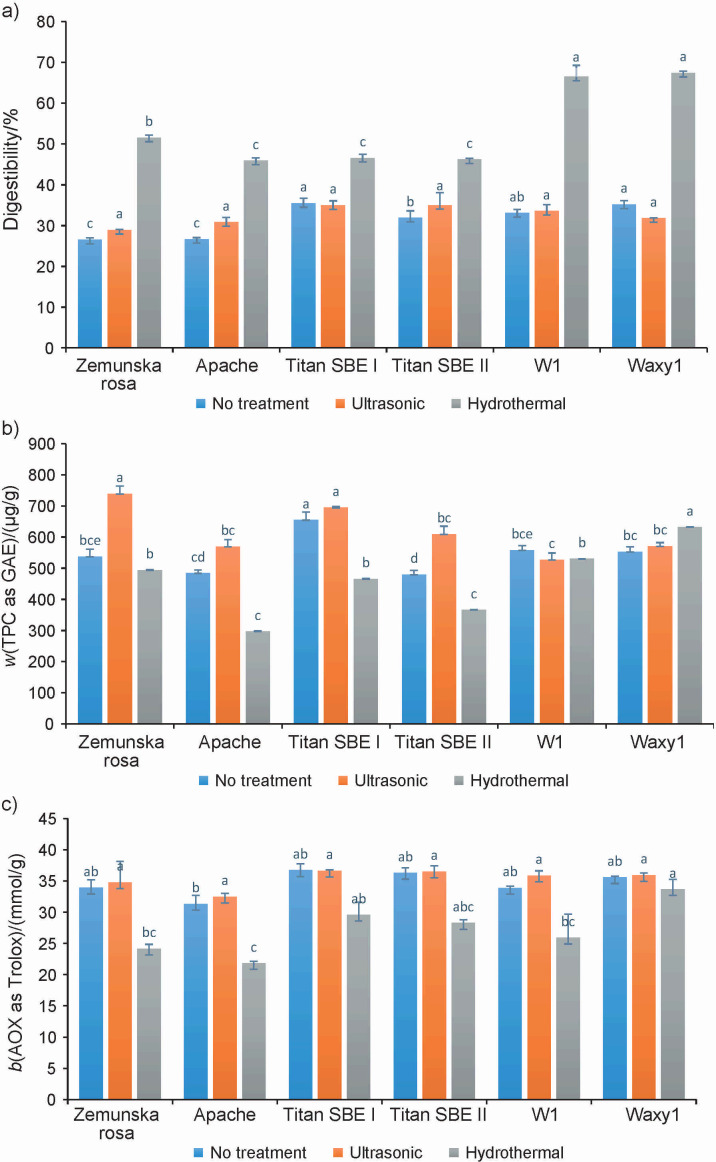
Results and conclusions: Hydrothermal treatment had a positive effect on the digestibility of the whole grain flour, especially in waxy wheat genotypes compared to those with high amylose content, due to the formation of resistant starch. The hydrothermal treatment had an overall negative effect on the antioxidant capacity of the flour samples, while ultrasonic treatment generally increased the analytical values of total free phenolic compounds by enhancing their extractability. These findings can provide valuable information for the development of new whole wheat foods.
Novelty and scientific contribution: To the best of our knowledge, this type of study of the effects of ultrasound and hydrothermal treatment on the digestibility and antioxidant properties has not yet been performed on whole wheat flour with different amylose content. Waxy and high-amylose wheat varieties are considered novel raw materials because of their unique properties in bread making, such as improved bread texture and increased dietary fibre content.
期刊介绍:
New Phytologist is an international electronic journal published 24 times a year. It is owned by the New Phytologist Foundation, a non-profit-making charitable organization dedicated to promoting plant science. The journal publishes excellent, novel, rigorous, and timely research and scholarship in plant science and its applications. The articles cover topics in five sections: Physiology & Development, Environment, Interaction, Evolution, and Transformative Plant Biotechnology. These sections encompass intracellular processes, global environmental change, and encourage cross-disciplinary approaches. The journal recognizes the use of techniques from molecular and cell biology, functional genomics, modeling, and system-based approaches in plant science. Abstracting and Indexing Information for New Phytologist includes Academic Search, AgBiotech News & Information, Agroforestry Abstracts, Biochemistry & Biophysics Citation Index, Botanical Pesticides, CAB Abstracts®, Environment Index, Global Health, and Plant Breeding Abstracts, and others.




 京公网安备 11010802042870号
京ICP备2023020795号-1
京公网安备 11010802042870号
京ICP备2023020795号-1

 分享
分享
 求助内容:
求助内容: 应助结果提醒方式:
 扫码关注我们
