{"title":"Design, synthesis of novel quinazolin-4-one derivatives and biological evaluation against human MCF-7 breast cancer cell line","authors":"Marwa F. Ahmed, Amel AA. Hashim","doi":"10.1007/s11164-015-2117-z","DOIUrl":null,"url":null,"abstract":"<p>A new series of 6,8-dibromo-2-(4-chlorophenyl)quinazolin-4(3H)-one derivatives VI–XIII were synthesized. Their chemical structures were confirmed by spectral and elemental analysis. The cytotoxic effect of the newly synthesized compounds was tested in vitro against human breast cancer cell line (MCF-7). Most of the tested compounds have shown promising cytotoxic activity. Compounds X and XIIIb exerted a powerful cytotoxic effect against MCF-7 with a very low IC50 (0.0015 and 0.0047?μmol/ml), while compounds VI, VII, VIII, XIIb, XI, XIIIc and IX exerted a moderate cytotoxic effect (IC50 0.01523, 0.0213, 0.031, 0.0478, 0.049, 0.068 and 0.079?μmol/ml respectively), compared to doxorubicin (0.0025?μmol/ml). Exploring their apoptotic effect; interestingly,all compounds activated apoptotic cascade in MCF-7. Compounds VI, XIIIb, XIIb, XI, XIIa, VII, V and VIII showed potent effect even much more than doxorubicin by 12.87–5.91 folds, while compounds XIIIc, IX, XIIIa, XIIc and X showed moderate increase in CASP3 activity by 4.96–3.22 folds relative to untreated cells more or less similar to doxorubicin (5.57 folds).</p>","PeriodicalId":753,"journal":{"name":"Research on Chemical Intermediates","volume":"42 3","pages":"1777 - 1789"},"PeriodicalIF":3.5000,"publicationDate":"2015-06-03","publicationTypes":"Journal Article","fieldsOfStudy":null,"isOpenAccess":false,"openAccessPdf":"https://sci-hub-pdf.com/10.1007/s11164-015-2117-z","citationCount":"9","resultStr":null,"platform":"Semanticscholar","paperid":null,"PeriodicalName":"Research on Chemical Intermediates","FirstCategoryId":"92","ListUrlMain":"https://link.springer.com/article/10.1007/s11164-015-2117-z","RegionNum":3,"RegionCategory":"化学","ArticlePicture":[],"TitleCN":null,"AbstractTextCN":null,"PMCID":null,"EPubDate":"","PubModel":"","JCR":"Q2","JCRName":"CHEMISTRY, MULTIDISCIPLINARY","Score":null,"Total":0}
引用次数: 9
Abstract
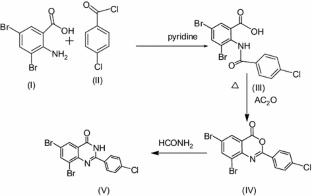
A new series of 6,8-dibromo-2-(4-chlorophenyl)quinazolin-4(3H)-one derivatives VI–XIII were synthesized. Their chemical structures were confirmed by spectral and elemental analysis. The cytotoxic effect of the newly synthesized compounds was tested in vitro against human breast cancer cell line (MCF-7). Most of the tested compounds have shown promising cytotoxic activity. Compounds X and XIIIb exerted a powerful cytotoxic effect against MCF-7 with a very low IC50 (0.0015 and 0.0047?μmol/ml), while compounds VI, VII, VIII, XIIb, XI, XIIIc and IX exerted a moderate cytotoxic effect (IC50 0.01523, 0.0213, 0.031, 0.0478, 0.049, 0.068 and 0.079?μmol/ml respectively), compared to doxorubicin (0.0025?μmol/ml). Exploring their apoptotic effect; interestingly,all compounds activated apoptotic cascade in MCF-7. Compounds VI, XIIIb, XIIb, XI, XIIa, VII, V and VIII showed potent effect even much more than doxorubicin by 12.87–5.91 folds, while compounds XIIIc, IX, XIIIa, XIIc and X showed moderate increase in CASP3 activity by 4.96–3.22 folds relative to untreated cells more or less similar to doxorubicin (5.57 folds).
期刊介绍:
Research on Chemical Intermediates publishes current research articles and concise dynamic reviews on the properties, structures and reactivities of intermediate species in all the various domains of chemistry.
The journal also contains articles in related disciplines such as spectroscopy, molecular biology and biochemistry, atmospheric and environmental sciences, catalysis, photochemistry and photophysics. In addition, special issues dedicated to specific topics in the field are regularly published.



 京公网安备 11010802042870号
京ICP备2023020795号-1
京公网安备 11010802042870号
京ICP备2023020795号-1

 分享
分享
 求助内容:
求助内容: 应助结果提醒方式:
 扫码关注我们
