Ting Xia , Chaoyan Kang , Xiao Qiang , Xiaodong Zhang , Shaopeng Li , Kai Liang , Yiming Wang , Jianxin Wang , Hui Cao , Min Wang
{"title":"Beneficial effect of vinegar consumption associated with regulating gut microbiome and metabolome","authors":"Ting Xia , Chaoyan Kang , Xiao Qiang , Xiaodong Zhang , Shaopeng Li , Kai Liang , Yiming Wang , Jianxin Wang , Hui Cao , Min Wang","doi":"10.1016/j.crfs.2023.100566","DOIUrl":null,"url":null,"abstract":"<div><p>Vinegar is used as fermented condiment and functional food worldwide. Vinegar contains many nutrients and bioactive components, which exhibits health benefits. In this study, the potential effects of Shanxi aged vinegar (SAV) on gut microbiome and metabolome were explored in normal mice. The levels of inflammatory factors were significantly decreased in SAV-treated mice. Immunoglobulin, NK cells and CD20 expression were significantly increased after SAV administration. In addition, SAV intake altered gut microbiota structure by up-regulating Verrucomicrobia, <em>Akkermansia</em>, <em>Hungatella</em> and <em>Alistipes</em>, and down-regulating Firmicutes, <em>Lachnospiraceae_NK4A136_group</em> and <em>Oscillibacter</em>. The differential metabolites were mainly included amino acids, carbohydrates and bile acids. Furthermore, after SAV intake, Verrucomicrobia, and <em>Akkermansia</em> closely impacted the related gut metabolites. These alterations of gut microbiota-related metabolism further modulated some immunoregulatory and inflammatory factors, and confer potential health benefits. Our results imply that vinegar consumption has beneficial effects on regulating gut microbiome and metabolome.</p></div>","PeriodicalId":10939,"journal":{"name":"Current Research in Food Science","volume":"8 ","pages":"Article 100566"},"PeriodicalIF":7.0000,"publicationDate":"2024-01-01","publicationTypes":"Journal Article","fieldsOfStudy":null,"isOpenAccess":false,"openAccessPdf":"https://www.sciencedirect.com/science/article/pii/S266592712300134X/pdfft?md5=c5e2bc33b3f152a88f4fab8fa547a0e1&pid=1-s2.0-S266592712300134X-main.pdf","citationCount":"0","resultStr":null,"platform":"Semanticscholar","paperid":null,"PeriodicalName":"Current Research in Food Science","FirstCategoryId":"97","ListUrlMain":"https://www.sciencedirect.com/science/article/pii/S266592712300134X","RegionNum":2,"RegionCategory":"农林科学","ArticlePicture":[],"TitleCN":null,"AbstractTextCN":null,"PMCID":null,"EPubDate":"","PubModel":"","JCR":"Q1","JCRName":"FOOD SCIENCE & TECHNOLOGY","Score":null,"Total":0}
引用次数: 0
Abstract
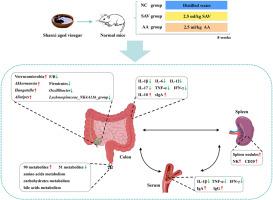
Vinegar is used as fermented condiment and functional food worldwide. Vinegar contains many nutrients and bioactive components, which exhibits health benefits. In this study, the potential effects of Shanxi aged vinegar (SAV) on gut microbiome and metabolome were explored in normal mice. The levels of inflammatory factors were significantly decreased in SAV-treated mice. Immunoglobulin, NK cells and CD20 expression were significantly increased after SAV administration. In addition, SAV intake altered gut microbiota structure by up-regulating Verrucomicrobia, Akkermansia, Hungatella and Alistipes, and down-regulating Firmicutes, Lachnospiraceae_NK4A136_group and Oscillibacter. The differential metabolites were mainly included amino acids, carbohydrates and bile acids. Furthermore, after SAV intake, Verrucomicrobia, and Akkermansia closely impacted the related gut metabolites. These alterations of gut microbiota-related metabolism further modulated some immunoregulatory and inflammatory factors, and confer potential health benefits. Our results imply that vinegar consumption has beneficial effects on regulating gut microbiome and metabolome.
期刊介绍:
Current Research in Food Science is an international peer-reviewed journal dedicated to advancing the breadth of knowledge in the field of food science. It serves as a platform for publishing original research articles and short communications that encompass a wide array of topics, including food chemistry, physics, microbiology, nutrition, nutraceuticals, process and package engineering, materials science, food sustainability, and food security. By covering these diverse areas, the journal aims to provide a comprehensive source of the latest scientific findings and technological advancements that are shaping the future of the food industry. The journal's scope is designed to address the multidisciplinary nature of food science, reflecting its commitment to promoting innovation and ensuring the safety and quality of the food supply.




 京公网安备 11010802042870号
京ICP备2023020795号-1
京公网安备 11010802042870号
京ICP备2023020795号-1

 分享
分享
 求助内容:
求助内容: 应助结果提醒方式:
 扫码关注我们
