{"title":"Microgravity inhibits autophagy in human capillary endothelial cells in space flight.","authors":"Ivana Barravecchia, Debora Angeloni","doi":"10.1080/27694127.2022.2102363","DOIUrl":null,"url":null,"abstract":"<p><p>Microgravity and space radiation (SR) are the two environmental factors that most affect human crews in space flight (SF). The endothelium is highly sensitive to gravitational unloading and several health problems reported by astronauts derive from endothelial dysfunction and impaired homeostasis. Recently, we found that space-flown, endothelial cells show cell softening, the presence of stress granules, reduced motility, profound cytoskeletal reorganization, an increased number of primary cilia, mitochondrial senescence, activation of DNA repair mechanisms, changes of chromosome territories, telomere shortening and increased apoptosis. The transcriptomic study showed activation of oxidative stress, inflammation and DNA damage repair pathways. In general, pathways for metabolism and a pro-proliferative phenotype are activated by microgravity and downregulated by SR. SR upregulates pathways for endothelial activation (hypoxia, cytokines, inflammation), DNA repair and apoptosis, promoting macroautophagy/autophagy flux and an ageing-like phenotype, which instead are downregulated by microgravity. Microgravity and SR exert opposite effects on the MTORC1 gene pathway: SR inhibits the pathway (with consequent enhancement of autophagy), while microgravity strongly stimulates MTORC1 (with consequent inhibition of autophagy). The sum of both contributions results in the net effect of autophagy inhibition in space-flown cells. Microgravity and SR should be considered separately to tailor effective countermeasures to protect astronauts' health. Potentiation of autophagy is worthy of further investigation as a possible physiological countermeasure to SF-induced cell stress.</p>","PeriodicalId":72341,"journal":{"name":"Autophagy reports","volume":" ","pages":"337-340"},"PeriodicalIF":0.0000,"publicationDate":"2022-07-29","publicationTypes":"Journal Article","fieldsOfStudy":null,"isOpenAccess":false,"openAccessPdf":"https://www.ncbi.nlm.nih.gov/pmc/articles/PMC11864720/pdf/","citationCount":"0","resultStr":null,"platform":"Semanticscholar","paperid":null,"PeriodicalName":"Autophagy reports","FirstCategoryId":"1085","ListUrlMain":"https://doi.org/10.1080/27694127.2022.2102363","RegionNum":0,"RegionCategory":null,"ArticlePicture":[],"TitleCN":null,"AbstractTextCN":null,"PMCID":null,"EPubDate":"2022/1/1 0:00:00","PubModel":"eCollection","JCR":"","JCRName":"","Score":null,"Total":0}
引用次数: 0
Abstract
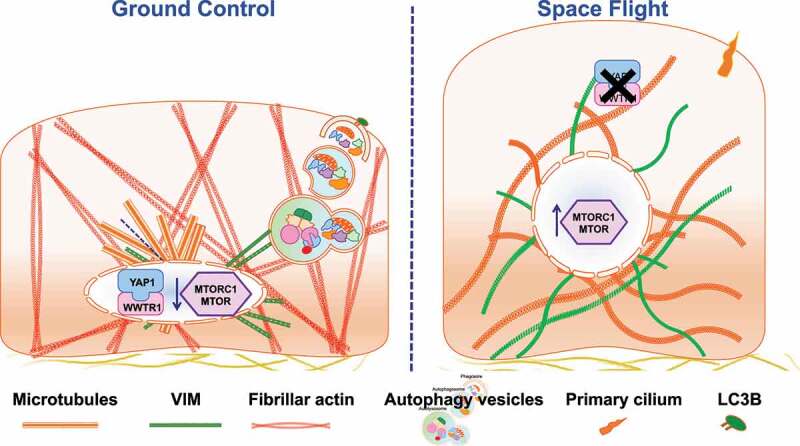
Microgravity and space radiation (SR) are the two environmental factors that most affect human crews in space flight (SF). The endothelium is highly sensitive to gravitational unloading and several health problems reported by astronauts derive from endothelial dysfunction and impaired homeostasis. Recently, we found that space-flown, endothelial cells show cell softening, the presence of stress granules, reduced motility, profound cytoskeletal reorganization, an increased number of primary cilia, mitochondrial senescence, activation of DNA repair mechanisms, changes of chromosome territories, telomere shortening and increased apoptosis. The transcriptomic study showed activation of oxidative stress, inflammation and DNA damage repair pathways. In general, pathways for metabolism and a pro-proliferative phenotype are activated by microgravity and downregulated by SR. SR upregulates pathways for endothelial activation (hypoxia, cytokines, inflammation), DNA repair and apoptosis, promoting macroautophagy/autophagy flux and an ageing-like phenotype, which instead are downregulated by microgravity. Microgravity and SR exert opposite effects on the MTORC1 gene pathway: SR inhibits the pathway (with consequent enhancement of autophagy), while microgravity strongly stimulates MTORC1 (with consequent inhibition of autophagy). The sum of both contributions results in the net effect of autophagy inhibition in space-flown cells. Microgravity and SR should be considered separately to tailor effective countermeasures to protect astronauts' health. Potentiation of autophagy is worthy of further investigation as a possible physiological countermeasure to SF-induced cell stress.




 京公网安备 11010802042870号
京ICP备2023020795号-1
京公网安备 11010802042870号
京ICP备2023020795号-1

 分享
分享

 求助内容:
求助内容: 应助结果提醒方式:
 扫码关注我们
