Xiaoyan Chen , Wang Zhou , Jilei Liu , Yingpeng Wu , Zhigang Liu
{"title":"Sulfur/nitrogen/oxygen tri-doped carbon nanospheres as an anode for potassium ion storage","authors":"Xiaoyan Chen , Wang Zhou , Jilei Liu , Yingpeng Wu , Zhigang Liu","doi":"10.1016/j.jechem.2022.10.042","DOIUrl":null,"url":null,"abstract":"<div><p>Carbonaceous materials are considered as ideal anode for potassium ion batteries (PIBs) due to their abundant resources and stable physical and chemical properties. However, improvements of reversible capacity and cycle performance are still needed, aiming to the practical application. Herein, S/N/O tri-doped carbon (SNOC) nanospheres are prepared by in-situ vulcanized polybenzoxazine. The S/N/O tri-doped carbon matrix provides abundant active sites for potassium ion adsorption and effectively improves potassium storage capacity. Moreover, the SNOC nanospheres possess large carbon interlayer spacing and high specific surface area, which broaden the diffusion pathway of potassium ions and accelerate the electron transfer speed, resulting in excellent rate performance. As an anode for PIBs, SNOC shows attractive rate performance (438.5 mA h g<sup>−1</sup> at 50 mA g<sup>−1</sup> and 174.5 mA h g<sup>−1</sup> at 2000 mA g<sup>−1</sup>), ultra-high reversible capacity (397.4 mA h g<sup>−1</sup> at 100 mA g<sup>−1</sup> after 700 cycles) and ultra-long cycling life (218.9 mA h g<sup>−1</sup> at 2000 mA g<sup>−1</sup> after 7300 cycles, 123.1 mA h g<sup>−1</sup> at 3000 mA g<sup>−1</sup> after 16500 cycles and full cell runs for 4000 cycles). Density functional theory calculation confirms that S/N/O tri-doping enhances the adsorption and diffusion of potassium ions, and in-situ Fourier-transform infrared explores explored the potassium storage mechanism of SNOC.</p></div>","PeriodicalId":15728,"journal":{"name":"Journal of Energy Chemistry","volume":"77 ","pages":"Pages 338-347"},"PeriodicalIF":14.9000,"publicationDate":"2023-02-01","publicationTypes":"Journal Article","fieldsOfStudy":null,"isOpenAccess":false,"openAccessPdf":"","citationCount":"4","resultStr":null,"platform":"Semanticscholar","paperid":null,"PeriodicalName":"Journal of Energy Chemistry","FirstCategoryId":"1085","ListUrlMain":"https://www.sciencedirect.com/science/article/pii/S2095495622005824","RegionNum":1,"RegionCategory":"化学","ArticlePicture":[],"TitleCN":null,"AbstractTextCN":null,"PMCID":null,"EPubDate":"","PubModel":"","JCR":"Q1","JCRName":"Energy","Score":null,"Total":0}
引用次数: 4
Abstract
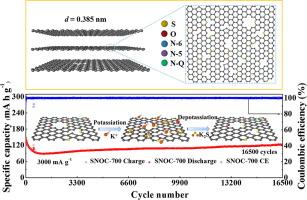
Carbonaceous materials are considered as ideal anode for potassium ion batteries (PIBs) due to their abundant resources and stable physical and chemical properties. However, improvements of reversible capacity and cycle performance are still needed, aiming to the practical application. Herein, S/N/O tri-doped carbon (SNOC) nanospheres are prepared by in-situ vulcanized polybenzoxazine. The S/N/O tri-doped carbon matrix provides abundant active sites for potassium ion adsorption and effectively improves potassium storage capacity. Moreover, the SNOC nanospheres possess large carbon interlayer spacing and high specific surface area, which broaden the diffusion pathway of potassium ions and accelerate the electron transfer speed, resulting in excellent rate performance. As an anode for PIBs, SNOC shows attractive rate performance (438.5 mA h g−1 at 50 mA g−1 and 174.5 mA h g−1 at 2000 mA g−1), ultra-high reversible capacity (397.4 mA h g−1 at 100 mA g−1 after 700 cycles) and ultra-long cycling life (218.9 mA h g−1 at 2000 mA g−1 after 7300 cycles, 123.1 mA h g−1 at 3000 mA g−1 after 16500 cycles and full cell runs for 4000 cycles). Density functional theory calculation confirms that S/N/O tri-doping enhances the adsorption and diffusion of potassium ions, and in-situ Fourier-transform infrared explores explored the potassium storage mechanism of SNOC.
碳质材料由于其丰富的资源和稳定的物理化学性质,被认为是钾离子电池(PIBs)的理想阳极。然而,针对实际应用,仍需要提高可逆容量和循环性能。本文通过原位硫化聚苯并恶嗪制备了S/N/O三掺杂碳(SNOC)纳米球。S/N/O三掺杂碳基体为钾离子吸附提供了丰富的活性位点,有效提高了储钾能力。此外,SNOC纳米球具有大的碳层间距和高比表面积,拓宽了钾离子的扩散途径,加快了电子转移速度,具有优异的倍率性能。作为PIB的阳极,SNOC显示出有吸引力的速率性能(50 mA g−1时为438.5 mA h g−1,2000 mA g−2时为174.5 mA h h g−),超高可逆容量(700次循环后100 mA g−1时为397.4 mA h g−1)和超长循环寿命(7300次循环后2000 mA g−2时为218.9 mA h g–1,16500次循环和4000次全电池运行后3000 mA g−3时为123.1 mA h g-1)。密度泛函理论计算证实了S/N/O三掺杂增强了钾离子的吸附和扩散,原位傅立叶变换红外探索了SNOC的储钾机理。
期刊介绍:
The Journal of Energy Chemistry, the official publication of Science Press and the Dalian Institute of Chemical Physics, Chinese Academy of Sciences, serves as a platform for reporting creative research and innovative applications in energy chemistry. It mainly reports on creative researches and innovative applications of chemical conversions of fossil energy, carbon dioxide, electrochemical energy and hydrogen energy, as well as the conversions of biomass and solar energy related with chemical issues to promote academic exchanges in the field of energy chemistry and to accelerate the exploration, research and development of energy science and technologies.
This journal focuses on original research papers covering various topics within energy chemistry worldwide, including:
Optimized utilization of fossil energy
Hydrogen energy
Conversion and storage of electrochemical energy
Capture, storage, and chemical conversion of carbon dioxide
Materials and nanotechnologies for energy conversion and storage
Chemistry in biomass conversion
Chemistry in the utilization of solar energy



 京公网安备 11010802042870号
京ICP备2023020795号-1
京公网安备 11010802042870号
京ICP备2023020795号-1

 分享
分享
 求助内容:
求助内容: 应助结果提醒方式:
 扫码关注我们
