P-009: IDENTIFYING BARRIERS FOR PATIENTS WITH SICKLE CELL DISEASE TO ACCESS TREATMENT WITH HYDROXYUREA – A QUALITATIVE ANALYSIS OF THE SUPPLY CHAIN IN GHANA
GRAVEN S., MARFO K., KARIM A., BISCHOF A., GEISSLER A.
{"title":"P-009: IDENTIFYING BARRIERS FOR PATIENTS WITH SICKLE CELL DISEASE TO ACCESS TREATMENT WITH HYDROXYUREA – A QUALITATIVE ANALYSIS OF THE SUPPLY CHAIN IN GHANA","authors":"GRAVEN S., MARFO K., KARIM A., BISCHOF A., GEISSLER A.","doi":"10.1097/01.HS9.0000872940.76494.9b","DOIUrl":null,"url":null,"abstract":"<p><b>Materials and methods:</b> We conducted qualitative in-depth virtual semi-structured interviews with 10 key stakeholders involved in the supply chain of health commodities, including but not restricted to hydroxyurea. The questions asked in the expert interviews were supported by a preparatory interview guide containing of semi-structured questions. The interview guide was reviewed by the study team ahead of the virtual interviews. The responses received were examined based on a content analysis and presented in a process map and a causal loop diagram.</p><p><b>Results:</b> Our results revealed a high fragmentation and decentralization of the supply chain of health commodities in Ghana that severely compromises the continuous availability of hydroxyurea in Ghana. The results also disclosed that there is currently no central procurement or distribution of hydroxyurea. Outside of the public sector, most patients have to pay for treatment out-of-pocket which is a great financial barrier that leaves many patients unable to afford the treatment. Furthermore, there is a lack of accurate data on SCD prevalence in Ghana, which makes effective forecasting and adequate health interventions challenging. Additionally, health facilities that offer hydroxyurea treatment are mainly located in urban areas, which are inaccessible to many patients living in rural areas.</p><p>The causal loop diagram depicted below (see Figure 1) summarizes the findings of our study and captures their complexity. It shows the factors that influence each other with regard to the accessibility of hydroxyurea treatment for patients with SCD in Ghana. The arrow between the factors shows the direction of influence and the sign next to the arrow represents the positive (+) or negative (–) influence a factor has on another factor.</p><p><b>Conclusion:</b> Based on our evaluation, this study identifies four main barriers that patients with SCD face to access treatment with hydroxyurea in Ghana. These barriers include the lack of accurate data on the number of patients with SCD in Ghana, the high financial hurdles to access treatment with hydroxyurea, the lack of treatment decentralization with hydroxyurea, and the limited availability of hydroxyurea. Digitalization was identified as a common denominator that could improve many of these barriers and therefore could support the wide-scale implementation of hydroxyurea access for SCD treatment.</p><p><i>Figure 1. Causal Loop Diagram (own representation</i>)</p><p>K. MARFO declares a conflict of interest:</p><p><b>Stock shareholder:</b> Novartis</p><p><b>Other:</b> Novartis employee</p>","PeriodicalId":12982,"journal":{"name":"HemaSphere","volume":"6 S4","pages":"21"},"PeriodicalIF":14.6000,"publicationDate":"2022-08-16","publicationTypes":"Journal Article","fieldsOfStudy":null,"isOpenAccess":false,"openAccessPdf":"https://onlinelibrary.wiley.com/doi/epdf/10.1097/01.HS9.0000872940.76494.9b","citationCount":"0","resultStr":null,"platform":"Semanticscholar","paperid":null,"PeriodicalName":"HemaSphere","FirstCategoryId":"3","ListUrlMain":"https://onlinelibrary.wiley.com/doi/10.1097/01.HS9.0000872940.76494.9b","RegionNum":2,"RegionCategory":"医学","ArticlePicture":[],"TitleCN":null,"AbstractTextCN":null,"PMCID":null,"EPubDate":"","PubModel":"","JCR":"Q1","JCRName":"HEMATOLOGY","Score":null,"Total":0}
引用次数: 0
Abstract
Materials and methods: We conducted qualitative in-depth virtual semi-structured interviews with 10 key stakeholders involved in the supply chain of health commodities, including but not restricted to hydroxyurea. The questions asked in the expert interviews were supported by a preparatory interview guide containing of semi-structured questions. The interview guide was reviewed by the study team ahead of the virtual interviews. The responses received were examined based on a content analysis and presented in a process map and a causal loop diagram.
Results: Our results revealed a high fragmentation and decentralization of the supply chain of health commodities in Ghana that severely compromises the continuous availability of hydroxyurea in Ghana. The results also disclosed that there is currently no central procurement or distribution of hydroxyurea. Outside of the public sector, most patients have to pay for treatment out-of-pocket which is a great financial barrier that leaves many patients unable to afford the treatment. Furthermore, there is a lack of accurate data on SCD prevalence in Ghana, which makes effective forecasting and adequate health interventions challenging. Additionally, health facilities that offer hydroxyurea treatment are mainly located in urban areas, which are inaccessible to many patients living in rural areas.
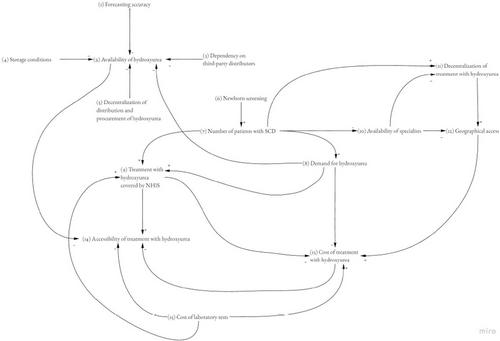
The causal loop diagram depicted below (see Figure 1) summarizes the findings of our study and captures their complexity. It shows the factors that influence each other with regard to the accessibility of hydroxyurea treatment for patients with SCD in Ghana. The arrow between the factors shows the direction of influence and the sign next to the arrow represents the positive (+) or negative (–) influence a factor has on another factor.
Conclusion: Based on our evaluation, this study identifies four main barriers that patients with SCD face to access treatment with hydroxyurea in Ghana. These barriers include the lack of accurate data on the number of patients with SCD in Ghana, the high financial hurdles to access treatment with hydroxyurea, the lack of treatment decentralization with hydroxyurea, and the limited availability of hydroxyurea. Digitalization was identified as a common denominator that could improve many of these barriers and therefore could support the wide-scale implementation of hydroxyurea access for SCD treatment.
期刊介绍:
HemaSphere, as a publication, is dedicated to disseminating the outcomes of profoundly pertinent basic, translational, and clinical research endeavors within the field of hematology. The journal actively seeks robust studies that unveil novel discoveries with significant ramifications for hematology.
In addition to original research, HemaSphere features review articles and guideline articles that furnish lucid synopses and discussions of emerging developments, along with recommendations for patient care.
Positioned as the foremost resource in hematology, HemaSphere augments its offerings with specialized sections like HemaTopics and HemaPolicy. These segments engender insightful dialogues covering a spectrum of hematology-related topics, including digestible summaries of pivotal articles, updates on new therapies, deliberations on European policy matters, and other noteworthy news items within the field. Steering the course of HemaSphere are Editor in Chief Jan Cools and Deputy Editor in Chief Claire Harrison, alongside the guidance of an esteemed Editorial Board comprising international luminaries in both research and clinical realms, each representing diverse areas of hematologic expertise.



 京公网安备 11010802042870号
京ICP备2023020795号-1
京公网安备 11010802042870号
京ICP备2023020795号-1

 分享
分享
 求助内容:
求助内容: 应助结果提醒方式:
 扫码关注我们
