P1747: A REAL-WORLD ANALYSIS OF HEALTHCARE RESOURCE UTILIZATION AMONG PATIENTS WITH PAROXYSMAL NOCTURNAL HEMOGLOBINURIA WHO RECEIVED TREATMENT WITH RAVULIZUMAB
J. Fishman, S. Kuranz, M. Yeh, K. Brzozowski, H. Chen
{"title":"P1747: A REAL-WORLD ANALYSIS OF HEALTHCARE RESOURCE UTILIZATION AMONG PATIENTS WITH PAROXYSMAL NOCTURNAL HEMOGLOBINURIA WHO RECEIVED TREATMENT WITH RAVULIZUMAB","authors":"J. Fishman, S. Kuranz, M. Yeh, K. Brzozowski, H. Chen","doi":"10.1097/01.HS9.0000849844.54528.5f","DOIUrl":null,"url":null,"abstract":"<p><b>Background:</b> Paroxysmal nocturnal hemoglobinuria (PNH) is a rare and potentially life-threatening disease involving complement-mediated hemolysis and thrombosis. C5 inhibition (C5i) therapy for PNH with ravulizumab (RAV) has led to hemoglobin (Hb) stabilization (avoiding a ≥2 g/dL decrease in Hb levels from baseline) and some decreases in transfusion dependence. However, international guidance recommends assessing PNH treatment response with Hb normalization (e.g., Hb levels ≥12 g/dL; Debureaux <i>et al</i>., <i>Bone Marrow Transplant</i>. 2021 Oct;56(10):2600-2602), and evidence showing Hb normalization with RAV is scarce. Anemia-related complications, including transfusions, contribute significantly to PNH-associated costs of care, thus highlighting the need to understand Hb level changes and healthcare resource utilization (HCRU) in patients with PNH.</p><p><b>Aims:</b> To evaluate Hb level changes in patients with PNH and corresponding HCRU after 6 months of RAV treatment.</p><p><b>Methods:</b> Data were extracted from patients with PNH aged ≥12 years between 2010-2021 from the TriNetX Dataworks USA Network, a federated electronic medical record (EMR) data network of >68 million de-identified patients. Patients were required to have a PNH diagnosis based on the International Classification of Diseases 9<sup>th</sup> or 10<sup>th</sup> Revision code, a medical visit recorded ≥6 months before index/first RAV treatment, and no record of myasthenia gravis, atypical hemolytic uremic syndrome, or neuromyelitis optica spectrum disorder. RAV-treated patients were analyzed as a whole and stratified by C5i treatment history (C5i naïve or prior C5i/eculizumab). Patients were categorized by Hb levels using changes in Hb levels from baseline (within 365 days pre-index) to the final Hb value recorded between 91-180 days post-index. Patients were excluded if they were missing baseline Hb levels, Hb values at 91-180 days or received a transfusion between 0-180 days post-index. HCRU values were evaluated through 180 days post-index for inpatient visits (total number of events post-index) and length of stay ([LOS] total days in the inpatient setting post-index, calculated among all patients regardless of hospitalization history).</p><p><b>Results:</b> Data from 36 RAV-treated patients were extracted from the EMR network (Table). Before starting RAV treatment, 24 (66.7%) patients were naïve to C5i, and 12 (33.3%) patients had prior C5i treatment. Following 6 months of RAV, many patients displayed decreased or no change in Hb levels (77.8%, n=28). Patients with decreased or no change in Hb levels after 6 months of RAV experienced more inpatient visits (mean visits [SD]: 1.3 [2.0]) compared to patients with increased Hb levels (mean visits [SD]: 0.9 [1.5]). RAV-treated patients with decreased or no change in Hb levels also demonstrated a longer mean LOS (mean days [SD]: 2.2 [6.7]) compared to patients with increased Hb levels (mean days [SD]: 0.2 [0.4]). Findings were similar among all three analysis groups (All RAV; RAV, C5i naïve; RAV, prior C5i), but slightly more C5i naïve patients with decreased or no change in Hb levels following RAV treatment (79.2%, n=19) had higher HCRU values for inpatient visits and LOS (Table).</p><p><b>Image:</b></p><p><b>Summary/Conclusion:</b> The majority of RAV-treated patients did not display Hb improvement after 6 months of treatment, and patients lacking Hb improvement also demonstrated increased HCRU. This suggests improvements in Hb may be an important driver of morbidity and costs among patients with PNH. These findings also highlight the utility of improved Hb levels as a metric for assessing the PNH treatment response.</p>","PeriodicalId":12982,"journal":{"name":"HemaSphere","volume":"6 S3","pages":"1628-1629"},"PeriodicalIF":14.6000,"publicationDate":"2022-06-23","publicationTypes":"Journal Article","fieldsOfStudy":null,"isOpenAccess":false,"openAccessPdf":"https://onlinelibrary.wiley.com/doi/epdf/10.1097/01.HS9.0000849844.54528.5f","citationCount":"0","resultStr":null,"platform":"Semanticscholar","paperid":null,"PeriodicalName":"HemaSphere","FirstCategoryId":"3","ListUrlMain":"https://onlinelibrary.wiley.com/doi/10.1097/01.HS9.0000849844.54528.5f","RegionNum":2,"RegionCategory":"医学","ArticlePicture":[],"TitleCN":null,"AbstractTextCN":null,"PMCID":null,"EPubDate":"","PubModel":"","JCR":"Q1","JCRName":"HEMATOLOGY","Score":null,"Total":0}
引用次数: 0
Abstract
Background: Paroxysmal nocturnal hemoglobinuria (PNH) is a rare and potentially life-threatening disease involving complement-mediated hemolysis and thrombosis. C5 inhibition (C5i) therapy for PNH with ravulizumab (RAV) has led to hemoglobin (Hb) stabilization (avoiding a ≥2 g/dL decrease in Hb levels from baseline) and some decreases in transfusion dependence. However, international guidance recommends assessing PNH treatment response with Hb normalization (e.g., Hb levels ≥12 g/dL; Debureaux et al., Bone Marrow Transplant. 2021 Oct;56(10):2600-2602), and evidence showing Hb normalization with RAV is scarce. Anemia-related complications, including transfusions, contribute significantly to PNH-associated costs of care, thus highlighting the need to understand Hb level changes and healthcare resource utilization (HCRU) in patients with PNH.
Aims: To evaluate Hb level changes in patients with PNH and corresponding HCRU after 6 months of RAV treatment.
Methods: Data were extracted from patients with PNH aged ≥12 years between 2010-2021 from the TriNetX Dataworks USA Network, a federated electronic medical record (EMR) data network of >68 million de-identified patients. Patients were required to have a PNH diagnosis based on the International Classification of Diseases 9th or 10th Revision code, a medical visit recorded ≥6 months before index/first RAV treatment, and no record of myasthenia gravis, atypical hemolytic uremic syndrome, or neuromyelitis optica spectrum disorder. RAV-treated patients were analyzed as a whole and stratified by C5i treatment history (C5i naïve or prior C5i/eculizumab). Patients were categorized by Hb levels using changes in Hb levels from baseline (within 365 days pre-index) to the final Hb value recorded between 91-180 days post-index. Patients were excluded if they were missing baseline Hb levels, Hb values at 91-180 days or received a transfusion between 0-180 days post-index. HCRU values were evaluated through 180 days post-index for inpatient visits (total number of events post-index) and length of stay ([LOS] total days in the inpatient setting post-index, calculated among all patients regardless of hospitalization history).
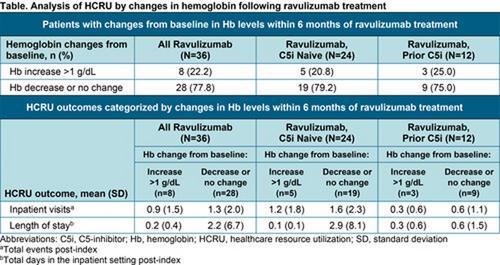
Results: Data from 36 RAV-treated patients were extracted from the EMR network (Table). Before starting RAV treatment, 24 (66.7%) patients were naïve to C5i, and 12 (33.3%) patients had prior C5i treatment. Following 6 months of RAV, many patients displayed decreased or no change in Hb levels (77.8%, n=28). Patients with decreased or no change in Hb levels after 6 months of RAV experienced more inpatient visits (mean visits [SD]: 1.3 [2.0]) compared to patients with increased Hb levels (mean visits [SD]: 0.9 [1.5]). RAV-treated patients with decreased or no change in Hb levels also demonstrated a longer mean LOS (mean days [SD]: 2.2 [6.7]) compared to patients with increased Hb levels (mean days [SD]: 0.2 [0.4]). Findings were similar among all three analysis groups (All RAV; RAV, C5i naïve; RAV, prior C5i), but slightly more C5i naïve patients with decreased or no change in Hb levels following RAV treatment (79.2%, n=19) had higher HCRU values for inpatient visits and LOS (Table).
Image:
Summary/Conclusion: The majority of RAV-treated patients did not display Hb improvement after 6 months of treatment, and patients lacking Hb improvement also demonstrated increased HCRU. This suggests improvements in Hb may be an important driver of morbidity and costs among patients with PNH. These findings also highlight the utility of improved Hb levels as a metric for assessing the PNH treatment response.
期刊介绍:
HemaSphere, as a publication, is dedicated to disseminating the outcomes of profoundly pertinent basic, translational, and clinical research endeavors within the field of hematology. The journal actively seeks robust studies that unveil novel discoveries with significant ramifications for hematology.
In addition to original research, HemaSphere features review articles and guideline articles that furnish lucid synopses and discussions of emerging developments, along with recommendations for patient care.
Positioned as the foremost resource in hematology, HemaSphere augments its offerings with specialized sections like HemaTopics and HemaPolicy. These segments engender insightful dialogues covering a spectrum of hematology-related topics, including digestible summaries of pivotal articles, updates on new therapies, deliberations on European policy matters, and other noteworthy news items within the field. Steering the course of HemaSphere are Editor in Chief Jan Cools and Deputy Editor in Chief Claire Harrison, alongside the guidance of an esteemed Editorial Board comprising international luminaries in both research and clinical realms, each representing diverse areas of hematologic expertise.




 京公网安备 11010802042870号
京ICP备2023020795号-1
京公网安备 11010802042870号
京ICP备2023020795号-1

 分享
分享
 求助内容:
求助内容: 应助结果提醒方式:
 扫码关注我们
