{"title":"Construction of multilayer superhydrophobic film on Al alloy and corrosion resistance mechanism","authors":"Jiaojiao Li, Jiahong Liu, Yijun Cao, Tianfeng Chen, Qun Liao, Wei Shang, Ning Peng, Yuqing Wen","doi":"10.1016/j.matchemphys.2022.126313","DOIUrl":null,"url":null,"abstract":"<div><p><span><span>The higher corrosion rates of aluminum alloys<span> limit applications. In order to provide the service life, this paper uses anodic oxidation<span><span> as a transition layer, adopts the layer-by-layer self-assembly technology was used to prepare anodized/perfluorooctyltriethoxysilane (POTS)/polypropylene (PP) (APP) composite films on aluminum alloys, and the film-forming mechanism was studied by </span>molecular dynamics simulation<span> and quantum chemical calculation. The APP composite film has excellent superhydrophobicity (contact angle of 157°), thermal shock stability and </span></span></span></span>abrasion resistance. Electrochemical tests show that the resistance value of the super-hydrophobic composite film is increased from 10</span><sup>3</sup> to 10<sup>9</sup> Ω cm<sup>2</sup>, and the corrosion current density is reduced from 10<sup>−5</sup> to 10<sup>−9</sup> A/cm<sup>2</sup><span>. Acid-base test and salt spray test<span> show excellent corrosion resistance and stability, can be widely used in complex environments, and have broad application prospects.</span></span></p></div>","PeriodicalId":18227,"journal":{"name":"Materials Chemistry and Physics","volume":"287 ","pages":"Article 126313"},"PeriodicalIF":4.7000,"publicationDate":"2022-08-01","publicationTypes":"Journal Article","fieldsOfStudy":null,"isOpenAccess":false,"openAccessPdf":"","citationCount":"4","resultStr":null,"platform":"Semanticscholar","paperid":null,"PeriodicalName":"Materials Chemistry and Physics","FirstCategoryId":"88","ListUrlMain":"https://www.sciencedirect.com/science/article/pii/S0254058422006198","RegionNum":3,"RegionCategory":"材料科学","ArticlePicture":[],"TitleCN":null,"AbstractTextCN":null,"PMCID":null,"EPubDate":"","PubModel":"","JCR":"Q2","JCRName":"MATERIALS SCIENCE, MULTIDISCIPLINARY","Score":null,"Total":0}
引用次数: 4
Abstract
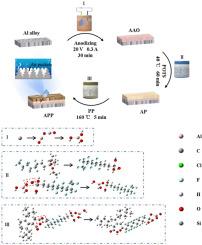
The higher corrosion rates of aluminum alloys limit applications. In order to provide the service life, this paper uses anodic oxidation as a transition layer, adopts the layer-by-layer self-assembly technology was used to prepare anodized/perfluorooctyltriethoxysilane (POTS)/polypropylene (PP) (APP) composite films on aluminum alloys, and the film-forming mechanism was studied by molecular dynamics simulation and quantum chemical calculation. The APP composite film has excellent superhydrophobicity (contact angle of 157°), thermal shock stability and abrasion resistance. Electrochemical tests show that the resistance value of the super-hydrophobic composite film is increased from 103 to 109 Ω cm2, and the corrosion current density is reduced from 10−5 to 10−9 A/cm2. Acid-base test and salt spray test show excellent corrosion resistance and stability, can be widely used in complex environments, and have broad application prospects.
期刊介绍:
Materials Chemistry and Physics is devoted to short communications, full-length research papers and feature articles on interrelationships among structure, properties, processing and performance of materials. The Editors welcome manuscripts on thin films, surface and interface science, materials degradation and reliability, metallurgy, semiconductors and optoelectronic materials, fine ceramics, magnetics, superconductors, specialty polymers, nano-materials and composite materials.



 京公网安备 11010802042870号
京ICP备2023020795号-1
京公网安备 11010802042870号
京ICP备2023020795号-1

 分享
分享
 求助内容:
求助内容: 应助结果提醒方式:
 扫码关注我们
