{"title":"The impact of COVID-19 lockdown on abortion care: a time series analysis of data from Marie Stopes Nepal.","authors":"Corrina Horan, Melissa Palmer, Raman Shrestha, Chelsey Porter Erlank, Kathryn Church","doi":"10.1080/26410397.2022.2079185","DOIUrl":null,"url":null,"abstract":"<p><p>The COVID-19 pandemic significantly impacted sexual and reproductive health and rights. Nepal implemented a nationwide lockdown in March 2020, limiting population movement and service access. The 36 clinics run by Marie Stopes Nepal (MSN) closed for varying periods at the beginning of lockdown. This study assesses the impact of lockdown and associated clinic closures on abortion services within MSN's network. An interrupted time-series analysis of clinic-level MSN data compared abortion service use in the pre-closure and post-reopening periods, focusing on the following outcomes: number of abortion care visits, proportion of abortion-related visits, gestational age at time of abortion care and demographics of patients accessing abortion care. Subsequent meta-analyses combined clinic-level results to generate outcome-specific pooled effect estimates. As MSN clinics reopened, during ongoing wider lockdown, weekly visits for abortion care decreased by 37% on average, but abortion increased as a proportion of services post-reopening (OR: 1.53) compared with pre-closure, with no evidence of a change in the proportion of higher gestation abortions. The demographic profile of abortion care clients was altered, with post-reopening clients more likely to have completed primary education (OR: 1.54) and be aged 25 years or older (OR: 1.31) compared with pre-closure clients. COVID-19 lockdown and associated clinic closures reduced the absolute number of abortion services provided within MSN's network, impacting the composition of service provision. Reductions in safe abortion and wider SRH access will have wide-ranging consequences, curtailing crucial reproductive rights. Policy-makers must ensure ongoing abortion access to protect rights and ensure access.</p>","PeriodicalId":3,"journal":{"name":"ACS Applied Electronic Materials","volume":" ","pages":"2079185"},"PeriodicalIF":4.7000,"publicationDate":"2022-12-01","publicationTypes":"Journal Article","fieldsOfStudy":null,"isOpenAccess":false,"openAccessPdf":"https://www.ncbi.nlm.nih.gov/pmc/articles/PMC9225672/pdf/","citationCount":"0","resultStr":null,"platform":"Semanticscholar","paperid":null,"PeriodicalName":"ACS Applied Electronic Materials","FirstCategoryId":"3","ListUrlMain":"https://doi.org/10.1080/26410397.2022.2079185","RegionNum":3,"RegionCategory":"材料科学","ArticlePicture":[],"TitleCN":null,"AbstractTextCN":null,"PMCID":null,"EPubDate":"","PubModel":"","JCR":"Q1","JCRName":"ENGINEERING, ELECTRICAL & ELECTRONIC","Score":null,"Total":0}
引用次数: 0
Abstract
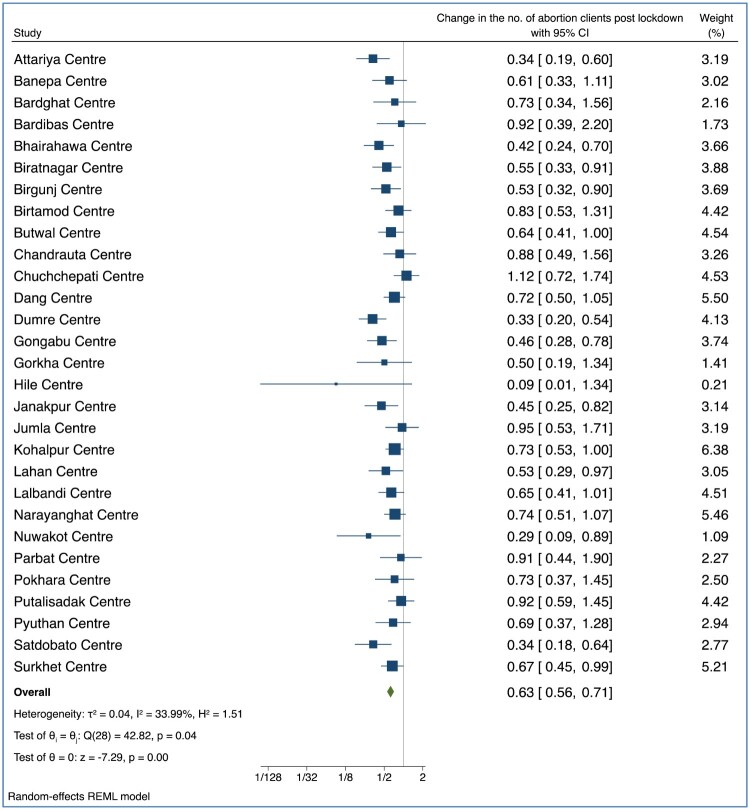
The COVID-19 pandemic significantly impacted sexual and reproductive health and rights. Nepal implemented a nationwide lockdown in March 2020, limiting population movement and service access. The 36 clinics run by Marie Stopes Nepal (MSN) closed for varying periods at the beginning of lockdown. This study assesses the impact of lockdown and associated clinic closures on abortion services within MSN's network. An interrupted time-series analysis of clinic-level MSN data compared abortion service use in the pre-closure and post-reopening periods, focusing on the following outcomes: number of abortion care visits, proportion of abortion-related visits, gestational age at time of abortion care and demographics of patients accessing abortion care. Subsequent meta-analyses combined clinic-level results to generate outcome-specific pooled effect estimates. As MSN clinics reopened, during ongoing wider lockdown, weekly visits for abortion care decreased by 37% on average, but abortion increased as a proportion of services post-reopening (OR: 1.53) compared with pre-closure, with no evidence of a change in the proportion of higher gestation abortions. The demographic profile of abortion care clients was altered, with post-reopening clients more likely to have completed primary education (OR: 1.54) and be aged 25 years or older (OR: 1.31) compared with pre-closure clients. COVID-19 lockdown and associated clinic closures reduced the absolute number of abortion services provided within MSN's network, impacting the composition of service provision. Reductions in safe abortion and wider SRH access will have wide-ranging consequences, curtailing crucial reproductive rights. Policy-makers must ensure ongoing abortion access to protect rights and ensure access.
期刊介绍:
ACS Applied Electronic Materials is an interdisciplinary journal publishing original research covering all aspects of electronic materials. The journal is devoted to reports of new and original experimental and theoretical research of an applied nature that integrate knowledge in the areas of materials science, engineering, optics, physics, and chemistry into important applications of electronic materials. Sample research topics that span the journal's scope are inorganic, organic, ionic and polymeric materials with properties that include conducting, semiconducting, superconducting, insulating, dielectric, magnetic, optoelectronic, piezoelectric, ferroelectric and thermoelectric.
Indexed/Abstracted:
Web of Science SCIE
Scopus
CAS
INSPEC
Portico






 京公网安备 11010802042870号
京ICP备2023020795号-1
京公网安备 11010802042870号
京ICP备2023020795号-1

 分享
分享
 求助内容:
求助内容: 应助结果提醒方式:
 扫码关注我们
