{"title":"Analysis of Energy Consumption and Its Influencing Factors in Hydrogen Metallurgy Process","authors":"Xicui Chai, Qiang Yue, Yujie Zhang, Qi Wang","doi":"10.1002/srin.202100730","DOIUrl":null,"url":null,"abstract":"<div>\n \n <section>\n \n <p>Hydrogen metallurgy is an effective way for the high carbon emission steel industry to achieve low-carbon green transformation and upgrading. According to energy conservation law, the article establishes gas utilization rate and thermal balance calculation models, discusses the influence of key factors such as reducing gas composition, reducing the temperature, and metallization rate on the gas utilization rate and energy consumption, and theoretically calculates the change of energy consumption in the process of steel industry production caused by using hydrogen. The optimal reduction temperature range is 1250–1350 K, which has theoretical minimum energy consumption, about 3.14 GJ, and maximum gas utilization rate, about 45%. The results show that when using 100% hydrogen reduction, increasing the reduction temperature properly lower theoretical energy consumption can be achieved and raise gas utilization rate and further achieve the goal of energy saving and consumption reduction, which is expected to provide beneficial help for hydrogen metallurgy developing in the steel industry.</p>\n </section>\n </div>","PeriodicalId":21929,"journal":{"name":"steel research international","volume":"93 7","pages":""},"PeriodicalIF":2.5000,"publicationDate":"2022-02-05","publicationTypes":"Journal Article","fieldsOfStudy":null,"isOpenAccess":false,"openAccessPdf":"","citationCount":"4","resultStr":null,"platform":"Semanticscholar","paperid":null,"PeriodicalName":"steel research international","FirstCategoryId":"88","ListUrlMain":"https://onlinelibrary.wiley.com/doi/10.1002/srin.202100730","RegionNum":3,"RegionCategory":"材料科学","ArticlePicture":[],"TitleCN":null,"AbstractTextCN":null,"PMCID":null,"EPubDate":"","PubModel":"","JCR":"Q2","JCRName":"METALLURGY & METALLURGICAL ENGINEERING","Score":null,"Total":0}
引用次数: 4
Abstract
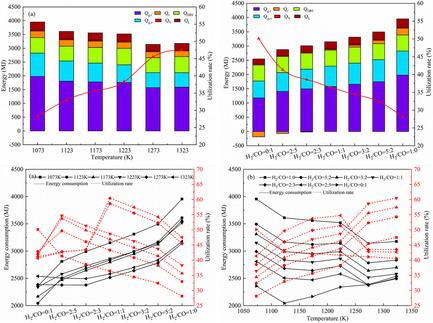
Hydrogen metallurgy is an effective way for the high carbon emission steel industry to achieve low-carbon green transformation and upgrading. According to energy conservation law, the article establishes gas utilization rate and thermal balance calculation models, discusses the influence of key factors such as reducing gas composition, reducing the temperature, and metallization rate on the gas utilization rate and energy consumption, and theoretically calculates the change of energy consumption in the process of steel industry production caused by using hydrogen. The optimal reduction temperature range is 1250–1350 K, which has theoretical minimum energy consumption, about 3.14 GJ, and maximum gas utilization rate, about 45%. The results show that when using 100% hydrogen reduction, increasing the reduction temperature properly lower theoretical energy consumption can be achieved and raise gas utilization rate and further achieve the goal of energy saving and consumption reduction, which is expected to provide beneficial help for hydrogen metallurgy developing in the steel industry.
期刊介绍:
steel research international is a journal providing a forum for the publication of high-quality manuscripts in areas ranging from process metallurgy and metal forming to materials engineering as well as process control and testing. The emphasis is on steel and on materials involved in steelmaking and the processing of steel, such as refractories and slags.
steel research international welcomes manuscripts describing basic scientific research as well as industrial research. The journal received a further increased, record-high Impact Factor of 1.522 (2018 Journal Impact Factor, Journal Citation Reports (Clarivate Analytics, 2019)).
The journal was formerly well known as "Archiv für das Eisenhüttenwesen" and "steel research"; with effect from January 1, 2006, the former "Scandinavian Journal of Metallurgy" merged with Steel Research International.
Hot Topics:
-Steels for Automotive Applications
-High-strength Steels
-Sustainable steelmaking
-Interstitially Alloyed Steels
-Electromagnetic Processing of Metals
-High Speed Forming