Kalyani Sai Reju, Chaithra Priya S, Ravi Manjithaya, Venkata Rao Dk
{"title":"Role of diacylglycerol kinase in autophagy, ER biogenesis, and triterpene metabolism.","authors":"Kalyani Sai Reju, Chaithra Priya S, Ravi Manjithaya, Venkata Rao Dk","doi":"10.1080/27694127.2022.2105455","DOIUrl":null,"url":null,"abstract":"<p><p><i>Saccharomyces cerevisiae</i> is widely used for producing various triterpenes by exploiting its native mevalonate/ergosterol pathway. Yeasts that accumulate phospholipids can produce more triterpenes. Our recent study demonstrated that a high phospholipid-accumulating yeast phenotype, as in <i>spt10Δ</i> yeast, results in increased endoplasmic reticulum (ER) biogenesis, resulting in ER expansion. However, the <i>spt10Δ</i> strain also exhibits high reticulophagy. Dgk1 (diacylglycerol kinase) is an important enzyme in lipid metabolism, which synthesizes phosphatidic acid (PA) by phosphorylating diacylglycerol (DG). We demonstrate that <i>spt10Δ</i> yeast with increased Dgk1 activity offer two desired results, (i) a highly expanded ER, due to redirection of the lipid pathway away from triglycerides towards phospholipid synthesis, increasing ER biogenesis; and (ii) decreased reticulophagy, by increasing the PA pool that activates TOR complex-mediated autophagy suppression. It was speculated that more ER-bound pathway enzymes can fit in the expanded ER, and the mevalonate-ergosterol pathway, being ER bound, might have higher activity. This was demonstrated by the co-expression of Dgk1 and plant triterpene synthase in <i>spt10Δ</i> yeast, which shows a high accumulation of plant triterpene.</p>","PeriodicalId":72341,"journal":{"name":"Autophagy reports","volume":" ","pages":"368-372"},"PeriodicalIF":0.0000,"publicationDate":"2022-07-26","publicationTypes":"Journal Article","fieldsOfStudy":null,"isOpenAccess":false,"openAccessPdf":"https://www.ncbi.nlm.nih.gov/pmc/articles/PMC11864703/pdf/","citationCount":"0","resultStr":null,"platform":"Semanticscholar","paperid":null,"PeriodicalName":"Autophagy reports","FirstCategoryId":"1085","ListUrlMain":"https://doi.org/10.1080/27694127.2022.2105455","RegionNum":0,"RegionCategory":null,"ArticlePicture":[],"TitleCN":null,"AbstractTextCN":null,"PMCID":null,"EPubDate":"2022/1/1 0:00:00","PubModel":"eCollection","JCR":"","JCRName":"","Score":null,"Total":0}
引用次数: 0
Abstract
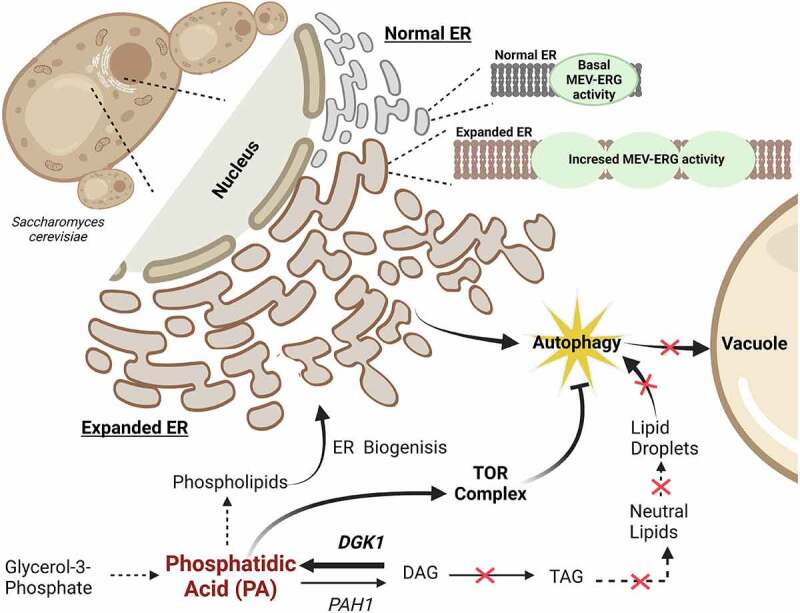
Saccharomyces cerevisiae is widely used for producing various triterpenes by exploiting its native mevalonate/ergosterol pathway. Yeasts that accumulate phospholipids can produce more triterpenes. Our recent study demonstrated that a high phospholipid-accumulating yeast phenotype, as in spt10Δ yeast, results in increased endoplasmic reticulum (ER) biogenesis, resulting in ER expansion. However, the spt10Δ strain also exhibits high reticulophagy. Dgk1 (diacylglycerol kinase) is an important enzyme in lipid metabolism, which synthesizes phosphatidic acid (PA) by phosphorylating diacylglycerol (DG). We demonstrate that spt10Δ yeast with increased Dgk1 activity offer two desired results, (i) a highly expanded ER, due to redirection of the lipid pathway away from triglycerides towards phospholipid synthesis, increasing ER biogenesis; and (ii) decreased reticulophagy, by increasing the PA pool that activates TOR complex-mediated autophagy suppression. It was speculated that more ER-bound pathway enzymes can fit in the expanded ER, and the mevalonate-ergosterol pathway, being ER bound, might have higher activity. This was demonstrated by the co-expression of Dgk1 and plant triterpene synthase in spt10Δ yeast, which shows a high accumulation of plant triterpene.




 京公网安备 11010802042870号
京ICP备2023020795号-1
京公网安备 11010802042870号
京ICP备2023020795号-1

 分享
分享

 求助内容:
求助内容: 应助结果提醒方式:
 扫码关注我们
