{"title":"Adsorption of Acicular Particles at Liquid−Fluid Interfaces and the Influence of the Line Tension","authors":"Lichun Dong, Duane T. Johnson","doi":"10.1021/la047851v","DOIUrl":null,"url":null,"abstract":"<p >In this paper, the adsorption energy of an acicular (prolate and cylindrical) particle onto a liquid?fluid interface and the effect of the line tension are investigated. The results show that, without line tension, acicular particles always prefer to lie flat in the plane of the interface. However, line tension plays a significant role in determining the adsorption of an acicular particle. First, the line tension creates an energy barrier for the adsorption of particles onto an interface. The planar configuration has a larger energy barrier due to the longer contact line. Therefore, the particles prefer to enter the interface in a homeotropic configuration and then rearrange to a planar configuration or an oblique configuration with a small tilt angle. Second, for prolate particles, an energy maximum occurs at some tilt angles when the line tension is large. Therefore, once the prolate particle is adsorbed on the interface in a homeotropic configuration or with a larger tilt angle, it must conquer an energy barrier to rearrange to a planar configuration. For cylindrical particles, when the line tension is higher, the planar configuration will not be the most energy-favorable configuration. The cylindrical particles prefer to stay in the interface with a small tilt angle. </p>","PeriodicalId":50,"journal":{"name":"Langmuir","volume":"21 9","pages":"3838–3849"},"PeriodicalIF":3.9000,"publicationDate":"2005-03-18","publicationTypes":"Journal Article","fieldsOfStudy":null,"isOpenAccess":false,"openAccessPdf":"https://sci-hub-pdf.com/10.1021/la047851v","citationCount":"51","resultStr":null,"platform":"Semanticscholar","paperid":null,"PeriodicalName":"Langmuir","FirstCategoryId":"92","ListUrlMain":"https://pubs.acs.org/doi/10.1021/la047851v","RegionNum":2,"RegionCategory":"化学","ArticlePicture":[],"TitleCN":null,"AbstractTextCN":null,"PMCID":null,"EPubDate":"","PubModel":"","JCR":"Q2","JCRName":"CHEMISTRY, MULTIDISCIPLINARY","Score":null,"Total":0}
引用次数: 51
Abstract
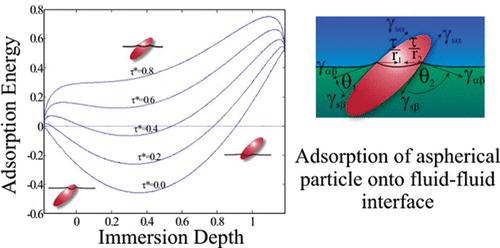
In this paper, the adsorption energy of an acicular (prolate and cylindrical) particle onto a liquid?fluid interface and the effect of the line tension are investigated. The results show that, without line tension, acicular particles always prefer to lie flat in the plane of the interface. However, line tension plays a significant role in determining the adsorption of an acicular particle. First, the line tension creates an energy barrier for the adsorption of particles onto an interface. The planar configuration has a larger energy barrier due to the longer contact line. Therefore, the particles prefer to enter the interface in a homeotropic configuration and then rearrange to a planar configuration or an oblique configuration with a small tilt angle. Second, for prolate particles, an energy maximum occurs at some tilt angles when the line tension is large. Therefore, once the prolate particle is adsorbed on the interface in a homeotropic configuration or with a larger tilt angle, it must conquer an energy barrier to rearrange to a planar configuration. For cylindrical particles, when the line tension is higher, the planar configuration will not be the most energy-favorable configuration. The cylindrical particles prefer to stay in the interface with a small tilt angle.
期刊介绍:
Langmuir is an interdisciplinary journal publishing articles in the following subject categories:
Colloids: surfactants and self-assembly, dispersions, emulsions, foams
Interfaces: adsorption, reactions, films, forces
Biological Interfaces: biocolloids, biomolecular and biomimetic materials
Materials: nano- and mesostructured materials, polymers, gels, liquid crystals
Electrochemistry: interfacial charge transfer, charge transport, electrocatalysis, electrokinetic phenomena, bioelectrochemistry
Devices and Applications: sensors, fluidics, patterning, catalysis, photonic crystals
However, when high-impact, original work is submitted that does not fit within the above categories, decisions to accept or decline such papers will be based on one criteria: What Would Irving Do?
Langmuir ranks #2 in citations out of 136 journals in the category of Physical Chemistry with 113,157 total citations. The journal received an Impact Factor of 4.384*.
This journal is also indexed in the categories of Materials Science (ranked #1) and Multidisciplinary Chemistry (ranked #5).



 京公网安备 11010802042870号
京ICP备2023020795号-1
京公网安备 11010802042870号
京ICP备2023020795号-1

 分享
分享
 求助内容:
求助内容: 应助结果提醒方式:
 扫码关注我们
