{"title":"Technoeconomic and environmental assessment of a process for biodiesel production from spent coffee grounds (SCGs)","authors":"I.K. Kookos","doi":"10.1016/j.resconrec.2018.02.002","DOIUrl":null,"url":null,"abstract":"<div><p>The valorization of the spent coffee grounds (SCGs) has attracted a lot of attention recently from both the academia and industry. The development of an economically attractive and environmentally sustainable process based on available experimental data on the SCGs valorization has not been investigated in the open literature. This is clearly a very important issue and is the subject of the present work. Evidence is presented to support the conclusion that the economic performance of the process can be acceptable only at large production capacities realized at centralized facilities. In addition, it is shown, using a “gate-to-gate” Life Cycle Assessment (LCI), that the environmental performance of the process is acceptable and the process can be considered sustainable. Further research is necessary in the area of efficient recovery of the bioactive compounds available in SCGs. These compounds have a significant added value that can render the process economically attractive at capacities that are low enough to be practically realizable.</p></div>","PeriodicalId":21153,"journal":{"name":"Resources Conservation and Recycling","volume":"134 ","pages":"Pages 156-164"},"PeriodicalIF":10.9000,"publicationDate":"2018-07-01","publicationTypes":"Journal Article","fieldsOfStudy":null,"isOpenAccess":false,"openAccessPdf":"https://sci-hub-pdf.com/10.1016/j.resconrec.2018.02.002","citationCount":"59","resultStr":null,"platform":"Semanticscholar","paperid":null,"PeriodicalName":"Resources Conservation and Recycling","FirstCategoryId":"93","ListUrlMain":"https://www.sciencedirect.com/science/article/pii/S0921344918300405","RegionNum":1,"RegionCategory":"环境科学与生态学","ArticlePicture":[],"TitleCN":null,"AbstractTextCN":null,"PMCID":null,"EPubDate":"","PubModel":"","JCR":"Q1","JCRName":"ENGINEERING, ENVIRONMENTAL","Score":null,"Total":0}
引用次数: 59
Abstract
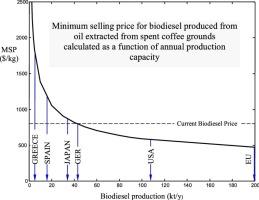
The valorization of the spent coffee grounds (SCGs) has attracted a lot of attention recently from both the academia and industry. The development of an economically attractive and environmentally sustainable process based on available experimental data on the SCGs valorization has not been investigated in the open literature. This is clearly a very important issue and is the subject of the present work. Evidence is presented to support the conclusion that the economic performance of the process can be acceptable only at large production capacities realized at centralized facilities. In addition, it is shown, using a “gate-to-gate” Life Cycle Assessment (LCI), that the environmental performance of the process is acceptable and the process can be considered sustainable. Further research is necessary in the area of efficient recovery of the bioactive compounds available in SCGs. These compounds have a significant added value that can render the process economically attractive at capacities that are low enough to be practically realizable.
期刊介绍:
The journal Resources, Conservation & Recycling welcomes contributions from research, which consider sustainable management and conservation of resources. The journal prioritizes understanding the transformation processes crucial for transitioning toward more sustainable production and consumption systems. It highlights technological, economic, institutional, and policy aspects related to specific resource management practices such as conservation, recycling, and resource substitution, as well as broader strategies like improving resource productivity and restructuring production and consumption patterns.
Contributions may address regional, national, or international scales and can range from individual resources or technologies to entire sectors or systems. Authors are encouraged to explore scientific and methodological issues alongside practical, environmental, and economic implications. However, manuscripts focusing solely on laboratory experiments without discussing their broader implications will not be considered for publication in the journal.



 京公网安备 11010802042870号
京ICP备2023020795号-1
京公网安备 11010802042870号
京ICP备2023020795号-1

 分享
分享
 求助内容:
求助内容: 应助结果提醒方式:
 扫码关注我们
