{"title":"Autophagy and proliferation are dysregulated in Charcot-Marie-Tooth disease type 2A cells harboring MFN2 (mitofusin 2) mutation.","authors":"Paola Zanfardino, Vittoria Petruzzella","doi":"10.1080/27694127.2022.2132447","DOIUrl":null,"url":null,"abstract":"<p><p>MFN2 (mitofusin 2) is a mitochondrial outer membrane protein that serves primarily as a mitochondrial fusion protein, which is its best known role but has additional functions in regulating cell biological processes. Multiple functions include participation in mitochondrial fusion, tethering of mitochondrial-endoplasmic reticulum membranes, movement of mitochondria along axons, and control of the quality of mitochondria, which is important for the maintenance of cellular homeostasis. Mitochondrial quality control is a process that includes the exchange of mitochondrial components through mitochondrial fusion and fission, and the removal of dysfunctional mitochondria through autophagy/mitophagy. Macroautophagy/autophagy, as major intracellular machinery for degrading aggregated proteins and damaged organelles, is involved in the occurrence of pathological changes in diabetes, obesity, neurodegenerative diseases and cancer. Intriguingly, MFN2 has been referred to as a tumor suppressor gene in some forms of cancer. Several studies of the effects of MFN2 mutations have not been conclusive on molecular mechanisms causing cellular alterations. We tackled some of these issues in fibroblasts derived from a Charcot-Marie-Tooth disease type 2A (CMT2A) patient with a mutation in the GTPase domain of MFN2. So, in this <i>punctum</i>, we discuss the mechanism whereby mitochondrial MFN2 protein mutation affects autophagy and cell proliferation rate.</p>","PeriodicalId":72341,"journal":{"name":"Autophagy reports","volume":" ","pages":"537-541"},"PeriodicalIF":0.0000,"publicationDate":"2022-10-11","publicationTypes":"Journal Article","fieldsOfStudy":null,"isOpenAccess":false,"openAccessPdf":"https://www.ncbi.nlm.nih.gov/pmc/articles/PMC11864700/pdf/","citationCount":"0","resultStr":null,"platform":"Semanticscholar","paperid":null,"PeriodicalName":"Autophagy reports","FirstCategoryId":"1085","ListUrlMain":"https://doi.org/10.1080/27694127.2022.2132447","RegionNum":0,"RegionCategory":null,"ArticlePicture":[],"TitleCN":null,"AbstractTextCN":null,"PMCID":null,"EPubDate":"2022/1/1 0:00:00","PubModel":"eCollection","JCR":"","JCRName":"","Score":null,"Total":0}
引用次数: 0
Abstract
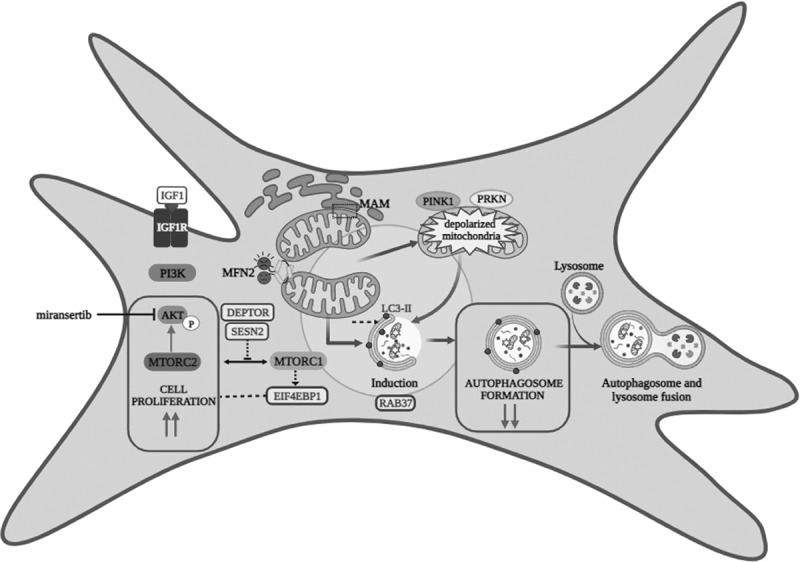
MFN2 (mitofusin 2) is a mitochondrial outer membrane protein that serves primarily as a mitochondrial fusion protein, which is its best known role but has additional functions in regulating cell biological processes. Multiple functions include participation in mitochondrial fusion, tethering of mitochondrial-endoplasmic reticulum membranes, movement of mitochondria along axons, and control of the quality of mitochondria, which is important for the maintenance of cellular homeostasis. Mitochondrial quality control is a process that includes the exchange of mitochondrial components through mitochondrial fusion and fission, and the removal of dysfunctional mitochondria through autophagy/mitophagy. Macroautophagy/autophagy, as major intracellular machinery for degrading aggregated proteins and damaged organelles, is involved in the occurrence of pathological changes in diabetes, obesity, neurodegenerative diseases and cancer. Intriguingly, MFN2 has been referred to as a tumor suppressor gene in some forms of cancer. Several studies of the effects of MFN2 mutations have not been conclusive on molecular mechanisms causing cellular alterations. We tackled some of these issues in fibroblasts derived from a Charcot-Marie-Tooth disease type 2A (CMT2A) patient with a mutation in the GTPase domain of MFN2. So, in this punctum, we discuss the mechanism whereby mitochondrial MFN2 protein mutation affects autophagy and cell proliferation rate.




 京公网安备 11010802042870号
京ICP备2023020795号-1
京公网安备 11010802042870号
京ICP备2023020795号-1

 分享
分享

 求助内容:
求助内容: 应助结果提醒方式:
 扫码关注我们
