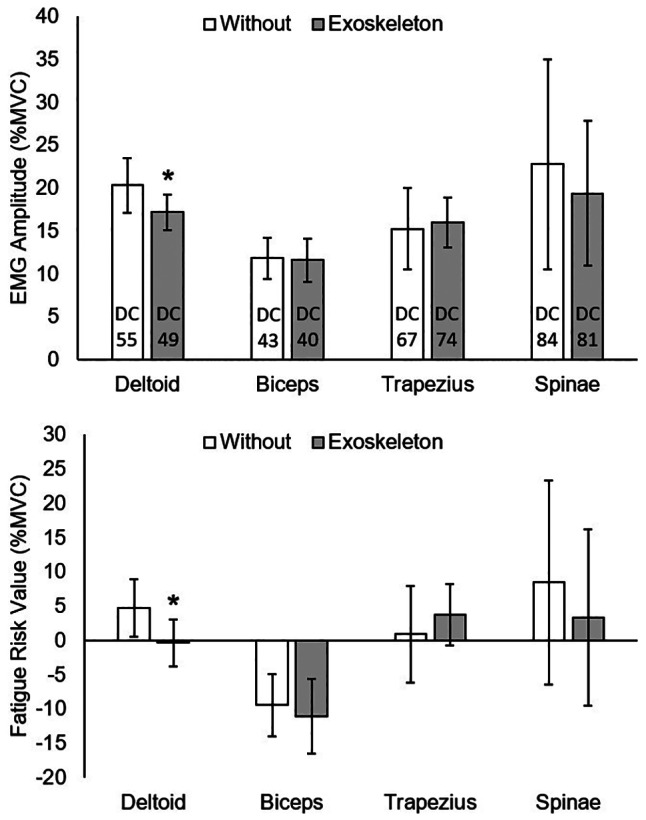
{"title":"Electromyography-based fatigue assessment of an upper body exoskeleton during automotive assembly.","authors":"Jason C Gillette, Shekoofe Saadat, Terry Butler","doi":"10.1017/wtc.2022.20","DOIUrl":null,"url":null,"abstract":"<p><p>The purpose of this study was to assess an upper body exoskeleton during automotive assembly processes that involve elevated arm postures. Sixteen team members at Toyota Motor Manufacturing Canada were fitted with a Levitate Airframe, and each team member performed between one and three processes with and without the exoskeleton. A total of 16 assembly processes were studied. Electromyography (EMG) data were collected on the anterior deltoid, biceps brachii, upper trapezius, and erector spinae. Team members also completed a usability survey. The exoskeleton significantly reduced anterior deltoid mean active EMG amplitude (<i>p</i> = .01, Δ = -3.2 %MVC, <i>d</i> = 0.56 medium effect) and fatigue risk value (<i>p</i> < .01, Δ = -5.1 %MVC, <i>d</i> = 0.62 medium effect) across the assembly processes, with no significant changes for the other muscles tested. A subset of nine assembly processes with a greater amount of time spent in arm elevations at or above 90° (30 vs. 24%) and at or above 135° (18 vs. 9%) appeared to benefit more from exoskeleton usage. For these processes, the exoskeleton significantly reduced anterior deltoid mean active EMG amplitude (<i>p</i> < .01, Δ = -5.1 %MVC, <i>d</i> = 0.95 large effect) and fatigue risk value (<i>p</i> < .01, Δ = -7.4 %MVC, <i>d</i> = 0.96 large effect). Team members responded positively about comfort and fatigue benefits, although there were concerns about the exoskeleton hindering certain job duties. The results support quantitative testing to match exoskeleton usage with specific job tasks and surveying team members for perceived benefits/drawbacks.</p>","PeriodicalId":3,"journal":{"name":"ACS Applied Electronic Materials","volume":" ","pages":"e23"},"PeriodicalIF":4.7000,"publicationDate":"2022-09-19","publicationTypes":"Journal Article","fieldsOfStudy":null,"isOpenAccess":false,"openAccessPdf":"https://www.ncbi.nlm.nih.gov/pmc/articles/PMC10936263/pdf/","citationCount":"0","resultStr":null,"platform":"Semanticscholar","paperid":null,"PeriodicalName":"ACS Applied Electronic Materials","FirstCategoryId":"1085","ListUrlMain":"https://doi.org/10.1017/wtc.2022.20","RegionNum":3,"RegionCategory":"材料科学","ArticlePicture":[],"TitleCN":null,"AbstractTextCN":null,"PMCID":null,"EPubDate":"2022/1/1 0:00:00","PubModel":"eCollection","JCR":"Q1","JCRName":"ENGINEERING, ELECTRICAL & ELECTRONIC","Score":null,"Total":0}
引用次数: 0
Abstract
The purpose of this study was to assess an upper body exoskeleton during automotive assembly processes that involve elevated arm postures. Sixteen team members at Toyota Motor Manufacturing Canada were fitted with a Levitate Airframe, and each team member performed between one and three processes with and without the exoskeleton. A total of 16 assembly processes were studied. Electromyography (EMG) data were collected on the anterior deltoid, biceps brachii, upper trapezius, and erector spinae. Team members also completed a usability survey. The exoskeleton significantly reduced anterior deltoid mean active EMG amplitude (p = .01, Δ = -3.2 %MVC, d = 0.56 medium effect) and fatigue risk value (p < .01, Δ = -5.1 %MVC, d = 0.62 medium effect) across the assembly processes, with no significant changes for the other muscles tested. A subset of nine assembly processes with a greater amount of time spent in arm elevations at or above 90° (30 vs. 24%) and at or above 135° (18 vs. 9%) appeared to benefit more from exoskeleton usage. For these processes, the exoskeleton significantly reduced anterior deltoid mean active EMG amplitude (p < .01, Δ = -5.1 %MVC, d = 0.95 large effect) and fatigue risk value (p < .01, Δ = -7.4 %MVC, d = 0.96 large effect). Team members responded positively about comfort and fatigue benefits, although there were concerns about the exoskeleton hindering certain job duties. The results support quantitative testing to match exoskeleton usage with specific job tasks and surveying team members for perceived benefits/drawbacks.
期刊介绍:
ACS Applied Electronic Materials is an interdisciplinary journal publishing original research covering all aspects of electronic materials. The journal is devoted to reports of new and original experimental and theoretical research of an applied nature that integrate knowledge in the areas of materials science, engineering, optics, physics, and chemistry into important applications of electronic materials. Sample research topics that span the journal's scope are inorganic, organic, ionic and polymeric materials with properties that include conducting, semiconducting, superconducting, insulating, dielectric, magnetic, optoelectronic, piezoelectric, ferroelectric and thermoelectric.
Indexed/Abstracted:
Web of Science SCIE
Scopus
CAS
INSPEC
Portico






 京公网安备 11010802042870号
京ICP备2023020795号-1
京公网安备 11010802042870号
京ICP备2023020795号-1

 分享
分享
 求助内容:
求助内容: 应助结果提醒方式:
 扫码关注我们
