Sierra A. Walker , Irina Davidovich , Yubo Yang , Andrew Lai , Jenifer Pendiuk Goncalves , Vatsal Deliwala , Sara Busatto , Shane Shapiro , Na’ama Koifman , Carlos Salomon , Yeshayahu Talmon , Joy Wolfram
{"title":"Sucrose-based cryoprotective storage of extracellular vesicles","authors":"Sierra A. Walker , Irina Davidovich , Yubo Yang , Andrew Lai , Jenifer Pendiuk Goncalves , Vatsal Deliwala , Sara Busatto , Shane Shapiro , Na’ama Koifman , Carlos Salomon , Yeshayahu Talmon , Joy Wolfram","doi":"10.1016/j.vesic.2022.100016","DOIUrl":null,"url":null,"abstract":"<div><p>Advancements in extracellular vesicle (EV) studies necessitate the development of optimized storage conditions to ensure preservation of physical and biochemical characteristics. In this study, the most common buffer for EV storage (phosphate-buffered saline/PBS) was compared to a cryoprotective 5% sucrose solution. The size distribution and concentration of EVs from two different sources changed to a greater extent after −80 °C storage in PBS compared to the sucrose solution. Additionally, molecular surface protrusions and transmembrane proteins were more prevalent in EVs stored in the sucrose solution compared to those stored in PBS. This study demonstrates, for the first time, that distinct ring-like molecular complexes and cristae-like folded membranous structures are visible upon EV degradation. Taken together, the size, concentration, molecular surface extensions, and transmembrane proteins of EVs varied substantially based on the buffer used for −80 °C storage, suggesting that biocompatible cryoprotectants, such as sucrose, should be considered for EV studies.</p></div>","PeriodicalId":73007,"journal":{"name":"Extracellular vesicle","volume":"1 ","pages":"Article 100016"},"PeriodicalIF":0.0000,"publicationDate":"2022-12-01","publicationTypes":"Journal Article","fieldsOfStudy":null,"isOpenAccess":false,"openAccessPdf":"https://www.sciencedirect.com/science/article/pii/S2773041722000117/pdfft?md5=86b94a603c3bfe47ab1d92a96499da88&pid=1-s2.0-S2773041722000117-main.pdf","citationCount":"7","resultStr":null,"platform":"Semanticscholar","paperid":null,"PeriodicalName":"Extracellular vesicle","FirstCategoryId":"1085","ListUrlMain":"https://www.sciencedirect.com/science/article/pii/S2773041722000117","RegionNum":0,"RegionCategory":null,"ArticlePicture":[],"TitleCN":null,"AbstractTextCN":null,"PMCID":null,"EPubDate":"2022/11/21 0:00:00","PubModel":"Epub","JCR":"","JCRName":"","Score":null,"Total":0}
引用次数: 7
Abstract
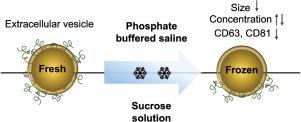
Advancements in extracellular vesicle (EV) studies necessitate the development of optimized storage conditions to ensure preservation of physical and biochemical characteristics. In this study, the most common buffer for EV storage (phosphate-buffered saline/PBS) was compared to a cryoprotective 5% sucrose solution. The size distribution and concentration of EVs from two different sources changed to a greater extent after −80 °C storage in PBS compared to the sucrose solution. Additionally, molecular surface protrusions and transmembrane proteins were more prevalent in EVs stored in the sucrose solution compared to those stored in PBS. This study demonstrates, for the first time, that distinct ring-like molecular complexes and cristae-like folded membranous structures are visible upon EV degradation. Taken together, the size, concentration, molecular surface extensions, and transmembrane proteins of EVs varied substantially based on the buffer used for −80 °C storage, suggesting that biocompatible cryoprotectants, such as sucrose, should be considered for EV studies.




 京公网安备 11010802042870号
京ICP备2023020795号-1
京公网安备 11010802042870号
京ICP备2023020795号-1

 分享
分享
 求助内容:
求助内容: 应助结果提醒方式:
 扫码关注我们
