Andrew Magee, Michael Karcher, Frederick A Matsen, Volodymyr M Minin
{"title":"How Trustworthy Is Your Tree? Bayesian Phylogenetic Effective Sample Size Through the Lens of Monte Carlo Error.","authors":"Andrew Magee, Michael Karcher, Frederick A Matsen, Volodymyr M Minin","doi":"10.1214/22-ba1339","DOIUrl":null,"url":null,"abstract":"<p><p>Bayesian inference is a popular and widely-used approach to infer phylogenies (evolutionary trees). However, despite decades of widespread application, it remains difficult to judge how well a given Bayesian Markov chain Monte Carlo (MCMC) run explores the space of phylogenetic trees. In this paper, we investigate the Monte Carlo error of phylogenies, focusing on high-dimensional summaries of the posterior distribution, including variability in estimated edge/branch (known in phylogenetics as \"split\") probabilities and tree probabilities, and variability in the estimated summary tree. Specifically, we ask if there is any measure of effective sample size (ESS) applicable to phylogenetic trees which is capable of capturing the Monte Carlo error of these three summary measures. We find that there are some ESS measures capable of capturing the error inherent in using MCMC samples to approximate the posterior distributions on phylogenies. We term these tree ESS measures, and identify a set of three which are useful in practice for assessing the Monte Carlo error. Lastly, we present visualization tools that can improve comparisons between multiple independent MCMC runs by accounting for the Monte Carlo error present in each chain. Our results indicate that common post-MCMC workflows are insufficient to capture the inherent Monte Carlo error of the tree, and highlight the need for both within-chain mixing and between-chain convergence assessments.</p>","PeriodicalId":4,"journal":{"name":"ACS Applied Energy Materials","volume":" ","pages":"565-593"},"PeriodicalIF":5.5000,"publicationDate":"2024-06-01","publicationTypes":"Journal Article","fieldsOfStudy":null,"isOpenAccess":false,"openAccessPdf":"https://www.ncbi.nlm.nih.gov/pmc/articles/PMC11042687/pdf/","citationCount":"0","resultStr":null,"platform":"Semanticscholar","paperid":null,"PeriodicalName":"ACS Applied Energy Materials","FirstCategoryId":"100","ListUrlMain":"https://doi.org/10.1214/22-ba1339","RegionNum":3,"RegionCategory":"材料科学","ArticlePicture":[],"TitleCN":null,"AbstractTextCN":null,"PMCID":null,"EPubDate":"2024/4/9 0:00:00","PubModel":"Epub","JCR":"Q2","JCRName":"CHEMISTRY, PHYSICAL","Score":null,"Total":0}
引用次数: 0
Abstract
Bayesian inference is a popular and widely-used approach to infer phylogenies (evolutionary trees). However, despite decades of widespread application, it remains difficult to judge how well a given Bayesian Markov chain Monte Carlo (MCMC) run explores the space of phylogenetic trees. In this paper, we investigate the Monte Carlo error of phylogenies, focusing on high-dimensional summaries of the posterior distribution, including variability in estimated edge/branch (known in phylogenetics as "split") probabilities and tree probabilities, and variability in the estimated summary tree. Specifically, we ask if there is any measure of effective sample size (ESS) applicable to phylogenetic trees which is capable of capturing the Monte Carlo error of these three summary measures. We find that there are some ESS measures capable of capturing the error inherent in using MCMC samples to approximate the posterior distributions on phylogenies. We term these tree ESS measures, and identify a set of three which are useful in practice for assessing the Monte Carlo error. Lastly, we present visualization tools that can improve comparisons between multiple independent MCMC runs by accounting for the Monte Carlo error present in each chain. Our results indicate that common post-MCMC workflows are insufficient to capture the inherent Monte Carlo error of the tree, and highlight the need for both within-chain mixing and between-chain convergence assessments.
期刊介绍:
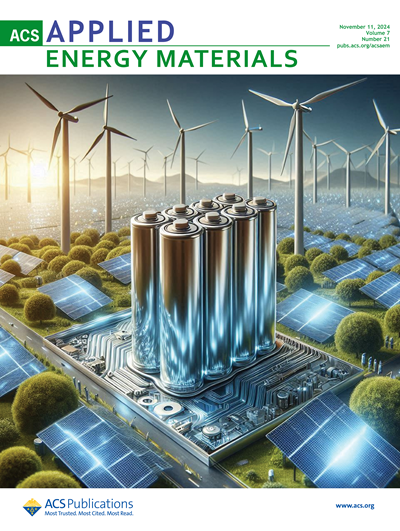
ACS Applied Energy Materials is an interdisciplinary journal publishing original research covering all aspects of materials, engineering, chemistry, physics and biology relevant to energy conversion and storage. The journal is devoted to reports of new and original experimental and theoretical research of an applied nature that integrate knowledge in the areas of materials, engineering, physics, bioscience, and chemistry into important energy applications.



 京公网安备 11010802042870号
京ICP备2023020795号-1
京公网安备 11010802042870号
京ICP备2023020795号-1

 分享
分享
 求助内容:
求助内容: 应助结果提醒方式:
 扫码关注我们
