Haoyuan Chi , Jianlong Lin , Siyu Kuang , Minglu Li , Hai Liu , Qun Fan , Tianxiang Yan , Sheng Zhang , Xinbin Ma
{"title":"Self-supported ultrathin NiCo layered double hydroxides nanosheets electrode for efficient electrosynthesis of formate","authors":"Haoyuan Chi , Jianlong Lin , Siyu Kuang , Minglu Li , Hai Liu , Qun Fan , Tianxiang Yan , Sheng Zhang , Xinbin Ma","doi":"10.1016/j.jechem.2023.06.024","DOIUrl":null,"url":null,"abstract":"<div><p>Electrochemical CO<sub>2</sub> reduction into energy-carrying compounds, such as formate, is of great importance for carbon neutrality, which however suffers from high electrical energy input and liquid products crossover. Herein, we fabricated self-supported ultrathin NiCo layered double hydroxides (LDHs) electrodes as anode for methanol electrooxidation to achieve a high formate production rate (5.89 mmol h<sup>−1</sup> cm<sup>−2</sup>) coupled with CO<sub>2</sub> electro-reduction at the cathode. A total formate faradic efficiency of both anode for methanol oxidation and cathode for CO<sub>2</sub> reduction can reach up to 188% driven by a low cell potential of only 2.06 V at 100 mA cm<sup>−2</sup> in membrane-electrode assembly (MEA). Physical characterizations demonstrated that Ni<sup>3+</sup> species, formed on the electrochemical oxidation of Ni-containing hydroxide, acted as catalytically active species for the oxidation of methanol to formate. Furthermore, DFT calculations revealed that ultrathin LDHs were beneficial for the formation of Ni<sup>3+</sup> in hydroxides and introducing oxygen vacancy in NiCo-LDH could decrease the energy barrier of the rate-determining step for methanol oxidation. This work presents a promising approach for fabricating advanced electrodes towards electrocatalytic reactions.</p></div>","PeriodicalId":15728,"journal":{"name":"Journal of Energy Chemistry","volume":"85 ","pages":"Pages 267-275"},"PeriodicalIF":14.9000,"publicationDate":"2023-10-01","publicationTypes":"Journal Article","fieldsOfStudy":null,"isOpenAccess":false,"openAccessPdf":"","citationCount":"0","resultStr":null,"platform":"Semanticscholar","paperid":null,"PeriodicalName":"Journal of Energy Chemistry","FirstCategoryId":"1085","ListUrlMain":"https://www.sciencedirect.com/science/article/pii/S2095495623003716","RegionNum":1,"RegionCategory":"化学","ArticlePicture":[],"TitleCN":null,"AbstractTextCN":null,"PMCID":null,"EPubDate":"2023/7/3 0:00:00","PubModel":"Epub","JCR":"Q1","JCRName":"Energy","Score":null,"Total":0}
引用次数: 0
Abstract
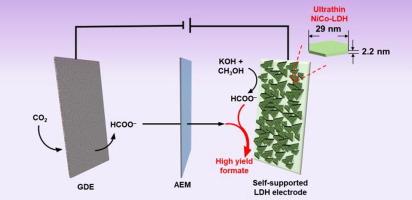
Electrochemical CO2 reduction into energy-carrying compounds, such as formate, is of great importance for carbon neutrality, which however suffers from high electrical energy input and liquid products crossover. Herein, we fabricated self-supported ultrathin NiCo layered double hydroxides (LDHs) electrodes as anode for methanol electrooxidation to achieve a high formate production rate (5.89 mmol h−1 cm−2) coupled with CO2 electro-reduction at the cathode. A total formate faradic efficiency of both anode for methanol oxidation and cathode for CO2 reduction can reach up to 188% driven by a low cell potential of only 2.06 V at 100 mA cm−2 in membrane-electrode assembly (MEA). Physical characterizations demonstrated that Ni3+ species, formed on the electrochemical oxidation of Ni-containing hydroxide, acted as catalytically active species for the oxidation of methanol to formate. Furthermore, DFT calculations revealed that ultrathin LDHs were beneficial for the formation of Ni3+ in hydroxides and introducing oxygen vacancy in NiCo-LDH could decrease the energy barrier of the rate-determining step for methanol oxidation. This work presents a promising approach for fabricating advanced electrodes towards electrocatalytic reactions.
期刊介绍:
The Journal of Energy Chemistry, the official publication of Science Press and the Dalian Institute of Chemical Physics, Chinese Academy of Sciences, serves as a platform for reporting creative research and innovative applications in energy chemistry. It mainly reports on creative researches and innovative applications of chemical conversions of fossil energy, carbon dioxide, electrochemical energy and hydrogen energy, as well as the conversions of biomass and solar energy related with chemical issues to promote academic exchanges in the field of energy chemistry and to accelerate the exploration, research and development of energy science and technologies.
This journal focuses on original research papers covering various topics within energy chemistry worldwide, including:
Optimized utilization of fossil energy
Hydrogen energy
Conversion and storage of electrochemical energy
Capture, storage, and chemical conversion of carbon dioxide
Materials and nanotechnologies for energy conversion and storage
Chemistry in biomass conversion
Chemistry in the utilization of solar energy



 京公网安备 11010802042870号
京ICP备2023020795号-1
京公网安备 11010802042870号
京ICP备2023020795号-1

 分享
分享
 求助内容:
求助内容: 应助结果提醒方式:
 扫码关注我们
