Lisa A Shender, Theresa Cody, Mark Ruder, Heather Fenton, Kevin D Niedringhaus, Jason Blanton, Jessy Motes, Sarah Schmedes, Elizabeth Forys
{"title":"Heavy Rainfall, Sewer Overflows, and Salmonellosis in Black Skimmers (Rynchops niger).","authors":"Lisa A Shender, Theresa Cody, Mark Ruder, Heather Fenton, Kevin D Niedringhaus, Jason Blanton, Jessy Motes, Sarah Schmedes, Elizabeth Forys","doi":"10.1007/s10393-022-01596-6","DOIUrl":null,"url":null,"abstract":"<p><p>Extreme weather events, particularly heavy rainfall, are occurring at greater frequency with climate change. Although adverse human health effects from heavy rainfall are often publicized, impacts to free-ranging wildlife populations are less well known. We first summarize documented associations of heavy rainfall on wildlife health. We then report a novel investigation of a salmonellosis outbreak in a colony of black skimmers (Rynchops niger) in Florida, USA. During June-September 2016, heavy rainfall resulted in the discharge of millions of gallons of untreated wastewater into the Tampa Bay system, contaminating the water body, where adult skimmers foraged. At least 48 fledglings died, comprising 39% of the colony's nesting season's offspring. Of eight examined deceased birds from the colony, six had a systemic salmonellosis infection. Isolates were identified as Salmonella enterica serotype Typhimurium. Their pulsed-field gel electrophoresis patterns were identical to each other and matched those from several human Salmonella sp. infections. Differences among whole-genome sequences were negligible. These findings and the outbreak's epidemic curve suggest propagated transmission occurred within the colony. A multidisciplinary and One Health approach is recommended to mitigate any adverse effects of climate change-driven stochastic events, especially when they place already imperiled wildlife at further risk.</p>","PeriodicalId":51027,"journal":{"name":"Ecohealth","volume":"19 1","pages":"203-215"},"PeriodicalIF":2.2000,"publicationDate":"2022-06-01","publicationTypes":"Journal Article","fieldsOfStudy":null,"isOpenAccess":false,"openAccessPdf":"","citationCount":"0","resultStr":null,"platform":"Semanticscholar","paperid":null,"PeriodicalName":"Ecohealth","FirstCategoryId":"93","ListUrlMain":"https://doi.org/10.1007/s10393-022-01596-6","RegionNum":3,"RegionCategory":"环境科学与生态学","ArticlePicture":[],"TitleCN":null,"AbstractTextCN":null,"PMCID":null,"EPubDate":"2022/6/3 0:00:00","PubModel":"Epub","JCR":"Q3","JCRName":"ENVIRONMENTAL SCIENCES","Score":null,"Total":0}
引用次数: 0
Abstract
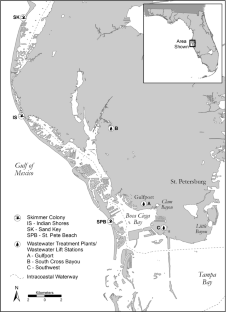
Extreme weather events, particularly heavy rainfall, are occurring at greater frequency with climate change. Although adverse human health effects from heavy rainfall are often publicized, impacts to free-ranging wildlife populations are less well known. We first summarize documented associations of heavy rainfall on wildlife health. We then report a novel investigation of a salmonellosis outbreak in a colony of black skimmers (Rynchops niger) in Florida, USA. During June-September 2016, heavy rainfall resulted in the discharge of millions of gallons of untreated wastewater into the Tampa Bay system, contaminating the water body, where adult skimmers foraged. At least 48 fledglings died, comprising 39% of the colony's nesting season's offspring. Of eight examined deceased birds from the colony, six had a systemic salmonellosis infection. Isolates were identified as Salmonella enterica serotype Typhimurium. Their pulsed-field gel electrophoresis patterns were identical to each other and matched those from several human Salmonella sp. infections. Differences among whole-genome sequences were negligible. These findings and the outbreak's epidemic curve suggest propagated transmission occurred within the colony. A multidisciplinary and One Health approach is recommended to mitigate any adverse effects of climate change-driven stochastic events, especially when they place already imperiled wildlife at further risk.
期刊介绍:
EcoHealth aims to advance research, practice, and knowledge integration at the interface of ecology and health by publishing high quality research and review articles that address and profile new ideas, developments, and programs. The journal’s scope encompasses research that integrates concepts and theory from many fields of scholarship (including ecological, social and health sciences, and the humanities) and draws upon multiple types of knowledge, including those of relevance to practice and policy. Papers address integrated ecology and health challenges arising in public health, human and veterinary medicine, conservation and ecosystem management, rural and urban development and planning, and other fields that address the social-ecological context of health. The journal is a central platform for fulfilling the mission of the EcoHealth Alliance to strive for sustainable health of people, domestic animals, wildlife, and ecosystems by promoting discovery, understanding, and transdisciplinarity.
The journal invites substantial contributions in the following areas:
One Health and Conservation Medicine
o Integrated research on health of humans, wildlife, livestock and ecosystems
o Research and policy in ecology, public health, and agricultural sustainability
o Emerging infectious diseases affecting people, wildlife, domestic animals, and plants
o Research and practice linking human and animal health and/or social-ecological systems
o Anthropogenic environmental change and drivers of disease emergence in humans, wildlife, livestock and ecosystems
o Health of humans and animals in relation to terrestrial, freshwater, and marine ecosystems
Ecosystem Approaches to Health
o Systems thinking and social-ecological systems in relation to health
o Transdiiplinary approaches to health, ecosystems and society.



 京公网安备 11010802042870号
京ICP备2023020795号-1
京公网安备 11010802042870号
京ICP备2023020795号-1

 分享
分享
 求助内容:
求助内容: 应助结果提醒方式:
 扫码关注我们
