{"title":"A review on the genus Melodinus: traditional uses, phytochemical diversity and pharmacological activities of indole alkaloids","authors":"Si-Fan Teng, Fang-Ru Li, Qi-Min Cui, Afsar Khan, Ting He, Xiao-Dong Luo, Ya-Ping Liu, Gui-Guang Cheng","doi":"10.1007/s11101-023-09871-2","DOIUrl":null,"url":null,"abstract":"<div><p>Indole alkaloids are an important group of natural products in the plant kingdom for their diversity structures and significant biological effects on human health. The genus <i>Melodinus</i> (family Apocynaceae) is rich in mono- and bis- indole alkaloids, which have been widely studied for medicinal research. The plants of genus <i>Melodinus</i> are traditionally used for the treatment of hernia, abdominal pain, pediatric malnutrition, indigestion, orchitis, pediatric meningitis, fractures, and rheumatic heart diseases. This article is aimed to provide a comprehensive review on phytochemical diversity of indole alkaloids from the genus <i>Melodinus</i> along with their pharmacological effects. To date, a total of 345 indole alkaloids have been reported from 21 medicinal <i>Melodinus</i> species. These indole alkaloids contain aspidospermine-type, vincadine-type, eburnamine-type, monoterpenoid quinolone-type, bis-indole alkaloids, and so on. And the main skeleton types are aspidospermine-type and monoterpenoid quinolone-type alkaloids. Some of them exhibited cytotoxic, antimicrobial, anti-inflammatory, antifungal, and antioxidant activities. This review presents the structure skeleton, distribution, therapeutic potential and pharmacological activity of indole alkaloids from the <i>Melodinus</i> species, which may promote further development and utilization of <i>Melodinus</i> species.</p></div>","PeriodicalId":733,"journal":{"name":"Phytochemistry Reviews","volume":"24 2","pages":"1143 - 1196"},"PeriodicalIF":7.6000,"publicationDate":"2023-05-10","publicationTypes":"Journal Article","fieldsOfStudy":null,"isOpenAccess":false,"openAccessPdf":"","citationCount":"0","resultStr":null,"platform":"Semanticscholar","paperid":null,"PeriodicalName":"Phytochemistry Reviews","FirstCategoryId":"99","ListUrlMain":"https://link.springer.com/article/10.1007/s11101-023-09871-2","RegionNum":2,"RegionCategory":"生物学","ArticlePicture":[],"TitleCN":null,"AbstractTextCN":null,"PMCID":null,"EPubDate":"","PubModel":"","JCR":"Q1","JCRName":"PLANT SCIENCES","Score":null,"Total":0}
引用次数: 0
Abstract
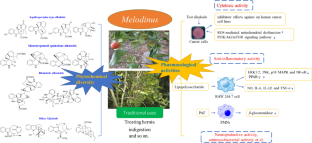
Indole alkaloids are an important group of natural products in the plant kingdom for their diversity structures and significant biological effects on human health. The genus Melodinus (family Apocynaceae) is rich in mono- and bis- indole alkaloids, which have been widely studied for medicinal research. The plants of genus Melodinus are traditionally used for the treatment of hernia, abdominal pain, pediatric malnutrition, indigestion, orchitis, pediatric meningitis, fractures, and rheumatic heart diseases. This article is aimed to provide a comprehensive review on phytochemical diversity of indole alkaloids from the genus Melodinus along with their pharmacological effects. To date, a total of 345 indole alkaloids have been reported from 21 medicinal Melodinus species. These indole alkaloids contain aspidospermine-type, vincadine-type, eburnamine-type, monoterpenoid quinolone-type, bis-indole alkaloids, and so on. And the main skeleton types are aspidospermine-type and monoterpenoid quinolone-type alkaloids. Some of them exhibited cytotoxic, antimicrobial, anti-inflammatory, antifungal, and antioxidant activities. This review presents the structure skeleton, distribution, therapeutic potential and pharmacological activity of indole alkaloids from the Melodinus species, which may promote further development and utilization of Melodinus species.
期刊介绍:
Phytochemistry Reviews is the sole review journal encompassing all facets of phytochemistry. It publishes peer-reviewed papers in six issues annually, including topical issues often stemming from meetings organized by the Phytochemical Society of Europe. Additionally, the journal welcomes original review papers that contribute to advancing knowledge in various aspects of plant chemistry, function, biosynthesis, effects on plant and animal physiology, pathology, and their application in agriculture and industry. Invited meeting papers are supplemented with additional review papers, providing a comprehensive overview of the current status across all areas of phytochemistry.



 京公网安备 11010802042870号
京ICP备2023020795号-1
京公网安备 11010802042870号
京ICP备2023020795号-1

 分享
分享
 求助内容:
求助内容: 应助结果提醒方式:
 扫码关注我们
