{"title":"Planar chromatographic super-hyphenations for rapid dereplication","authors":"Gertrud E. Morlock","doi":"10.1007/s11101-022-09844-x","DOIUrl":null,"url":null,"abstract":"<div><p>Analytical chemistry offers important tools that provide insight and step-by-step understanding. However, natural samples containing many thousands of different compounds are subject to natural variance which makes it complex for artificial intelligence and human understanding. Instead of the prevailing comprehensive separation/detection approach, a prioritization approach is discussed for dereplication that focuses on the most necessary to discover. It is extremely helpful to combine on the same surface two disciplines, <i>i.e.</i> chemistry for separation of mixtures and biology for detection of biological effects, to filter out and prioritize the important compounds that then need to be identified. Complex mixtures are separated in parallel with imaging high-performance thin-layer chromatography, detected non-targeted with planar multiplex bioassays to prioritize compounds and elute the important ones to orthogonal column chromatography−diode array detection−high-resolution mass spectrometry for further characterization. Super-hyphenations reduce thousands of compounds to a manageable number of important active compounds. Its potential lies not only in the prioritization of compounds, but also detection of unknown compounds that were not previously the focus of analysts. An image is worth a thousand words and an effect image even more so. On-surface multiplex bioassays enable the differentiation of opposing signals/effects of compounds in a complex natural sample, which only makes understanding possible. On-surface metabolization enables the study of any changes in the effects through digestion or de-/toxification (S9 liver system). By these new tools applied on the same surface, the mechanisms of action of complex mixtures can be better understood. The latest open-source 2LabsToGo system combines the chemistry and biology laboratory in a miniaturized system developed for wider use of this innovative technique.</p></div>","PeriodicalId":733,"journal":{"name":"Phytochemistry Reviews","volume":"24 1","pages":"1 - 12"},"PeriodicalIF":7.6000,"publicationDate":"2022-11-01","publicationTypes":"Journal Article","fieldsOfStudy":null,"isOpenAccess":false,"openAccessPdf":"https://link.springer.com/content/pdf/10.1007/s11101-022-09844-x.pdf","citationCount":"0","resultStr":null,"platform":"Semanticscholar","paperid":null,"PeriodicalName":"Phytochemistry Reviews","FirstCategoryId":"99","ListUrlMain":"https://link.springer.com/article/10.1007/s11101-022-09844-x","RegionNum":2,"RegionCategory":"生物学","ArticlePicture":[],"TitleCN":null,"AbstractTextCN":null,"PMCID":null,"EPubDate":"","PubModel":"","JCR":"Q1","JCRName":"PLANT SCIENCES","Score":null,"Total":0}
引用次数: 0
Abstract
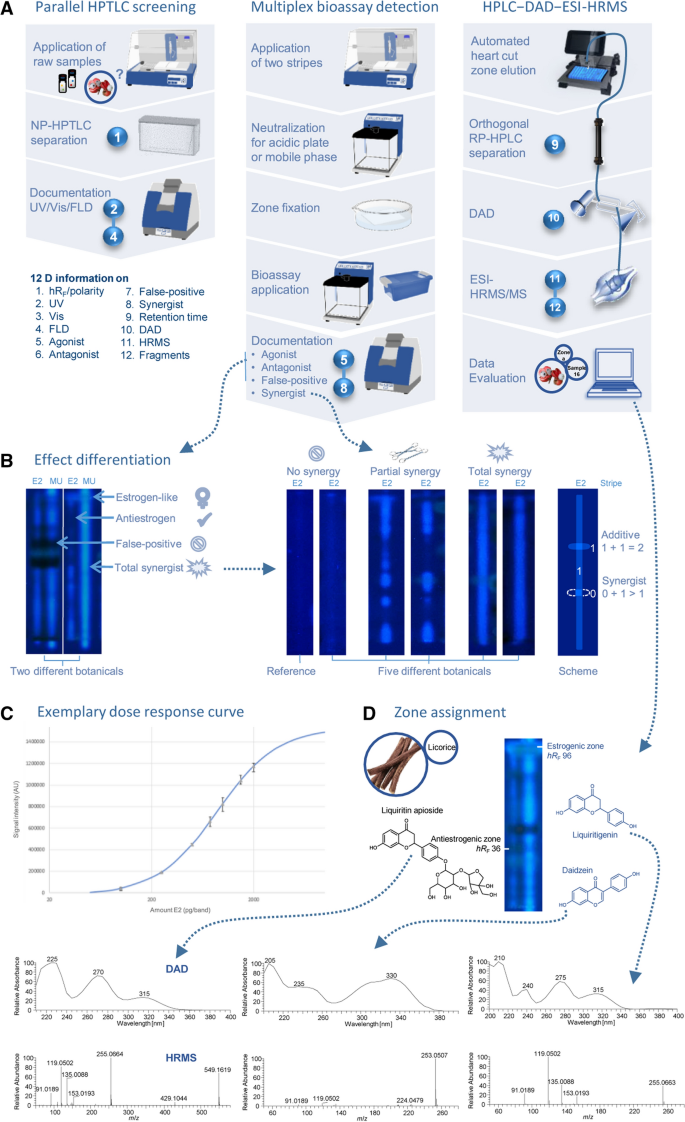
Analytical chemistry offers important tools that provide insight and step-by-step understanding. However, natural samples containing many thousands of different compounds are subject to natural variance which makes it complex for artificial intelligence and human understanding. Instead of the prevailing comprehensive separation/detection approach, a prioritization approach is discussed for dereplication that focuses on the most necessary to discover. It is extremely helpful to combine on the same surface two disciplines, i.e. chemistry for separation of mixtures and biology for detection of biological effects, to filter out and prioritize the important compounds that then need to be identified. Complex mixtures are separated in parallel with imaging high-performance thin-layer chromatography, detected non-targeted with planar multiplex bioassays to prioritize compounds and elute the important ones to orthogonal column chromatography−diode array detection−high-resolution mass spectrometry for further characterization. Super-hyphenations reduce thousands of compounds to a manageable number of important active compounds. Its potential lies not only in the prioritization of compounds, but also detection of unknown compounds that were not previously the focus of analysts. An image is worth a thousand words and an effect image even more so. On-surface multiplex bioassays enable the differentiation of opposing signals/effects of compounds in a complex natural sample, which only makes understanding possible. On-surface metabolization enables the study of any changes in the effects through digestion or de-/toxification (S9 liver system). By these new tools applied on the same surface, the mechanisms of action of complex mixtures can be better understood. The latest open-source 2LabsToGo system combines the chemistry and biology laboratory in a miniaturized system developed for wider use of this innovative technique.
期刊介绍:
Phytochemistry Reviews is the sole review journal encompassing all facets of phytochemistry. It publishes peer-reviewed papers in six issues annually, including topical issues often stemming from meetings organized by the Phytochemical Society of Europe. Additionally, the journal welcomes original review papers that contribute to advancing knowledge in various aspects of plant chemistry, function, biosynthesis, effects on plant and animal physiology, pathology, and their application in agriculture and industry. Invited meeting papers are supplemented with additional review papers, providing a comprehensive overview of the current status across all areas of phytochemistry.



 京公网安备 11010802042870号
京ICP备2023020795号-1
京公网安备 11010802042870号
京ICP备2023020795号-1

 分享
分享
 求助内容:
求助内容: 应助结果提醒方式:
 扫码关注我们
