{"title":"Gyroid-structured nanoporous chitosan from block copolymer template for UVC reflection","authors":"Tze-Chung Lin, Chih-Ying Yang, Tsung-Lun Lee, Jheng-Wei Lin, Yu-Ting Liang, Yi-Ting Xie, Zhi-Hong Xie, Yu-Chueh Hung, Rong-Ming Ho","doi":"10.1038/s41427-022-00440-1","DOIUrl":null,"url":null,"abstract":"Bioinspired from structural coloration of butterfly wing structure, this work aims to fabricate nanoporous chitosan for UVC reflection. By taking advantage of self-assembled polystyrene-b-polydimethylsiloxane (PS-b-PDMS) with double gyroid texture followed by hydrofluoric acid etching of PDMS block, nanoporous PS with well-defined nanochannels can be fabricated, and used as a template for templated crosslinking reaction of chitosan through a multiple pore-filling process. Well-ordered nanoporous chitosan with shifting networks in nanoscale can be successfully fabricated after removal of the PS template. With the low absorption of chitosan in the ultraviolet region and the shifting networks for opening the bandgap, it is appealing to exploit the nanonetwork chitosan as high reflective materials for UVC optical devices, as evidenced by finite-difference time-domain (FDTD) simulation and optical measurements experimentally. Gyroid-structured nanoporous chitosan is successfully fabricated by templated crosslinking reaction using nanoporous polymer as a template. A multiple pore-filling process is developed for templated synthesis to give well-ordered nanoporous chitosan. Bio-mimicking from the structural coloration of butterfly wing structure, the nanoporous chitosan with gyroid texture is highly appealing in the application of high reflective materials for UV optical devices.","PeriodicalId":19382,"journal":{"name":"Npg Asia Materials","volume":"15 1","pages":"1-9"},"PeriodicalIF":8.3000,"publicationDate":"2023-03-31","publicationTypes":"Journal Article","fieldsOfStudy":null,"isOpenAccess":false,"openAccessPdf":"https://www.nature.com/articles/s41427-022-00440-1.pdf","citationCount":"0","resultStr":null,"platform":"Semanticscholar","paperid":null,"PeriodicalName":"Npg Asia Materials","FirstCategoryId":"88","ListUrlMain":"https://www.nature.com/articles/s41427-022-00440-1","RegionNum":2,"RegionCategory":"材料科学","ArticlePicture":[],"TitleCN":null,"AbstractTextCN":null,"PMCID":null,"EPubDate":"","PubModel":"","JCR":"Q1","JCRName":"MATERIALS SCIENCE, MULTIDISCIPLINARY","Score":null,"Total":0}
引用次数: 0
Abstract
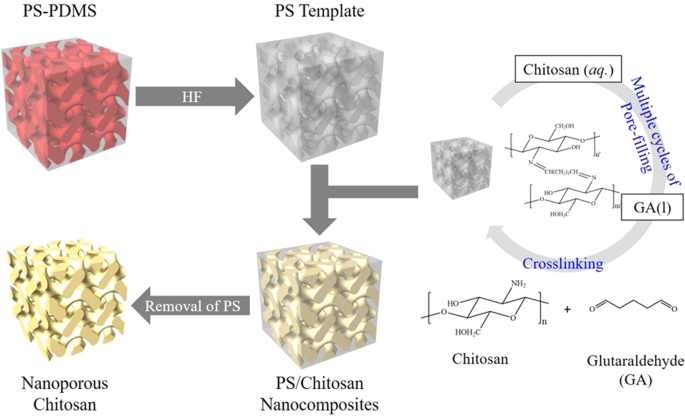
Bioinspired from structural coloration of butterfly wing structure, this work aims to fabricate nanoporous chitosan for UVC reflection. By taking advantage of self-assembled polystyrene-b-polydimethylsiloxane (PS-b-PDMS) with double gyroid texture followed by hydrofluoric acid etching of PDMS block, nanoporous PS with well-defined nanochannels can be fabricated, and used as a template for templated crosslinking reaction of chitosan through a multiple pore-filling process. Well-ordered nanoporous chitosan with shifting networks in nanoscale can be successfully fabricated after removal of the PS template. With the low absorption of chitosan in the ultraviolet region and the shifting networks for opening the bandgap, it is appealing to exploit the nanonetwork chitosan as high reflective materials for UVC optical devices, as evidenced by finite-difference time-domain (FDTD) simulation and optical measurements experimentally. Gyroid-structured nanoporous chitosan is successfully fabricated by templated crosslinking reaction using nanoporous polymer as a template. A multiple pore-filling process is developed for templated synthesis to give well-ordered nanoporous chitosan. Bio-mimicking from the structural coloration of butterfly wing structure, the nanoporous chitosan with gyroid texture is highly appealing in the application of high reflective materials for UV optical devices.
期刊介绍:
NPG Asia Materials is an open access, international journal that publishes peer-reviewed review and primary research articles in the field of materials sciences. The journal has a global outlook and reach, with a base in the Asia-Pacific region to reflect the significant and growing output of materials research from this area. The target audience for NPG Asia Materials is scientists and researchers involved in materials research, covering a wide range of disciplines including physical and chemical sciences, biotechnology, and nanotechnology. The journal particularly welcomes high-quality articles from rapidly advancing areas that bridge the gap between materials science and engineering, as well as the classical disciplines of physics, chemistry, and biology. NPG Asia Materials is abstracted/indexed in Journal Citation Reports/Science Edition Web of Knowledge, Google Scholar, Chemical Abstract Services, Scopus, Ulrichsweb (ProQuest), and Scirus.




 京公网安备 11010802042870号
京ICP备2023020795号-1
京公网安备 11010802042870号
京ICP备2023020795号-1

 分享
分享
 求助内容:
求助内容: 应助结果提醒方式:
 扫码关注我们
