{"title":"The (mis)understood image of the Korean students: how do high-achieving college students navigate their college experiences?","authors":"Yeseul Choi, So Hee Hyun, Seunghyeop Lee","doi":"10.1007/s12564-023-09878-6","DOIUrl":null,"url":null,"abstract":"<div><p>In higher education research, it is critical to identify and explore factors, experiences, and institutional environments influencing students’ academic performance and success. Korean students have the international image as higher achievers and a model minority in their academic performance, and several studies have explained that the characteristics of Confucian heritage culture widely influence students’ passive learning approach in Korea and other regions of Asia. While previous research on high-achieving Korean students in higher education highlighted the narrow side of learning strategies inside the classroom, this study explored how high-achieving college students navigate their college experience inside and outside of the campus in a top elite Korean university by applying a convergent parallel mixed-method approach. In the quantitative analysis results, there were statistically significant differences between the high-GPA group and middle- and low-GPA groups. The high-achieving college students not only focused more on research and academic activities but also put more academic effort into their college courses, connected learning experiences, and applied knowledge in various disciplines. Furthermore, in the qualitative analysis findings, the high-achieving students were deeply academic oriented in navigating college experiences. They were not only mobilizing knowledge resources and spaces but also maximizing individual viability to accomplish goals. These findings expanded our perspectives on understanding the college experiences of high-achieving students in-depth and explained the process of how a student who entered a university as a knowledge receiver becomes an independent knowledge agent through college experiences.</p></div>","PeriodicalId":47344,"journal":{"name":"Asia Pacific Education Review","volume":"26 1","pages":"61 - 74"},"PeriodicalIF":2.3000,"publicationDate":"2023-06-30","publicationTypes":"Journal Article","fieldsOfStudy":null,"isOpenAccess":false,"openAccessPdf":"","citationCount":"0","resultStr":null,"platform":"Semanticscholar","paperid":null,"PeriodicalName":"Asia Pacific Education Review","FirstCategoryId":"95","ListUrlMain":"https://link.springer.com/article/10.1007/s12564-023-09878-6","RegionNum":3,"RegionCategory":"教育学","ArticlePicture":[],"TitleCN":null,"AbstractTextCN":null,"PMCID":null,"EPubDate":"","PubModel":"","JCR":"Q1","JCRName":"EDUCATION & EDUCATIONAL RESEARCH","Score":null,"Total":0}
引用次数: 0
Abstract
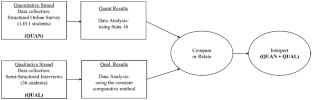
In higher education research, it is critical to identify and explore factors, experiences, and institutional environments influencing students’ academic performance and success. Korean students have the international image as higher achievers and a model minority in their academic performance, and several studies have explained that the characteristics of Confucian heritage culture widely influence students’ passive learning approach in Korea and other regions of Asia. While previous research on high-achieving Korean students in higher education highlighted the narrow side of learning strategies inside the classroom, this study explored how high-achieving college students navigate their college experience inside and outside of the campus in a top elite Korean university by applying a convergent parallel mixed-method approach. In the quantitative analysis results, there were statistically significant differences between the high-GPA group and middle- and low-GPA groups. The high-achieving college students not only focused more on research and academic activities but also put more academic effort into their college courses, connected learning experiences, and applied knowledge in various disciplines. Furthermore, in the qualitative analysis findings, the high-achieving students were deeply academic oriented in navigating college experiences. They were not only mobilizing knowledge resources and spaces but also maximizing individual viability to accomplish goals. These findings expanded our perspectives on understanding the college experiences of high-achieving students in-depth and explained the process of how a student who entered a university as a knowledge receiver becomes an independent knowledge agent through college experiences.
期刊介绍:
The Asia Pacific Education Review (APER) aims to stimulate research, encourage academic exchange, and enhance the professional development of scholars and other researchers who are interested in educational and cultural issues in the Asia Pacific region. APER covers all areas of educational research, with a focus on cross-cultural, comparative and other studies with a broad Asia-Pacific context.
APER is a peer reviewed journal produced by the Education Research Institute at Seoul National University. It was founded by the Institute of Asia Pacific Education Development, Seoul National University in 2000, which is owned and operated by Education Research Institute at Seoul National University since 2003.
APER requires all submitted manuscripts to follow the seventh edition of the Publication Manual of the American Psychological Association (APA; http://www.apastyle.org/index.aspx).




 京公网安备 11010802042870号
京ICP备2023020795号-1
京公网安备 11010802042870号
京ICP备2023020795号-1

 分享
分享
 求助内容:
求助内容: 应助结果提醒方式:
 扫码关注我们
