Enzyme-assisted HPTLC method for the simultaneous analysis of inositol phosphates and phosphate

IF 1.1 JSFA reports Pub Date : 2023-03-15 DOI:10.1002/jsf2.109
Corinna Henninger, Bernd Spangenberg, Mario Schmidt, Katrin Ochsenreither, Thomas Eisele
{"title":"Enzyme-assisted HPTLC method for the simultaneous analysis of inositol phosphates and phosphate","authors":"Corinna Henninger,&nbsp;Bernd Spangenberg,&nbsp;Mario Schmidt,&nbsp;Katrin Ochsenreither,&nbsp;Thomas Eisele","doi":"10.1002/jsf2.109","DOIUrl":null,"url":null,"abstract":"<div>\n \n \n <section>\n \n <h3> Background</h3>\n \n <p>The analysis of myo-inositol phosphates (InsP<sub>x</sub>) released by phytases during phytic acid degradation is challenging and time-consuming, particularly in terms of sample preparation, isomer separation, and detection. However, a fast and robust analysis method is crucial when screening for phytases during protein engineering approaches, which result in a large number of samples, to ensure reliable identification of promising novel enzymes or target variants with improved characteristics, for example, pH range, thermal stability, and phosphate release kinetics.</p>\n </section>\n \n <section>\n \n <h3> Results</h3>\n \n <p>The simultaneous analysis of several InsP<sub>x</sub> (InsP<sub>1</sub>-InsP<sub>4</sub> and InsP<sub>5 + 6</sub>) as well as free phosphate was established on cellulose HPTLC plates using a buffered mobile phase. Inositol phosphates were subsequently stained using a novel enzyme-assisted staining procedure. Immobilized InsP<sub>x</sub> were hydrolyzed by a phytase solution of Quantum® Blue<sub>liquid</sub> 5G followed by a molybdate reagent derivatization. Resulting blue zones were captured by DAD scan. The method shows good repeatability (intra-day and intra-lab) with maximum deviations of the Rf value of 0.01. The HPTLC method was applied to three commercially available phytases at two pH levels relevant to the gastrointestinal tract of poultry (pH 5.5 and pH 3.6) to observe their phytate degradation pattern and thus visualize their InsP<sub>x</sub> fingerprint.</p>\n </section>\n \n <section>\n \n <h3> Conclusion</h3>\n \n <p>This HPTLC method presents a semi-high-throughput analysis for the simultaneous analysis of phytic acid and the resulting lower inositol phosphates after its enzymatic hydrolysis and is also an effective tool to visualize the InsP<sub>x</sub> fingerprints and possible accumulations of inositol phosphates.</p>\n </section>\n </div>","PeriodicalId":93795,"journal":{"name":"JSFA reports","volume":"3 4","pages":"170-179"},"PeriodicalIF":1.1000,"publicationDate":"2023-03-15","publicationTypes":"Journal Article","fieldsOfStudy":null,"isOpenAccess":false,"openAccessPdf":"https://onlinelibrary.wiley.com/doi/epdf/10.1002/jsf2.109","citationCount":"1","resultStr":null,"platform":"Semanticscholar","paperid":null,"PeriodicalName":"JSFA reports","FirstCategoryId":"1085","ListUrlMain":"https://onlinelibrary.wiley.com/doi/10.1002/jsf2.109","RegionNum":0,"RegionCategory":null,"ArticlePicture":[],"TitleCN":null,"AbstractTextCN":null,"PMCID":null,"EPubDate":"","PubModel":"","JCR":"","JCRName":"","Score":null,"Total":0}
引用次数: 1

Abstract

Background

The analysis of myo-inositol phosphates (InsPx) released by phytases during phytic acid degradation is challenging and time-consuming, particularly in terms of sample preparation, isomer separation, and detection. However, a fast and robust analysis method is crucial when screening for phytases during protein engineering approaches, which result in a large number of samples, to ensure reliable identification of promising novel enzymes or target variants with improved characteristics, for example, pH range, thermal stability, and phosphate release kinetics.

Results

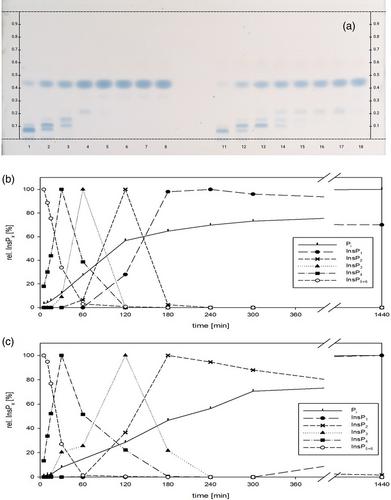
The simultaneous analysis of several InsPx (InsP1-InsP4 and InsP5 + 6) as well as free phosphate was established on cellulose HPTLC plates using a buffered mobile phase. Inositol phosphates were subsequently stained using a novel enzyme-assisted staining procedure. Immobilized InsPx were hydrolyzed by a phytase solution of Quantum® Blueliquid 5G followed by a molybdate reagent derivatization. Resulting blue zones were captured by DAD scan. The method shows good repeatability (intra-day and intra-lab) with maximum deviations of the Rf value of 0.01. The HPTLC method was applied to three commercially available phytases at two pH levels relevant to the gastrointestinal tract of poultry (pH 5.5 and pH 3.6) to observe their phytate degradation pattern and thus visualize their InsPx fingerprint.

Conclusion

This HPTLC method presents a semi-high-throughput analysis for the simultaneous analysis of phytic acid and the resulting lower inositol phosphates after its enzymatic hydrolysis and is also an effective tool to visualize the InsPx fingerprints and possible accumulations of inositol phosphates.

Abstract Image

查看原文
分享 分享
微信好友 朋友圈 QQ好友 复制链接
本刊更多论文
酶辅助HPTLC法同时分析肌醇磷酸和磷酸
植酸降解过程中由植酸酶释放的肌醇磷酸(InsPx)的分析是具有挑战性和耗时的,特别是在样品制备、异构体分离和检测方面。然而,在蛋白质工程方法中筛选植酸酶时,快速和强大的分析方法至关重要,这将导致大量的样品,以确保可靠地鉴定有前途的新酶或具有改进特性的靶变异体,例如pH范围,热稳定性和磷酸盐释放动力学。结果采用缓冲流动相,在纤维素HPTLC板上建立了多种InsPx (InsP1-InsP4和InsP5 + 6)和游离磷酸盐的同时分析方法。肌醇磷酸随后用一种新的酶辅助染色方法染色。固定化的InsPx用Quantum®Blueliquid 5G植酸酶溶液水解,然后用钼酸盐试剂衍生化。由此产生的蓝色区域被DAD扫描捕获。该方法重复性好(日间和实验室内),Rf值的最大偏差为0.01。采用HPTLC方法对3种市售植酸酶在与家禽胃肠道相关的两种pH水平(pH 5.5和pH 3.6)下的植酸酶进行分析,观察其植酸降解模式,并绘制其InsPx指纹图谱。结论该方法为同时分析植酸及其酶解后所得的低磷酸肌醇提供了半高通量分析方法,同时也是可视化insx指纹图谱和可能积累的磷酸肌醇的有效工具。
本文章由计算机程序翻译,如有差异,请以英文原文为准。
求助全文
约1分钟内获得全文 去求助
来源期刊
自引率
0.00%
发文量
0
期刊最新文献
Issue Information Issue Information Issue Information Note on pepper pungency and environmental stress Onion extract and grape seed powder as antioxidants to improve growth: Evidence from studies with oxidative stressed intestinal and liver cells as well as growing broilers
×
引用
GB/T 7714-2015
复制
MLA
复制
APA
复制
导出至
BibTeX EndNote RefMan NoteFirst NoteExpress
×
×
提示
您的信息不完整,为了账户安全,请先补充。
现在去补充
×
提示
您因"违规操作"
具体请查看互助需知
我知道了
×
提示
现在去查看 取消
×
提示
确定
0
微信
客服QQ
Book学术公众号 扫码关注我们
反馈
×
意见反馈
请填写您的意见或建议
请填写您的手机或邮箱
已复制链接
已复制链接
快去分享给好友吧!
我知道了
×
扫码分享
扫码分享
Book学术官方微信
Book学术文献互助
Book学术文献互助群
群 号:604180095
Book学术
文献互助 智能选刊 最新文献 互助须知 联系我们:info@booksci.cn
Book学术提供免费学术资源搜索服务,方便国内外学者检索中英文文献。致力于提供最便捷和优质的服务体验。
Copyright © 2023 Book学术 All rights reserved.
ghs 京公网安备 11010802042870号 京ICP备2023020795号-1





