Multi-material laser powder bed fusion additive manufacturing of concentrated wound stator teeth

IF 4.7 Q2 ENGINEERING, MANUFACTURING Additive manufacturing letters Pub Date : 2023-07-27 DOI:10.1016/j.addlet.2023.100165
Marcus Oel , Johannes Rossmann , Behrend Bode , Ina Meyer , Tobias Ehlers , Christoph M. Hackl , Roland Lachmayer
{"title":"Multi-material laser powder bed fusion additive manufacturing of concentrated wound stator teeth","authors":"Marcus Oel ,&nbsp;Johannes Rossmann ,&nbsp;Behrend Bode ,&nbsp;Ina Meyer ,&nbsp;Tobias Ehlers ,&nbsp;Christoph M. Hackl ,&nbsp;Roland Lachmayer","doi":"10.1016/j.addlet.2023.100165","DOIUrl":null,"url":null,"abstract":"<div><p>Additive manufacturing using Powder Bed Fusion by Laser Beam (PBF-LB) enables products with high design freedom. In addition, the ability to process more than one material in all three spatial directions makes it possible to produce highly functional components in one single process. This article investigates whether multi-material manufacturing using PBF-LB is suitable for producing coils for electric motors, which are designed with integrated cooling channels to increase the power density. For this purpose, the copper alloy CuCr1Zr for the coils and the stainless steel 1.4404 (316L) for the core are processed simultaneously. The component designs were verified using 2D and 3D finite element analysis and then manufactured in a multi-material PBF-LB process. While good electrical conductivity of the copper alloy was achieved by heat treatment, it was found that thermal distortion caused deviations from the nominal geometry. The measurement of the electrical properties showed that this distortion leads to short-circuit currents within the coils and the teeth. On this basis, ideas for solutions were developed, with the help of which the functionality of the coils can be ensured or the power density can also be increased. In addition to adapting the design of the component, this includes processing additional or other materials, such as soft magnetic composites.</p></div>","PeriodicalId":72068,"journal":{"name":"Additive manufacturing letters","volume":"7 ","pages":"Article 100165"},"PeriodicalIF":4.7000,"publicationDate":"2023-07-27","publicationTypes":"Journal Article","fieldsOfStudy":null,"isOpenAccess":false,"openAccessPdf":"","citationCount":"1","resultStr":null,"platform":"Semanticscholar","paperid":null,"PeriodicalName":"Additive manufacturing letters","FirstCategoryId":"1085","ListUrlMain":"https://www.sciencedirect.com/science/article/pii/S2772369023000440","RegionNum":0,"RegionCategory":null,"ArticlePicture":[],"TitleCN":null,"AbstractTextCN":null,"PMCID":null,"EPubDate":"","PubModel":"","JCR":"Q2","JCRName":"ENGINEERING, MANUFACTURING","Score":null,"Total":0}
引用次数: 1

Abstract

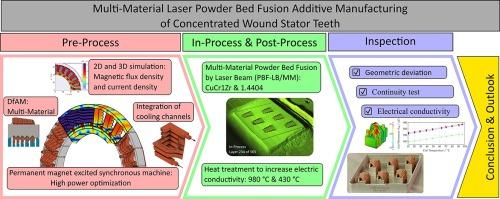
Additive manufacturing using Powder Bed Fusion by Laser Beam (PBF-LB) enables products with high design freedom. In addition, the ability to process more than one material in all three spatial directions makes it possible to produce highly functional components in one single process. This article investigates whether multi-material manufacturing using PBF-LB is suitable for producing coils for electric motors, which are designed with integrated cooling channels to increase the power density. For this purpose, the copper alloy CuCr1Zr for the coils and the stainless steel 1.4404 (316L) for the core are processed simultaneously. The component designs were verified using 2D and 3D finite element analysis and then manufactured in a multi-material PBF-LB process. While good electrical conductivity of the copper alloy was achieved by heat treatment, it was found that thermal distortion caused deviations from the nominal geometry. The measurement of the electrical properties showed that this distortion leads to short-circuit currents within the coils and the teeth. On this basis, ideas for solutions were developed, with the help of which the functionality of the coils can be ensured or the power density can also be increased. In addition to adapting the design of the component, this includes processing additional or other materials, such as soft magnetic composites.

Abstract Image

查看原文
分享 分享
微信好友 朋友圈 QQ好友 复制链接
本刊更多论文
多材料激光粉末床融合增材制造集中缠绕定子齿
使用激光粉末床融合(PBF-LB)的增材制造使产品具有高设计自由度。此外,在所有三个空间方向上加工一种以上材料的能力使得在单一工艺中生产高功能部件成为可能。本文研究了PBF-LB多材料制造是否适用于电机线圈的生产,这些线圈设计有集成的冷却通道以提高功率密度。为此,线圈的铜合金CuCr1Zr和铁芯的不锈钢1.4404 (316L)同时加工。通过二维和三维有限元分析验证了零件设计,然后在多材料PBF-LB工艺中制造。虽然铜合金通过热处理获得了良好的导电性,但发现热变形导致了与标称几何形状的偏差。电学性能的测量表明,这种变形导致线圈和齿内的短路电流。在此基础上,开发了解决方案的想法,借助它可以确保线圈的功能或也可以增加功率密度。除了适应组件的设计外,这还包括加工其他材料,如软磁复合材料。
本文章由计算机程序翻译,如有差异,请以英文原文为准。
求助全文
约1分钟内获得全文 去求助
来源期刊
Additive manufacturing letters
Additive manufacturing letters Materials Science (General), Industrial and Manufacturing Engineering, Mechanics of Materials
CiteScore
3.70
自引率
0.00%
发文量
0
审稿时长
37 days
期刊最新文献
Agentic additive manufacturing alloy evaluation Effect of TiN nanoparticle on shape memory properties of additively manufactured ferrous high entropy shape memory alloy Approximation of absorptivity conditions for Inconel 625 from in situ radiation thermometry measurements in electron beam powder bed fusion Friction-induced distortion in binder jetted 316 L stainless steel: Experimental analysis, simulation, and compensation strategy Mechanical properties and strain localization of WA-DED printed P91 steel
×
引用
GB/T 7714-2015
复制
MLA
复制
APA
复制
导出至
BibTeX EndNote RefMan NoteFirst NoteExpress
×
×
提示
您的信息不完整,为了账户安全,请先补充。
现在去补充
×
提示
您因"违规操作"
具体请查看互助需知
我知道了
×
提示
现在去查看 取消
×
提示
确定
0
微信
客服QQ
Book学术公众号 扫码关注我们
反馈
×
意见反馈
请填写您的意见或建议
请填写您的手机或邮箱
已复制链接
已复制链接
快去分享给好友吧!
我知道了
×
扫码分享
扫码分享
Book学术官方微信
Book学术文献互助
Book学术文献互助群
群 号:604180095
Book学术
文献互助 智能选刊 最新文献 互助须知 联系我们:info@booksci.cn
Book学术提供免费学术资源搜索服务,方便国内外学者检索中英文文献。致力于提供最便捷和优质的服务体验。
Copyright © 2023 Book学术 All rights reserved.
ghs 京公网安备 11010802042870号 京ICP备2023020795号-1





