{"title":"Infections associated with SARS-CoV-2 exploited via nanoformulated photodynamic therapy.","authors":"Pragya Pallavi, Karthick Harini, Noureddine Elboughdiri, Pemula Gowtham, Koyeli Girigoswami, Agnishwar Girigoswami","doi":"10.5599/admet.1883","DOIUrl":null,"url":null,"abstract":"<p><strong>Background and purpose: </strong>The pandemic of COVID-19 has highlighted the need for managing infectious diseases, which spreads by airborne transmission leading to serious health, social, and economic issues. SARS-CoV-2 is an enveloped virus with a 60-140 nm diameter and particle-like features, which majorly accounts for this disease. Expanding diagnostic capabilities, developing safe vaccinations with long-lasting immunity, and formulating effective medications are the strategies to be investigated.</p><p><strong>Experimental approach: </strong>For the literature search, electronic databases such as Scopus, Google Scholar, MEDLINE, Embase, PubMed, and Web of Science were used as the source. Search terms like 'Nano-mediated PDT,' 'PDT for SARS-CoV-2', and 'Nanotechnology in treatment for SARS-CoV-2' were used. Out of 275 initially selected articles, 198 were chosen after the abstract screening. During the full-text screening, 80 papers were excluded, and 18 were eliminated during data extraction. Preference was given to articles published from 2018 onwards, but a few older references were cited for their valuable information.</p><p><strong>Key results: </strong>Synthetic nanoparticles (NPs) have a close structural resemblance to viruses and interact greatly with their proteins due to their similarities in the configurations. NPs had previously been reported to be effective against a variety of viruses. In this way, with nanoparticles, photodynamic therapy (PDT) can be a viable alternative to antibiotics in fighting against microbial infections. The protocol of PDT includes the activation of photosensitizers using specific light to destroy microorganisms in the presence of oxygen, treating several respiratory diseases.</p><p><strong>Conclusion: </strong>The use of PDT in treating COVID-19 requires intensive investigations, which has been reviewed in this manuscript, including a computational approach to formulating effective photosensitizers.</p>","PeriodicalId":3,"journal":{"name":"ACS Applied Electronic Materials","volume":" ","pages":"513-531"},"PeriodicalIF":4.7000,"publicationDate":"2023-07-01","publicationTypes":"Journal Article","fieldsOfStudy":null,"isOpenAccess":false,"openAccessPdf":"https://www.ncbi.nlm.nih.gov/pmc/articles/PMC10626507/pdf/","citationCount":"0","resultStr":null,"platform":"Semanticscholar","paperid":null,"PeriodicalName":"ACS Applied Electronic Materials","FirstCategoryId":"1085","ListUrlMain":"https://doi.org/10.5599/admet.1883","RegionNum":3,"RegionCategory":"材料科学","ArticlePicture":[],"TitleCN":null,"AbstractTextCN":null,"PMCID":null,"EPubDate":"2023/1/1 0:00:00","PubModel":"eCollection","JCR":"Q1","JCRName":"ENGINEERING, ELECTRICAL & ELECTRONIC","Score":null,"Total":0}
引用次数: 0
Abstract
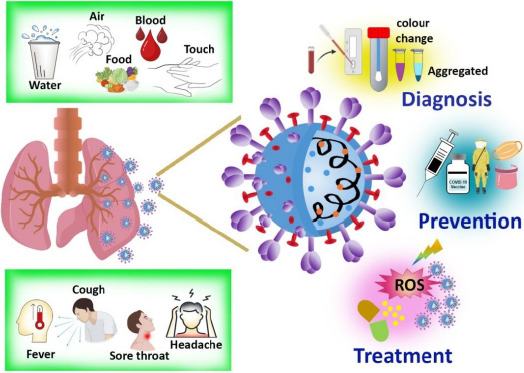
Background and purpose: The pandemic of COVID-19 has highlighted the need for managing infectious diseases, which spreads by airborne transmission leading to serious health, social, and economic issues. SARS-CoV-2 is an enveloped virus with a 60-140 nm diameter and particle-like features, which majorly accounts for this disease. Expanding diagnostic capabilities, developing safe vaccinations with long-lasting immunity, and formulating effective medications are the strategies to be investigated.
Experimental approach: For the literature search, electronic databases such as Scopus, Google Scholar, MEDLINE, Embase, PubMed, and Web of Science were used as the source. Search terms like 'Nano-mediated PDT,' 'PDT for SARS-CoV-2', and 'Nanotechnology in treatment for SARS-CoV-2' were used. Out of 275 initially selected articles, 198 were chosen after the abstract screening. During the full-text screening, 80 papers were excluded, and 18 were eliminated during data extraction. Preference was given to articles published from 2018 onwards, but a few older references were cited for their valuable information.
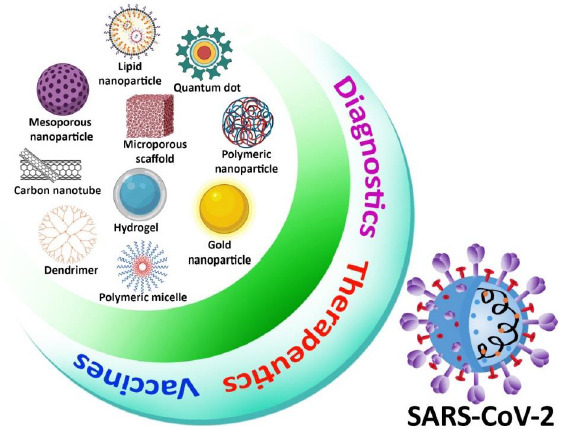
Key results: Synthetic nanoparticles (NPs) have a close structural resemblance to viruses and interact greatly with their proteins due to their similarities in the configurations. NPs had previously been reported to be effective against a variety of viruses. In this way, with nanoparticles, photodynamic therapy (PDT) can be a viable alternative to antibiotics in fighting against microbial infections. The protocol of PDT includes the activation of photosensitizers using specific light to destroy microorganisms in the presence of oxygen, treating several respiratory diseases.
Conclusion: The use of PDT in treating COVID-19 requires intensive investigations, which has been reviewed in this manuscript, including a computational approach to formulating effective photosensitizers.
背景和目的:新冠肺炎的大流行突出了管理传染病的必要性,传染病通过空气传播,导致严重的健康、社会和经济问题。严重急性呼吸系统综合征冠状病毒2型是一种直径为60–140纳米的包膜病毒,具有颗粒状特征,这是该疾病的主要原因。扩大诊断能力,开发具有长期免疫力的安全疫苗,以及制定有效的药物是需要研究的策略。实验方法:文献检索以Scopus、Google Scholar、MEDLINE、Embase、PubMed和Web of Science等电子数据库为来源。使用了“纳米介导PDT”、“严重急性呼吸系统综合征冠状病毒2型的PDT”和“治疗严重急性呼吸系综合征冠状病毒2中的纳米技术”等搜索术语。在最初选择的275篇文章中,198篇是在摘要筛选后选择的。在全文筛选过程中,80篇论文被排除,18篇论文在数据提取过程中被排除。从2018年起发表的文章被优先考虑,但一些较旧的参考文献因其有价值的信息而被引用。关键结果:合成纳米颗粒(NP)与病毒有着密切的结构相似性,由于其结构相似,因此与蛋白质的相互作用很大。NPs以前曾被报道对多种病毒有效。通过这种方式,有了纳米颗粒,光动力疗法(PDT)可以成为对抗微生物感染的抗生素的可行替代品。PDT的方案包括使用特定的光激活光敏剂,在氧气存在的情况下摧毁微生物,治疗几种呼吸道疾病。结论:PDT在治疗新冠肺炎中的应用需要深入研究,本文对其进行了综述,包括配制有效光敏剂的计算方法。
期刊介绍:
ACS Applied Electronic Materials is an interdisciplinary journal publishing original research covering all aspects of electronic materials. The journal is devoted to reports of new and original experimental and theoretical research of an applied nature that integrate knowledge in the areas of materials science, engineering, optics, physics, and chemistry into important applications of electronic materials. Sample research topics that span the journal's scope are inorganic, organic, ionic and polymeric materials with properties that include conducting, semiconducting, superconducting, insulating, dielectric, magnetic, optoelectronic, piezoelectric, ferroelectric and thermoelectric.
Indexed/Abstracted:
Web of Science SCIE
Scopus
CAS
INSPEC
Portico





 京公网安备 11010802042870号
京ICP备2023020795号-1
京公网安备 11010802042870号
京ICP备2023020795号-1

 分享
分享
 求助内容:
求助内容: 应助结果提醒方式:
 扫码关注我们
