{"title":"FKBP8, a new member of the PIK3C3/VPS34 complex.","authors":"Milton Osmar Aguilera, María Isabel Colombo","doi":"10.1080/27694127.2022.2100041","DOIUrl":null,"url":null,"abstract":"<p><p>Macroautophagy/autophagy is an adaptable pathway involved in the degradation of very different targets that include proteins, organelles, or even invading intracellular microorganisms. The regulation of this complex pathway depends on a great number of proteins, some common for the majority of the processes and others specific for a particular autophagic event. Nevertheless, the kind of interaction between the players contributes to determining the specificity of the regulation. In a recent study, we found a new regulatory protein of starvation-activated autophagy called FKBP8. The absence of this protein impairs autophagy activation produced by serum starvation and its overexpression can activate the pathway in cells incubated in full media. Besides, we found that the FKBP8 function is mediated by the interaction with the PIK3C3/VPS34-containing complex. Previously, FKBP8 has been shown to participate in mitophagy. In the latter process, FKBP8 works inducing mitochondrial fission, and also it functions as a receptor protein through its LIR domain to direct autophagy. In contrast to mitophagy, in starvation-activated autophagy, not the LIR but the transmembrane domain of FKBP8 is necessary for the regulatory function and interaction with the PIK3C3 complex.</p>","PeriodicalId":72341,"journal":{"name":"Autophagy reports","volume":" ","pages":"291-294"},"PeriodicalIF":0.0000,"publicationDate":"2022-07-21","publicationTypes":"Journal Article","fieldsOfStudy":null,"isOpenAccess":false,"openAccessPdf":"https://www.ncbi.nlm.nih.gov/pmc/articles/PMC11864611/pdf/","citationCount":"0","resultStr":null,"platform":"Semanticscholar","paperid":null,"PeriodicalName":"Autophagy reports","FirstCategoryId":"1085","ListUrlMain":"https://doi.org/10.1080/27694127.2022.2100041","RegionNum":0,"RegionCategory":null,"ArticlePicture":[],"TitleCN":null,"AbstractTextCN":null,"PMCID":null,"EPubDate":"2022/1/1 0:00:00","PubModel":"eCollection","JCR":"","JCRName":"","Score":null,"Total":0}
引用次数: 0
Abstract
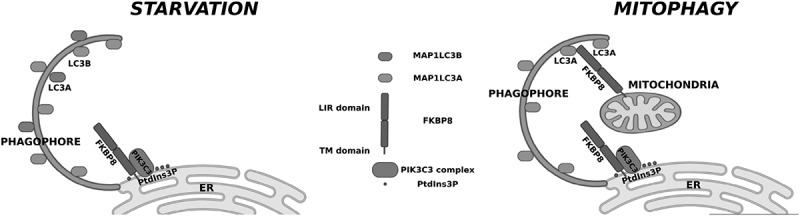
Macroautophagy/autophagy is an adaptable pathway involved in the degradation of very different targets that include proteins, organelles, or even invading intracellular microorganisms. The regulation of this complex pathway depends on a great number of proteins, some common for the majority of the processes and others specific for a particular autophagic event. Nevertheless, the kind of interaction between the players contributes to determining the specificity of the regulation. In a recent study, we found a new regulatory protein of starvation-activated autophagy called FKBP8. The absence of this protein impairs autophagy activation produced by serum starvation and its overexpression can activate the pathway in cells incubated in full media. Besides, we found that the FKBP8 function is mediated by the interaction with the PIK3C3/VPS34-containing complex. Previously, FKBP8 has been shown to participate in mitophagy. In the latter process, FKBP8 works inducing mitochondrial fission, and also it functions as a receptor protein through its LIR domain to direct autophagy. In contrast to mitophagy, in starvation-activated autophagy, not the LIR but the transmembrane domain of FKBP8 is necessary for the regulatory function and interaction with the PIK3C3 complex.




 京公网安备 11010802042870号
京ICP备2023020795号-1
京公网安备 11010802042870号
京ICP备2023020795号-1

 分享
分享

 求助内容:
求助内容: 应助结果提醒方式:
 扫码关注我们
