Meghan O'Hearn, Julia Reedy, Ella Robinson, Christina Economos, John B Wong, Gary Sacks, Dariush Mozaffarian
{"title":"Landscape analysis of environmental, social and governance (ESG) investing metrics for consumer nutrition and health in the food and beverage sector.","authors":"Meghan O'Hearn, Julia Reedy, Ella Robinson, Christina Economos, John B Wong, Gary Sacks, Dariush Mozaffarian","doi":"10.1136/bmjnph-2022-000600","DOIUrl":null,"url":null,"abstract":"<p><strong>Introduction: </strong>The private sector plays a critical role in influencing food choices and health outcomes of consumers. Among private sector actors, investors are a powerful yet underutilised stakeholder for driving scalable public health impact. There are systems to facilitate investors' involvement, notably environmental, social and governance (ESG) investing, which is well placed to include an assessment of business risks to social well-being. However, nutrition efforts within the ESG agenda (ESG-Nutrition) are nascent. We aimed to critically assess the strength of existing ESG-Nutrition metrics to advance the science of measuring business impacts on consumer nutrition and health.</p><p><strong>Methods: </strong>ESG-Nutrition metrics were extracted from eight ESG frameworks and categorised across four domains: product portfolio healthfulness; product distribution and equity; product marketing and labelling; and nutrition-related governance. The strength of each metric was evaluated and scored 1-3 (best), independently by two researchers, based on six attributes: materiality, objectivity, alignment, activity, resolution and verifiability. The total score (range 6-18) and intercorrelation for each attribute was calculated.</p><p><strong>Results: </strong>Across 529 metrics, most related to product marketing and labelling (n=230, 43.5%), followed by product healthfulness (n=126, 23.8%), nutrition-related governance (n=108, 20.4%) and product distribution and equity (n=65, 12.3%). Across all metrics, average total score was 10.94 (1.58), with average attribute scoring highest for verifiability (mean: 2.36 (SD: 0.57)), objectivity (2.11 (0.61)) and materiality (2.01 (0.68)) and lowest for activity (1.83 (0.74)), alignment (1.37 (0.67)) and resolution (1.26 (0.65)). Most intercorrelations were null, suggesting attributes were measuring distinct characteristics of each metric. Significant heterogeneity across domains and frameworks was also observed.</p><p><strong>Conclusions: </strong>This research identifies a range of nutrition-related metrics used in ESG frameworks with respect to food companies, but with substantial heterogeneity in relevant nutrition domains covered and strength of each metric. Efforts are required to improve the quality of metrics across frameworks, establish standardised reporting and align these with investor priorities.</p>","PeriodicalId":3,"journal":{"name":"ACS Applied Electronic Materials","volume":" ","pages":"139-152"},"PeriodicalIF":4.7000,"publicationDate":"2023-12-01","publicationTypes":"Journal Article","fieldsOfStudy":null,"isOpenAccess":false,"openAccessPdf":"https://www.ncbi.nlm.nih.gov/pmc/articles/PMC10800242/pdf/","citationCount":"0","resultStr":null,"platform":"Semanticscholar","paperid":null,"PeriodicalName":"ACS Applied Electronic Materials","FirstCategoryId":"1085","ListUrlMain":"https://doi.org/10.1136/bmjnph-2022-000600","RegionNum":3,"RegionCategory":"材料科学","ArticlePicture":[],"TitleCN":null,"AbstractTextCN":null,"PMCID":null,"EPubDate":"2023/8/24 0:00:00","PubModel":"Epub","JCR":"Q1","JCRName":"ENGINEERING, ELECTRICAL & ELECTRONIC","Score":null,"Total":0}
引用次数: 0
Abstract
Introduction: The private sector plays a critical role in influencing food choices and health outcomes of consumers. Among private sector actors, investors are a powerful yet underutilised stakeholder for driving scalable public health impact. There are systems to facilitate investors' involvement, notably environmental, social and governance (ESG) investing, which is well placed to include an assessment of business risks to social well-being. However, nutrition efforts within the ESG agenda (ESG-Nutrition) are nascent. We aimed to critically assess the strength of existing ESG-Nutrition metrics to advance the science of measuring business impacts on consumer nutrition and health.
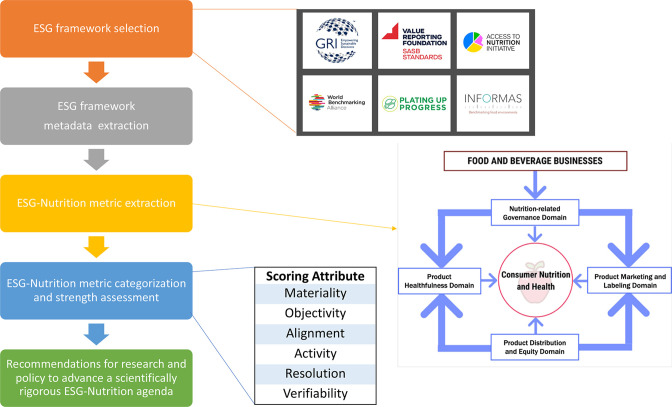
Methods: ESG-Nutrition metrics were extracted from eight ESG frameworks and categorised across four domains: product portfolio healthfulness; product distribution and equity; product marketing and labelling; and nutrition-related governance. The strength of each metric was evaluated and scored 1-3 (best), independently by two researchers, based on six attributes: materiality, objectivity, alignment, activity, resolution and verifiability. The total score (range 6-18) and intercorrelation for each attribute was calculated.
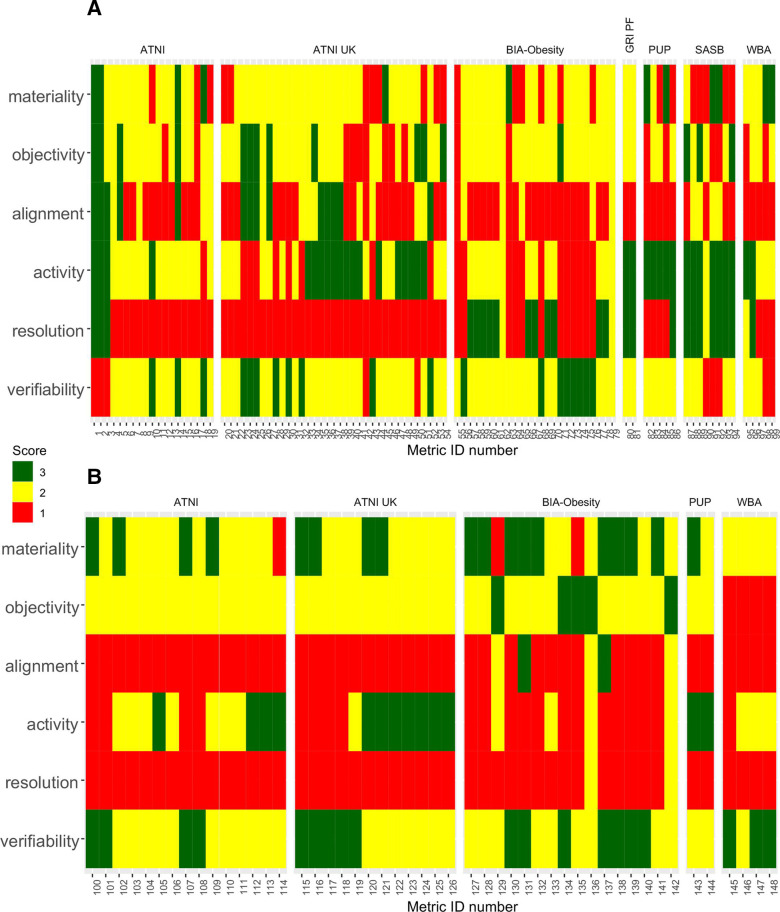
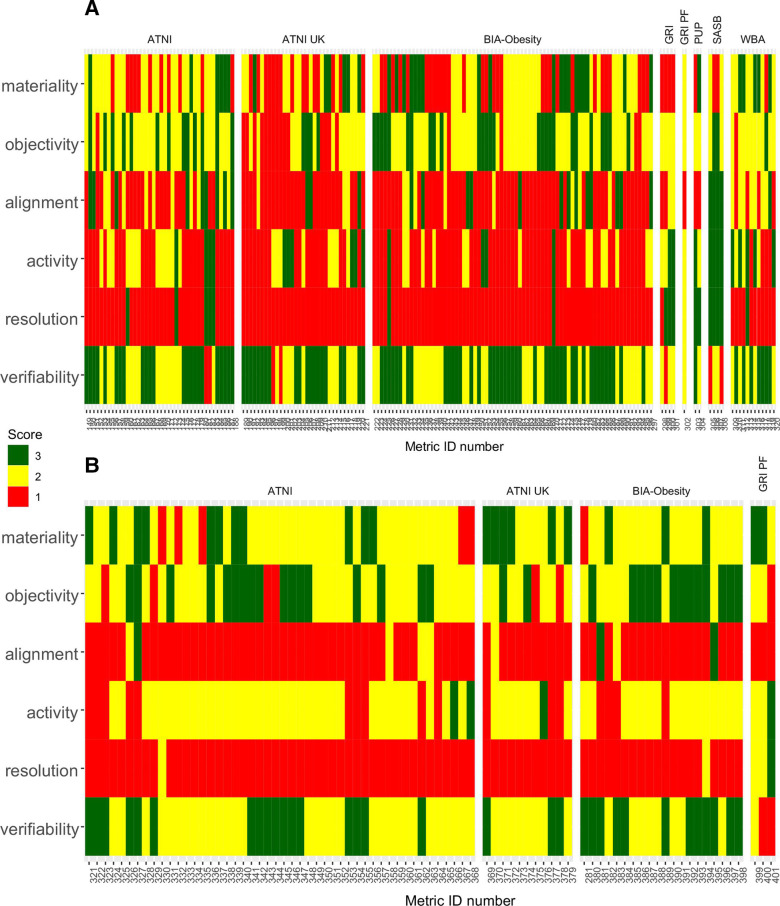
Results: Across 529 metrics, most related to product marketing and labelling (n=230, 43.5%), followed by product healthfulness (n=126, 23.8%), nutrition-related governance (n=108, 20.4%) and product distribution and equity (n=65, 12.3%). Across all metrics, average total score was 10.94 (1.58), with average attribute scoring highest for verifiability (mean: 2.36 (SD: 0.57)), objectivity (2.11 (0.61)) and materiality (2.01 (0.68)) and lowest for activity (1.83 (0.74)), alignment (1.37 (0.67)) and resolution (1.26 (0.65)). Most intercorrelations were null, suggesting attributes were measuring distinct characteristics of each metric. Significant heterogeneity across domains and frameworks was also observed.
Conclusions: This research identifies a range of nutrition-related metrics used in ESG frameworks with respect to food companies, but with substantial heterogeneity in relevant nutrition domains covered and strength of each metric. Efforts are required to improve the quality of metrics across frameworks, establish standardised reporting and align these with investor priorities.
期刊介绍:
ACS Applied Electronic Materials is an interdisciplinary journal publishing original research covering all aspects of electronic materials. The journal is devoted to reports of new and original experimental and theoretical research of an applied nature that integrate knowledge in the areas of materials science, engineering, optics, physics, and chemistry into important applications of electronic materials. Sample research topics that span the journal's scope are inorganic, organic, ionic and polymeric materials with properties that include conducting, semiconducting, superconducting, insulating, dielectric, magnetic, optoelectronic, piezoelectric, ferroelectric and thermoelectric.
Indexed/Abstracted:
Web of Science SCIE
Scopus
CAS
INSPEC
Portico




 京公网安备 11010802042870号
京ICP备2023020795号-1
京公网安备 11010802042870号
京ICP备2023020795号-1

 分享
分享
 求助内容:
求助内容: 应助结果提醒方式:
 扫码关注我们
