Diego Said, Gabriela Belinato, Gustavo S. Sarmiento, Rosa L. Simencio Otero, George E. Totten, Analía Gastón, Lauralice C. F. Canale
{"title":"Comparison of Oxidation Stability and Quenchant Cooling Curve Performance of Soybean Oil and Palm Oil","authors":"Diego Said, Gabriela Belinato, Gustavo S. Sarmiento, Rosa L. Simencio Otero, George E. Totten, Analía Gastón, Lauralice C. F. Canale","doi":"10.1007/s11665-013-0560-9","DOIUrl":null,"url":null,"abstract":"<p>The potential use of vegetable oil-derived industrial oils continues to be of great interest because vegetable oils are relatively non-toxic, biodegradable, and they are a renewable basestock alternative to petroleum oil. However, the fatty ester components containing conjugated double bonds of the triglyceride structure of vegetable oils typically produce considerably poorer thermal-oxidative stability than that achievable with petroleum basestocks under typical use conditions. Typically, these conditions involve furnace loads of hot steel (850?°C), which are rapidly immersed and cooled to bath temperatures of approximately 50-60?°C. This is especially true when a vegetable oil is held in an open tank with agitation and exposed to air at elevated temperatures for extended periods of time (months or years). This paper will describe the thermal-oxidative stability and quenching performance of soybean oil and palm oil and the resulting impact on the heat transfer coefficient. These results are compared to typical fully formulated, commercially available accelerated (fast) and an unaccelerated (slow) petroleum oil-based quenchants.</p>","PeriodicalId":644,"journal":{"name":"Journal of Materials Engineering and Performance","volume":"22 7","pages":"1929 - 1936"},"PeriodicalIF":2.0000,"publicationDate":"2013-05-10","publicationTypes":"Journal Article","fieldsOfStudy":null,"isOpenAccess":false,"openAccessPdf":"https://sci-hub-pdf.com/10.1007/s11665-013-0560-9","citationCount":"20","resultStr":null,"platform":"Semanticscholar","paperid":null,"PeriodicalName":"Journal of Materials Engineering and Performance","FirstCategoryId":"88","ListUrlMain":"https://link.springer.com/article/10.1007/s11665-013-0560-9","RegionNum":4,"RegionCategory":"材料科学","ArticlePicture":[],"TitleCN":null,"AbstractTextCN":null,"PMCID":null,"EPubDate":"","PubModel":"","JCR":"Q3","JCRName":"MATERIALS SCIENCE, MULTIDISCIPLINARY","Score":null,"Total":0}
引用次数: 20
Abstract
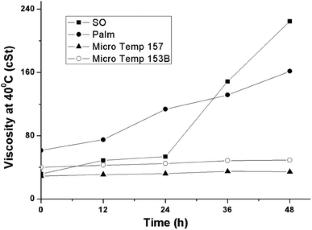
The potential use of vegetable oil-derived industrial oils continues to be of great interest because vegetable oils are relatively non-toxic, biodegradable, and they are a renewable basestock alternative to petroleum oil. However, the fatty ester components containing conjugated double bonds of the triglyceride structure of vegetable oils typically produce considerably poorer thermal-oxidative stability than that achievable with petroleum basestocks under typical use conditions. Typically, these conditions involve furnace loads of hot steel (850?°C), which are rapidly immersed and cooled to bath temperatures of approximately 50-60?°C. This is especially true when a vegetable oil is held in an open tank with agitation and exposed to air at elevated temperatures for extended periods of time (months or years). This paper will describe the thermal-oxidative stability and quenching performance of soybean oil and palm oil and the resulting impact on the heat transfer coefficient. These results are compared to typical fully formulated, commercially available accelerated (fast) and an unaccelerated (slow) petroleum oil-based quenchants.
期刊介绍:
ASM International''s Journal of Materials Engineering and Performance focuses on solving day-to-day engineering challenges, particularly those involving components for larger systems. The journal presents a clear understanding of relationships between materials selection, processing, applications and performance.
The Journal of Materials Engineering covers all aspects of materials selection, design, processing, characterization and evaluation, including how to improve materials properties through processes and process control of casting, forming, heat treating, surface modification and coating, and fabrication.
Testing and characterization (including mechanical and physical tests, NDE, metallography, failure analysis, corrosion resistance, chemical analysis, surface characterization, and microanalysis of surfaces, features and fractures), and industrial performance measurement are also covered



 京公网安备 11010802042870号
京ICP备2023020795号-1
京公网安备 11010802042870号
京ICP备2023020795号-1

 分享
分享
 求助内容:
求助内容: 应助结果提醒方式:
 扫码关注我们
