Monika Sharma , Mohammed Jalalah , Saeed A. Alsareii , Farid A. Harraz , Abdulrhman A. Almadiy , Nandini Thakur , El-Sayed Salama , Xiangkai Li
{"title":"Fat, oil, and grease as new feedstock towards bioelectrogenesis in microbial fuel cells: Microbial diversity, metabolic pathways, and key enzymes","authors":"Monika Sharma , Mohammed Jalalah , Saeed A. Alsareii , Farid A. Harraz , Abdulrhman A. Almadiy , Nandini Thakur , El-Sayed Salama , Xiangkai Li","doi":"10.1016/j.jechem.2023.06.028","DOIUrl":null,"url":null,"abstract":"<div><p>Microbial fuel cells (MFCs) are a well-known technology used for bioelectricity production from the decomposition of organic waste <em>via</em> electroactive microbes. Fat, oil, and grease (FOG) as a new substrate in the anode and microalgae in the cathode were added to accelerate the electrogenesis. The effect of FOG concentrations (0.1%, 0.5%, 1%, and 1.5%) on the anode chamber was investigated. The FOG degradation, volatile fatty acid (VFAs) production, and soluble chemical oxygen demand along with voltage output kinetics were analyzed. Moreover, the microbial community analysis and active functional enzymes were also evaluated. The maximum power and current density were observed at 0.5% FOG which accounts for 96 mW m<sup>−2</sup> (8-folds enhancement) and 560 mA m<sup>−2</sup> (3.7-folds enhancement), respectively. The daily voltage output enhanced upto 2.3-folds with 77.08% coulombic efficiency under 0.5% FOG, which was the highest among all the reactors. The 0.5% FOG was degraded >85%, followed by a 1% FOG-loaded reactor. The chief enzymes in β-oxidation and electrogenesis were acetyl-CoA C-acetyltransferase, riboflavin synthase, and riboflavin kinase. The identified enzymes symbolize the presence of <em>Clostridium</em> sp. (>15%) and <em>Pseudomonas</em> (>10%) which served as electrochemical active bacteria (EAB). The major metabolic pathways involved in electrogenesis and FOG degradation were fatty acid biosynthesis and glycerophospholipid metabolism. Utilization of lipidic-waste (such as FOG) in MFCs could be a potential approach for simultaneous biowaste utilization and bioenergy generation.</p></div>","PeriodicalId":15728,"journal":{"name":"Journal of Energy Chemistry","volume":"85 ","pages":"Pages 418-429"},"PeriodicalIF":14.9000,"publicationDate":"2023-10-01","publicationTypes":"Journal Article","fieldsOfStudy":null,"isOpenAccess":false,"openAccessPdf":"","citationCount":"1","resultStr":null,"platform":"Semanticscholar","paperid":null,"PeriodicalName":"Journal of Energy Chemistry","FirstCategoryId":"1085","ListUrlMain":"https://www.sciencedirect.com/science/article/pii/S2095495623003753","RegionNum":1,"RegionCategory":"化学","ArticlePicture":[],"TitleCN":null,"AbstractTextCN":null,"PMCID":null,"EPubDate":"","PubModel":"","JCR":"Q1","JCRName":"Energy","Score":null,"Total":0}
引用次数: 1
Abstract
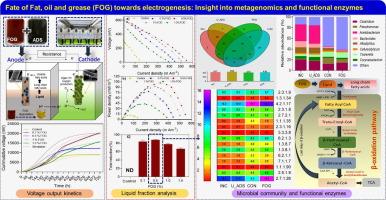
Microbial fuel cells (MFCs) are a well-known technology used for bioelectricity production from the decomposition of organic waste via electroactive microbes. Fat, oil, and grease (FOG) as a new substrate in the anode and microalgae in the cathode were added to accelerate the electrogenesis. The effect of FOG concentrations (0.1%, 0.5%, 1%, and 1.5%) on the anode chamber was investigated. The FOG degradation, volatile fatty acid (VFAs) production, and soluble chemical oxygen demand along with voltage output kinetics were analyzed. Moreover, the microbial community analysis and active functional enzymes were also evaluated. The maximum power and current density were observed at 0.5% FOG which accounts for 96 mW m−2 (8-folds enhancement) and 560 mA m−2 (3.7-folds enhancement), respectively. The daily voltage output enhanced upto 2.3-folds with 77.08% coulombic efficiency under 0.5% FOG, which was the highest among all the reactors. The 0.5% FOG was degraded >85%, followed by a 1% FOG-loaded reactor. The chief enzymes in β-oxidation and electrogenesis were acetyl-CoA C-acetyltransferase, riboflavin synthase, and riboflavin kinase. The identified enzymes symbolize the presence of Clostridium sp. (>15%) and Pseudomonas (>10%) which served as electrochemical active bacteria (EAB). The major metabolic pathways involved in electrogenesis and FOG degradation were fatty acid biosynthesis and glycerophospholipid metabolism. Utilization of lipidic-waste (such as FOG) in MFCs could be a potential approach for simultaneous biowaste utilization and bioenergy generation.
期刊介绍:
The Journal of Energy Chemistry, the official publication of Science Press and the Dalian Institute of Chemical Physics, Chinese Academy of Sciences, serves as a platform for reporting creative research and innovative applications in energy chemistry. It mainly reports on creative researches and innovative applications of chemical conversions of fossil energy, carbon dioxide, electrochemical energy and hydrogen energy, as well as the conversions of biomass and solar energy related with chemical issues to promote academic exchanges in the field of energy chemistry and to accelerate the exploration, research and development of energy science and technologies.
This journal focuses on original research papers covering various topics within energy chemistry worldwide, including:
Optimized utilization of fossil energy
Hydrogen energy
Conversion and storage of electrochemical energy
Capture, storage, and chemical conversion of carbon dioxide
Materials and nanotechnologies for energy conversion and storage
Chemistry in biomass conversion
Chemistry in the utilization of solar energy



 京公网安备 11010802042870号
京ICP备2023020795号-1
京公网安备 11010802042870号
京ICP备2023020795号-1

 分享
分享
 求助内容:
求助内容: 应助结果提醒方式:
 扫码关注我们
