Anna A. Simagina, Mikhail V. Polynski, A. Vinogradov, E. Pidko
{"title":"Towards rational design of metal-organic framework-based drug delivery systems","authors":"Anna A. Simagina, Mikhail V. Polynski, A. Vinogradov, E. Pidko","doi":"10.1070/RCR4797","DOIUrl":null,"url":null,"abstract":"Metal-organic frameworks comprise a class of crystalline porous coordination polymers with unique chemical and physical properties. On the one hand, due to high specific surface area, biocompatibility and stability in biological media, framework materials are ideal candidates for the development of new dosage forms, in particular, for drug delivery systems. On the other hand, the modular structure of frameworks provides an opportunity for computational screening and predictive calculations. This opens new prospects for the design of modern functional materials. The computational screening and simulation of adsorption – desorption processes play a key role in the development of drug delivery systems, as they provide data that are difficult to obtain solely from experiments. These data can greatly assist in the development of drug delivery systems. The first part of the review gives a brief overview of the metal-organic frameworks which have already proved to be potential drug carriers as well as frameworks which are currently being extensively studied and gain attention in this area. The second part addresses the concept of rational design and computer-aided design of such systems. The bibliography includes 216 references.","PeriodicalId":21523,"journal":{"name":"Russian Chemical Reviews","volume":"87 1","pages":"831 - 858"},"PeriodicalIF":6.0000,"publicationDate":"2018-09-03","publicationTypes":"Journal Article","fieldsOfStudy":null,"isOpenAccess":false,"openAccessPdf":"https://sci-hub-pdf.com/10.1070/RCR4797","citationCount":"22","resultStr":null,"platform":"Semanticscholar","paperid":null,"PeriodicalName":"Russian Chemical Reviews","FirstCategoryId":"92","ListUrlMain":"https://doi.org/10.1070/RCR4797","RegionNum":2,"RegionCategory":"化学","ArticlePicture":[],"TitleCN":null,"AbstractTextCN":null,"PMCID":null,"EPubDate":"","PubModel":"","JCR":"Q1","JCRName":"CHEMISTRY, MULTIDISCIPLINARY","Score":null,"Total":0}
引用次数: 22
Abstract
Metal-organic frameworks comprise a class of crystalline porous coordination polymers with unique chemical and physical properties. On the one hand, due to high specific surface area, biocompatibility and stability in biological media, framework materials are ideal candidates for the development of new dosage forms, in particular, for drug delivery systems. On the other hand, the modular structure of frameworks provides an opportunity for computational screening and predictive calculations. This opens new prospects for the design of modern functional materials. The computational screening and simulation of adsorption – desorption processes play a key role in the development of drug delivery systems, as they provide data that are difficult to obtain solely from experiments. These data can greatly assist in the development of drug delivery systems. The first part of the review gives a brief overview of the metal-organic frameworks which have already proved to be potential drug carriers as well as frameworks which are currently being extensively studied and gain attention in this area. The second part addresses the concept of rational design and computer-aided design of such systems. The bibliography includes 216 references.
期刊介绍:
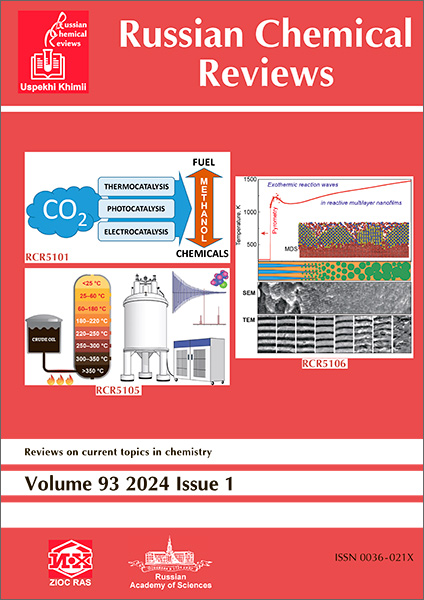
Russian Chemical Reviews serves as a complete translation of the esteemed monthly review journal Uspekhi Khimii, which has been a prominent figure in Russian scientific journals since its establishment in 1932. It offers comprehensive access to the advancements made by chemists from Russia and other former Soviet Union countries.
Established in 1932, Russian Chemical Reviews is committed to publishing timely and significant review articles encompassing various facets of modern chemistry, including chemical physics, physical chemistry, computational and theoretical chemistry, catalysis, coordination chemistry, analytical chemistry, organic, organometallic, and organoelement chemistry, chemistry of macromolecules, applied chemistry, biochemistry, bio-organic chemistry, biomolecular chemistry, medicinal chemistry, materials chemistry, nanochemistry, nanostructures, and environmental chemistry.



 京公网安备 11010802042870号
京ICP备2023020795号-1
京公网安备 11010802042870号
京ICP备2023020795号-1

 分享
分享
 求助内容:
求助内容: 应助结果提醒方式:
 扫码关注我们
