{"title":"Play and Scientific Creativity: A Critical Review and an Integrative Theoretical Framework","authors":"Xiangyou Shen","doi":"10.1002/jocb.596","DOIUrl":null,"url":null,"abstract":"<p>Emerging empirical evidence supports play's potential to stimulate and foster scientific creativity. Focusing on how play relates to scientific creativity in adulthood, this review synthesizes the current state of knowledge in four areas: the play element in scientific research, the playfulness of scientists, mechanisms through which play affects scientific creativity, and environmental factors key to the play-to-create process in scientists' work. The review highlights several limitations hindering further research development in this area. Specifically, existing studies: (a) are largely qualitative and focus on descriptive analysis of the forms and/or select aspects of play, (b) do not sufficiently consider the unique characteristics and processes of scientific research, and (c) decontextualize the creative process by separating the player-creator from the environment. Building on this analysis, the author clarifies the conceptualization of play, playfulness, and scientific creativity, differentiates between creative and recreative play in relation to core scientific activities, and identifies useful conceptual and measurement tools to facilitate future domain-specific empirical studies of play and scientific creativity. Collectively, these insights advance a new integrative theoretical framework—the play-to-create model—to encourage and guide systematic and contextualized investigations of how play, playfulness, creative processes, and the environment interact to generate creative scientific outcomes.</p>","PeriodicalId":39915,"journal":{"name":"Journal of Creative Behavior","volume":"57 4","pages":"503-515"},"PeriodicalIF":3.0000,"publicationDate":"2023-06-16","publicationTypes":"Journal Article","fieldsOfStudy":null,"isOpenAccess":false,"openAccessPdf":"https://onlinelibrary.wiley.com/doi/epdf/10.1002/jocb.596","citationCount":"0","resultStr":null,"platform":"Semanticscholar","paperid":null,"PeriodicalName":"Journal of Creative Behavior","FirstCategoryId":"102","ListUrlMain":"https://onlinelibrary.wiley.com/doi/10.1002/jocb.596","RegionNum":2,"RegionCategory":"心理学","ArticlePicture":[],"TitleCN":null,"AbstractTextCN":null,"PMCID":null,"EPubDate":"","PubModel":"","JCR":"Q2","JCRName":"PSYCHOLOGY, EDUCATIONAL","Score":null,"Total":0}
引用次数: 0
Abstract
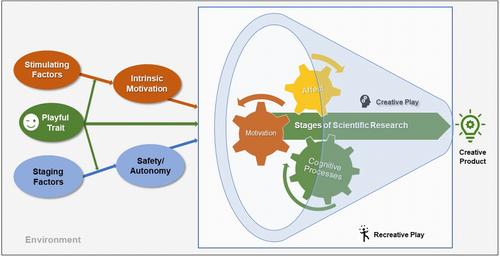
Emerging empirical evidence supports play's potential to stimulate and foster scientific creativity. Focusing on how play relates to scientific creativity in adulthood, this review synthesizes the current state of knowledge in four areas: the play element in scientific research, the playfulness of scientists, mechanisms through which play affects scientific creativity, and environmental factors key to the play-to-create process in scientists' work. The review highlights several limitations hindering further research development in this area. Specifically, existing studies: (a) are largely qualitative and focus on descriptive analysis of the forms and/or select aspects of play, (b) do not sufficiently consider the unique characteristics and processes of scientific research, and (c) decontextualize the creative process by separating the player-creator from the environment. Building on this analysis, the author clarifies the conceptualization of play, playfulness, and scientific creativity, differentiates between creative and recreative play in relation to core scientific activities, and identifies useful conceptual and measurement tools to facilitate future domain-specific empirical studies of play and scientific creativity. Collectively, these insights advance a new integrative theoretical framework—the play-to-create model—to encourage and guide systematic and contextualized investigations of how play, playfulness, creative processes, and the environment interact to generate creative scientific outcomes.
期刊介绍:
The Journal of Creative Behavior is our quarterly academic journal citing the most current research in creative thinking. For nearly four decades JCB has been the benchmark scientific periodical in the field. It provides up to date cutting-edge ideas about creativity in education, psychology, business, arts and more.




 京公网安备 11010802042870号
京ICP备2023020795号-1
京公网安备 11010802042870号
京ICP备2023020795号-1

 分享
分享
 求助内容:
求助内容: 应助结果提醒方式:
 扫码关注我们
