A modified neo-Hookean model for semi-crystalline thermoplastics assessed by relaxation and zero-stress creep tests of recycled polypropylene and polyoxymethylene
{"title":"A modified neo-Hookean model for semi-crystalline thermoplastics assessed by relaxation and zero-stress creep tests of recycled polypropylene and polyoxymethylene","authors":"Björn Stoltz, Magnus Lindvall, Martin Kroon","doi":"10.1007/s11043-023-09631-x","DOIUrl":null,"url":null,"abstract":"<div><p>The mechanical behavior of thermoplastics is strongly rate-dependent, and oftentimes it is difficult to find constitutive models that can accurately describe their behavior in the small to moderate strain regime. In this paper, a hyperelastic network model (modified neo-Hookean) and a set of experiments are presented. The testing consists of monotonic tensile loading as well as stress relaxation and zero stress creep. Two materials were tested, polyoxymethylene (POM) and recycled polypropylene (rPP), representing one more rigid and brittle and one softer and more ductile semi-crystalline polymer. The model contains two main novelties. The first novelty is that the stiffness is allowed to vary with the elastic deformation (in contrast to a standard neo-Hookean model). The second novelty is that the exponent governing viscous relaxation is allowed to vary with the viscous deformation. The basic features of the new model are illustrated, and the model was fitted to the experimental data. The model proved to be able to describe the experimental results well.</p></div>","PeriodicalId":698,"journal":{"name":"Mechanics of Time-Dependent Materials","volume":"28 1","pages":"43 - 63"},"PeriodicalIF":2.3000,"publicationDate":"2023-09-04","publicationTypes":"Journal Article","fieldsOfStudy":null,"isOpenAccess":false,"openAccessPdf":"https://link.springer.com/content/pdf/10.1007/s11043-023-09631-x.pdf","citationCount":"0","resultStr":null,"platform":"Semanticscholar","paperid":null,"PeriodicalName":"Mechanics of Time-Dependent Materials","FirstCategoryId":"88","ListUrlMain":"https://link.springer.com/article/10.1007/s11043-023-09631-x","RegionNum":4,"RegionCategory":"材料科学","ArticlePicture":[],"TitleCN":null,"AbstractTextCN":null,"PMCID":null,"EPubDate":"","PubModel":"","JCR":"Q2","JCRName":"MATERIALS SCIENCE, CHARACTERIZATION & TESTING","Score":null,"Total":0}
引用次数: 0
Abstract
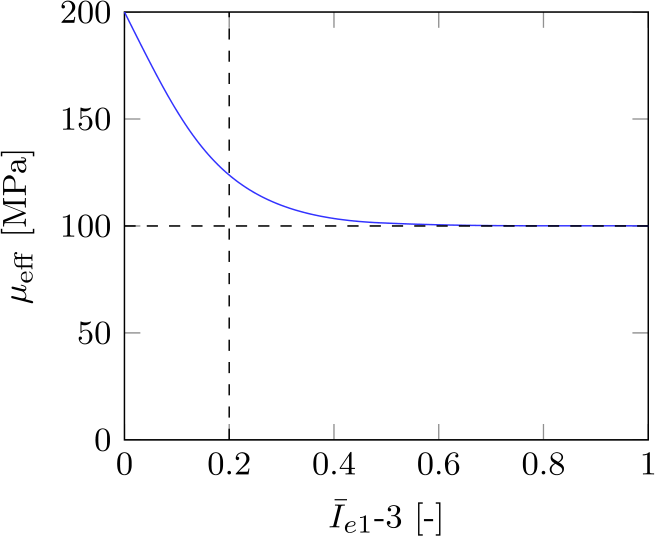
The mechanical behavior of thermoplastics is strongly rate-dependent, and oftentimes it is difficult to find constitutive models that can accurately describe their behavior in the small to moderate strain regime. In this paper, a hyperelastic network model (modified neo-Hookean) and a set of experiments are presented. The testing consists of monotonic tensile loading as well as stress relaxation and zero stress creep. Two materials were tested, polyoxymethylene (POM) and recycled polypropylene (rPP), representing one more rigid and brittle and one softer and more ductile semi-crystalline polymer. The model contains two main novelties. The first novelty is that the stiffness is allowed to vary with the elastic deformation (in contrast to a standard neo-Hookean model). The second novelty is that the exponent governing viscous relaxation is allowed to vary with the viscous deformation. The basic features of the new model are illustrated, and the model was fitted to the experimental data. The model proved to be able to describe the experimental results well.
期刊介绍:
Mechanics of Time-Dependent Materials accepts contributions dealing with the time-dependent mechanical properties of solid polymers, metals, ceramics, concrete, wood, or their composites. It is recognized that certain materials can be in the melt state as function of temperature and/or pressure. Contributions concerned with fundamental issues relating to processing and melt-to-solid transition behaviour are welcome, as are contributions addressing time-dependent failure and fracture phenomena. Manuscripts addressing environmental issues will be considered if they relate to time-dependent mechanical properties.
The journal promotes the transfer of knowledge between various disciplines that deal with the properties of time-dependent solid materials but approach these from different angles. Among these disciplines are: Mechanical Engineering, Aerospace Engineering, Chemical Engineering, Rheology, Materials Science, Polymer Physics, Design, and others.



 京公网安备 11010802042870号
京ICP备2023020795号-1
京公网安备 11010802042870号
京ICP备2023020795号-1

 分享
分享
 求助内容:
求助内容: 应助结果提醒方式:
 扫码关注我们
