Krishnamoorthy Sathiyan, Asmita Dutta, Vered Marks, Ohad Fleker, Tomer Zidki, Richard D. Webster, Arie Borenstein
{"title":"Nano-encapsulation: overcoming conductivity limitations by growing MOF nanoparticles in meso-porous carbon enables high electrocatalytic performance","authors":"Krishnamoorthy Sathiyan, Asmita Dutta, Vered Marks, Ohad Fleker, Tomer Zidki, Richard D. Webster, Arie Borenstein","doi":"10.1038/s41427-022-00459-4","DOIUrl":null,"url":null,"abstract":"Among the methods employed for carbon capture, the electroreduction of CO2 offers both a reduction in CO2 levels and the possibility of recycling it into commodity chemicals. However, the most efficient catalysts for this reaction are precious metals. To achieve cost-effective processes, other elements should be used. Transition-metal atoms coordinated with metal-organic frameworks (MOFs) exhibit high performance as electrocatalysts. However, the isolating natures of MOFs limit their utilization as electrocatalysts. In this study, we grew MOF nanoparticles inside hierarchically mesoporous carbon instead of mixing the MOFs with conductive carbon. The incorporated MOF nanoparticles showed improved properties compared with those of MOFs mixed with carbon, indicating strong electronic interactions in the composites. The encapsulated MOF nanoparticles demonstrated high electric conductivity while preserving their original crystallinity. When used as electrodes in CO2 electroreduction, the MOFs exhibited a high electroactive coverage of 155 nmol cm−2. Moreover, in a CO2-saturated electrolyte, the composites exhibited excellent electrochemical performance, including a small onset potential (−0.31 V vs. RHE) and large reduction currents (−18 mA. cm−2 at −1.0 V); these were considerably higher than those usually reported for MOF-based materials except in CO electroreduction. Importantly, the composite produced valuable hydrogenated commodity chemicals, including formic acid. MOFs uniquely combine metal-atom centers and developed organic-based structures. Both features are attractive for catalysis. However, their isolating nature prevents them from effective use in electrocatalysis processes. Modifying the chemical structure to gain electric conductivity often harms its natural advantages. In this study, Borenstein et al. present a new approach to overcoming the non-conductivity of MOF b growing MOF nanoparticles in a conductive carbon host. The host’s porosity controls the MOF nanoparticles’ size and their electric properties while preserving their structure. As a result, the composition efficiently electro-catalyzes carbon dioxide into formic acid at low overpotentials.","PeriodicalId":19382,"journal":{"name":"Npg Asia Materials","volume":"15 1","pages":"1-10"},"PeriodicalIF":8.3000,"publicationDate":"2023-03-31","publicationTypes":"Journal Article","fieldsOfStudy":null,"isOpenAccess":false,"openAccessPdf":"https://www.nature.com/articles/s41427-022-00459-4.pdf","citationCount":"0","resultStr":null,"platform":"Semanticscholar","paperid":null,"PeriodicalName":"Npg Asia Materials","FirstCategoryId":"88","ListUrlMain":"https://www.nature.com/articles/s41427-022-00459-4","RegionNum":2,"RegionCategory":"材料科学","ArticlePicture":[],"TitleCN":null,"AbstractTextCN":null,"PMCID":null,"EPubDate":"","PubModel":"","JCR":"Q1","JCRName":"MATERIALS SCIENCE, MULTIDISCIPLINARY","Score":null,"Total":0}
引用次数: 0
Abstract
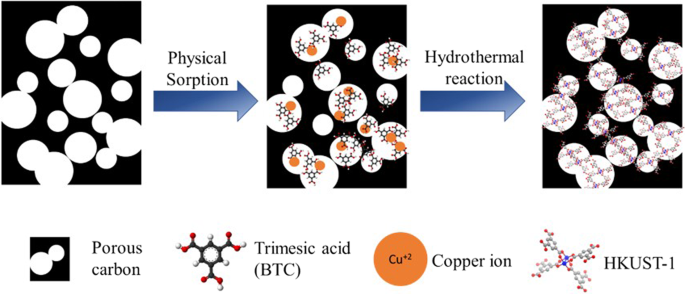
Among the methods employed for carbon capture, the electroreduction of CO2 offers both a reduction in CO2 levels and the possibility of recycling it into commodity chemicals. However, the most efficient catalysts for this reaction are precious metals. To achieve cost-effective processes, other elements should be used. Transition-metal atoms coordinated with metal-organic frameworks (MOFs) exhibit high performance as electrocatalysts. However, the isolating natures of MOFs limit their utilization as electrocatalysts. In this study, we grew MOF nanoparticles inside hierarchically mesoporous carbon instead of mixing the MOFs with conductive carbon. The incorporated MOF nanoparticles showed improved properties compared with those of MOFs mixed with carbon, indicating strong electronic interactions in the composites. The encapsulated MOF nanoparticles demonstrated high electric conductivity while preserving their original crystallinity. When used as electrodes in CO2 electroreduction, the MOFs exhibited a high electroactive coverage of 155 nmol cm−2. Moreover, in a CO2-saturated electrolyte, the composites exhibited excellent electrochemical performance, including a small onset potential (−0.31 V vs. RHE) and large reduction currents (−18 mA. cm−2 at −1.0 V); these were considerably higher than those usually reported for MOF-based materials except in CO electroreduction. Importantly, the composite produced valuable hydrogenated commodity chemicals, including formic acid. MOFs uniquely combine metal-atom centers and developed organic-based structures. Both features are attractive for catalysis. However, their isolating nature prevents them from effective use in electrocatalysis processes. Modifying the chemical structure to gain electric conductivity often harms its natural advantages. In this study, Borenstein et al. present a new approach to overcoming the non-conductivity of MOF b growing MOF nanoparticles in a conductive carbon host. The host’s porosity controls the MOF nanoparticles’ size and their electric properties while preserving their structure. As a result, the composition efficiently electro-catalyzes carbon dioxide into formic acid at low overpotentials.
期刊介绍:
NPG Asia Materials is an open access, international journal that publishes peer-reviewed review and primary research articles in the field of materials sciences. The journal has a global outlook and reach, with a base in the Asia-Pacific region to reflect the significant and growing output of materials research from this area. The target audience for NPG Asia Materials is scientists and researchers involved in materials research, covering a wide range of disciplines including physical and chemical sciences, biotechnology, and nanotechnology. The journal particularly welcomes high-quality articles from rapidly advancing areas that bridge the gap between materials science and engineering, as well as the classical disciplines of physics, chemistry, and biology. NPG Asia Materials is abstracted/indexed in Journal Citation Reports/Science Edition Web of Knowledge, Google Scholar, Chemical Abstract Services, Scopus, Ulrichsweb (ProQuest), and Scirus.




 京公网安备 11010802042870号
京ICP备2023020795号-1
京公网安备 11010802042870号
京ICP备2023020795号-1

 分享
分享
 求助内容:
求助内容: 应助结果提醒方式:
 扫码关注我们
