Vanesa B Meinardi, Juan M Díaz López, Hugo Diaz Fajreldines, Carina Boyallian, Monica Balzarini
{"title":"Linear mixed-effect models for correlated response to process electroencephalogram recordings.","authors":"Vanesa B Meinardi, Juan M Díaz López, Hugo Diaz Fajreldines, Carina Boyallian, Monica Balzarini","doi":"10.1007/s11571-023-09984-6","DOIUrl":null,"url":null,"abstract":"<p><p>A data set of clinical studies of electroencephalogram recordings (EEG) following data acquisition protocols in control individuals (Eyes Closed Wakefulness - Eyes Open Wakefulness, Hyperventilation, and Optostimulation) are quantified with information theory metrics, namely permutation Shanon entropy and permutation Lempel Ziv complexity, to identify functional changes. This work implement Linear mixed-effects models (LMEMs) for confirmatory hypothesis testing. The results show that EEGs have high variability for both metrics and there is a positive correlation between them. The mean of permutation Lempel-Ziv complexity and permutation Shanon entropy used simultaneously for each of the four states are distinguishable from each other. However, used separately, the differences between permutation Lempel-Ziv complexity or permutation Shanon entropy of some states were not statistically significant. This shows that the joint use of both metrics provides more information than the separate use of each of them. Despite their wide use in medicine, LMEMs have not been commonly applied to simultaneously model metrics that quantify EEG signals. Modeling EEGs using a model that characterizes more than one response variable and their possible correlations represents a new way of analyzing EEG data in neuroscience.</p>","PeriodicalId":3,"journal":{"name":"ACS Applied Electronic Materials","volume":" ","pages":"1197-1207"},"PeriodicalIF":4.7000,"publicationDate":"2024-06-01","publicationTypes":"Journal Article","fieldsOfStudy":null,"isOpenAccess":false,"openAccessPdf":"https://www.ncbi.nlm.nih.gov/pmc/articles/PMC11143122/pdf/","citationCount":"0","resultStr":null,"platform":"Semanticscholar","paperid":null,"PeriodicalName":"ACS Applied Electronic Materials","FirstCategoryId":"88","ListUrlMain":"https://doi.org/10.1007/s11571-023-09984-6","RegionNum":3,"RegionCategory":"材料科学","ArticlePicture":[],"TitleCN":null,"AbstractTextCN":null,"PMCID":null,"EPubDate":"2023/6/19 0:00:00","PubModel":"Epub","JCR":"Q1","JCRName":"ENGINEERING, ELECTRICAL & ELECTRONIC","Score":null,"Total":0}
引用次数: 0
Abstract
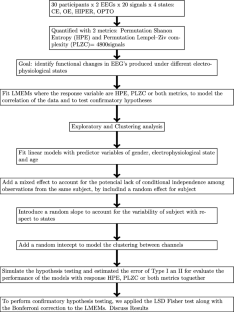
A data set of clinical studies of electroencephalogram recordings (EEG) following data acquisition protocols in control individuals (Eyes Closed Wakefulness - Eyes Open Wakefulness, Hyperventilation, and Optostimulation) are quantified with information theory metrics, namely permutation Shanon entropy and permutation Lempel Ziv complexity, to identify functional changes. This work implement Linear mixed-effects models (LMEMs) for confirmatory hypothesis testing. The results show that EEGs have high variability for both metrics and there is a positive correlation between them. The mean of permutation Lempel-Ziv complexity and permutation Shanon entropy used simultaneously for each of the four states are distinguishable from each other. However, used separately, the differences between permutation Lempel-Ziv complexity or permutation Shanon entropy of some states were not statistically significant. This shows that the joint use of both metrics provides more information than the separate use of each of them. Despite their wide use in medicine, LMEMs have not been commonly applied to simultaneously model metrics that quantify EEG signals. Modeling EEGs using a model that characterizes more than one response variable and their possible correlations represents a new way of analyzing EEG data in neuroscience.
期刊介绍:
ACS Applied Electronic Materials is an interdisciplinary journal publishing original research covering all aspects of electronic materials. The journal is devoted to reports of new and original experimental and theoretical research of an applied nature that integrate knowledge in the areas of materials science, engineering, optics, physics, and chemistry into important applications of electronic materials. Sample research topics that span the journal's scope are inorganic, organic, ionic and polymeric materials with properties that include conducting, semiconducting, superconducting, insulating, dielectric, magnetic, optoelectronic, piezoelectric, ferroelectric and thermoelectric.
Indexed/Abstracted:
Web of Science SCIE
Scopus
CAS
INSPEC
Portico




 京公网安备 11010802042870号
京ICP备2023020795号-1
京公网安备 11010802042870号
京ICP备2023020795号-1

 分享
分享
 求助内容:
求助内容: 应助结果提醒方式:
 扫码关注我们
