{"title":"Facile synthesis of Bi2Fe4O9 nanoplate and its application as a novel adsorbent for Cu(II) removal","authors":"Miaomiao Kong, Hui Song, Fenghua Li, Dongmei Dai, Hongtao Gao","doi":"10.1016/j.jece.2016.11.020","DOIUrl":null,"url":null,"abstract":"<div><p>To our knowledge, there were hardly any reports on the application of Bi<sub>2</sub>Fe<sub>4</sub>O<sub>9</sub> for adsorptive removal of heavy metal ions. In this study, Bi<sub>2</sub>Fe<sub>4</sub>O<sub>9</sub> nanoplate was successfully fabricated through a facile hydrothermal method without addition of any template agents. The adsorption mechanism of Cu(II) and its behaviour on Bi<sub>2</sub>Fe<sub>4</sub>O<sub>9</sub> were investigated comprehensively. The adsorbents were characterized by X-ray diffraction (XRD), scanning electron microscopy (SEM), Fourier transform infrared spectroscopy (FT-IR) and the N<sub>2</sub> adsorption-desorption isotherm, respectively. The investigation on adsorption kinetics and isotherm showed that the pseudo-second-order kinetic and Langmuir isotherm models could well fit the experimental adsorption data. The maximum adsorption capacity of Bi<sub>2</sub>Fe<sub>4</sub>O<sub>9</sub> for Cu(II) was found to be 42.7<!--> <!-->mg<!--> <!-->g<sup>−1</sup> at short equilibrium time of 40<!--> <!-->min and ambient temperature, which was higher than those of other adsorbents reported in literatures. Thermodynamic survey on Gibbs free energy (ΔG<!--> <!--><<!--> <!-->0), enthalpy (ΔH<!--> <!-->><!--> <!-->0) and entropy (ΔS<!--> <!-->><!--> <!-->0) demonstrated that the adsorption process was endothermic and spontaneous. Due to the adsorptive reaction of Cu<sup>2+</sup> on the surface, the regular plates of product were corroded to fragments, which illustrated that <img>OH, Fe<img>O, Fe<img>O<img>Fe, O<img>Fe<img>O and Bi<img>O involved in the adsorption process by FTIR. After recycling five times, the decline of adsorption capacity of product for Cu(II) was 7.2%, which indicated that the adsorbent could be recycled in the removal of Cu(II). Therefore, Bi<sub>2</sub>Fe<sub>4</sub>O<sub>9</sub> nanoplate might be potentially applied in the removal of heavy metal ions from aqueous solution.</p></div>","PeriodicalId":15759,"journal":{"name":"Journal of Environmental Chemical Engineering","volume":"5 1","pages":"Pages 69-78"},"PeriodicalIF":7.2000,"publicationDate":"2017-02-01","publicationTypes":"Journal Article","fieldsOfStudy":null,"isOpenAccess":false,"openAccessPdf":"https://sci-hub-pdf.com/10.1016/j.jece.2016.11.020","citationCount":"8","resultStr":null,"platform":"Semanticscholar","paperid":null,"PeriodicalName":"Journal of Environmental Chemical Engineering","FirstCategoryId":"5","ListUrlMain":"https://www.sciencedirect.com/science/article/pii/S2213343716304122","RegionNum":2,"RegionCategory":"工程技术","ArticlePicture":[],"TitleCN":null,"AbstractTextCN":null,"PMCID":null,"EPubDate":"","PubModel":"","JCR":"Q1","JCRName":"ENGINEERING, CHEMICAL","Score":null,"Total":0}
引用次数: 8
Abstract
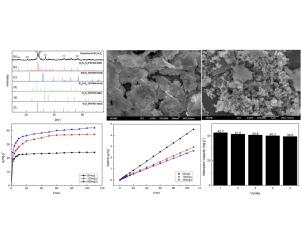
To our knowledge, there were hardly any reports on the application of Bi2Fe4O9 for adsorptive removal of heavy metal ions. In this study, Bi2Fe4O9 nanoplate was successfully fabricated through a facile hydrothermal method without addition of any template agents. The adsorption mechanism of Cu(II) and its behaviour on Bi2Fe4O9 were investigated comprehensively. The adsorbents were characterized by X-ray diffraction (XRD), scanning electron microscopy (SEM), Fourier transform infrared spectroscopy (FT-IR) and the N2 adsorption-desorption isotherm, respectively. The investigation on adsorption kinetics and isotherm showed that the pseudo-second-order kinetic and Langmuir isotherm models could well fit the experimental adsorption data. The maximum adsorption capacity of Bi2Fe4O9 for Cu(II) was found to be 42.7 mg g−1 at short equilibrium time of 40 min and ambient temperature, which was higher than those of other adsorbents reported in literatures. Thermodynamic survey on Gibbs free energy (ΔG < 0), enthalpy (ΔH > 0) and entropy (ΔS > 0) demonstrated that the adsorption process was endothermic and spontaneous. Due to the adsorptive reaction of Cu2+ on the surface, the regular plates of product were corroded to fragments, which illustrated that OH, FeO, FeOFe, OFeO and BiO involved in the adsorption process by FTIR. After recycling five times, the decline of adsorption capacity of product for Cu(II) was 7.2%, which indicated that the adsorbent could be recycled in the removal of Cu(II). Therefore, Bi2Fe4O9 nanoplate might be potentially applied in the removal of heavy metal ions from aqueous solution.
期刊介绍:
The Journal of Environmental Chemical Engineering (JECE) serves as a platform for the dissemination of original and innovative research focusing on the advancement of environmentally-friendly, sustainable technologies. JECE emphasizes the transition towards a carbon-neutral circular economy and a self-sufficient bio-based economy. Topics covered include soil, water, wastewater, and air decontamination; pollution monitoring, prevention, and control; advanced analytics, sensors, impact and risk assessment methodologies in environmental chemical engineering; resource recovery (water, nutrients, materials, energy); industrial ecology; valorization of waste streams; waste management (including e-waste); climate-water-energy-food nexus; novel materials for environmental, chemical, and energy applications; sustainability and environmental safety; water digitalization, water data science, and machine learning; process integration and intensification; recent developments in green chemistry for synthesis, catalysis, and energy; and original research on contaminants of emerging concern, persistent chemicals, and priority substances, including microplastics, nanoplastics, nanomaterials, micropollutants, antimicrobial resistance genes, and emerging pathogens (viruses, bacteria, parasites) of environmental significance.



 京公网安备 11010802042870号
京ICP备2023020795号-1
京公网安备 11010802042870号
京ICP备2023020795号-1

 分享
分享
 求助内容:
求助内容: 应助结果提醒方式:
 扫码关注我们
