Fei Wang, Zhi-Rong Zou, Dong Yuan, Yi Gong, Li Zhang, Xun Chen, Tao Sun, Hua-Lin Yu
{"title":"Correlation between serum S100β protein levels and cognitive dysfunction in patients with cerebral small vessel disease: a case-control study.","authors":"Fei Wang, Zhi-Rong Zou, Dong Yuan, Yi Gong, Li Zhang, Xun Chen, Tao Sun, Hua-Lin Yu","doi":"10.1042/BSR20160446","DOIUrl":null,"url":null,"abstract":"<p><p>The present study was designed to explore the correlation between serum S100β levels and cognitive dysfunction in patients with cerebral small vessel disease (SVD). A total of 172 SVD patients participated in the study, and they were assigned to patients with no cognitive impairment (NCI group) and those with vascular cognitive impairment no dementia (VCIND group). In total, 105 people were recruited into the normal control group. Serum S100β protein level was detected by ELISA. A receiver operating characteristic (ROC) curve was employed for the predictive value of serum S100β in diagnosing SVD with cognitive dysfunction. Pearson correlation analysis was used to examine the association of S100β level with mini-mental state examination (MMSE) and Montreal cognitive assessment (MoCA) and the association of S100β levels with hypertension. Logistic regression analysis was used to analyze risk factors of SVD. The serum S100β levels in the VCIND group were higher than those in the NCI and normal control groups. Logistic regression analysis revealed that a high serum S100β protein level, hypertension, and high low density lipoprotein-cholesterol (LDL-C) level were the independent risk factors for SVD. In addition, hypertension patients showed higher S100β levels than those with normal blood pressure and the normal control group, and there was a positive correlation between S100β level and blood pressure. The concentration of serum S100β level was related to impairment of cognition function of VCIND patients, therefore, early detection of serum S100β was of great value for diagnosis of SVD.</p>","PeriodicalId":3,"journal":{"name":"ACS Applied Electronic Materials","volume":" ","pages":""},"PeriodicalIF":4.7000,"publicationDate":"2017-04-10","publicationTypes":"Journal Article","fieldsOfStudy":null,"isOpenAccess":false,"openAccessPdf":"https://www.ncbi.nlm.nih.gov/pmc/articles/PMC5484012/pdf/","citationCount":"0","resultStr":null,"platform":"Semanticscholar","paperid":null,"PeriodicalName":"ACS Applied Electronic Materials","FirstCategoryId":"88","ListUrlMain":"https://doi.org/10.1042/BSR20160446","RegionNum":3,"RegionCategory":"材料科学","ArticlePicture":[],"TitleCN":null,"AbstractTextCN":null,"PMCID":null,"EPubDate":"2017/4/28 0:00:00","PubModel":"Print","JCR":"Q1","JCRName":"ENGINEERING, ELECTRICAL & ELECTRONIC","Score":null,"Total":0}
引用次数: 0
Abstract
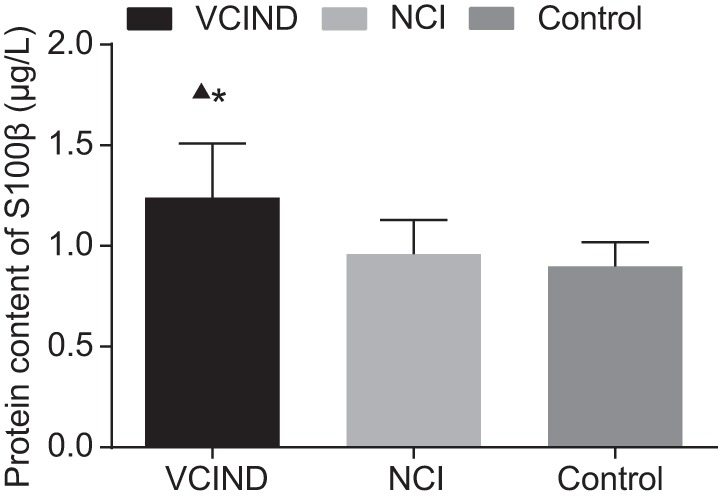
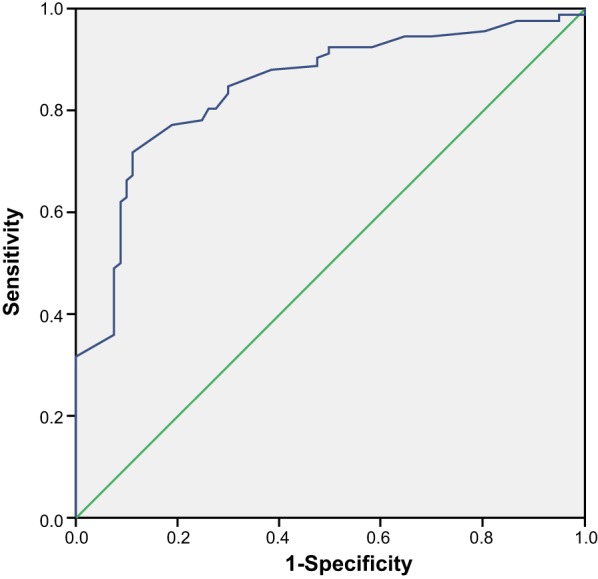
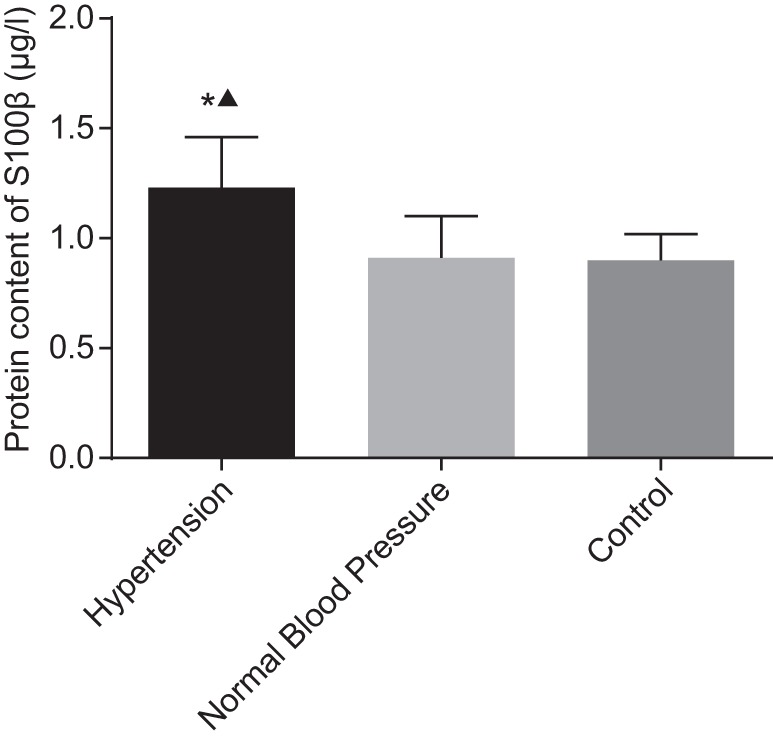
The present study was designed to explore the correlation between serum S100β levels and cognitive dysfunction in patients with cerebral small vessel disease (SVD). A total of 172 SVD patients participated in the study, and they were assigned to patients with no cognitive impairment (NCI group) and those with vascular cognitive impairment no dementia (VCIND group). In total, 105 people were recruited into the normal control group. Serum S100β protein level was detected by ELISA. A receiver operating characteristic (ROC) curve was employed for the predictive value of serum S100β in diagnosing SVD with cognitive dysfunction. Pearson correlation analysis was used to examine the association of S100β level with mini-mental state examination (MMSE) and Montreal cognitive assessment (MoCA) and the association of S100β levels with hypertension. Logistic regression analysis was used to analyze risk factors of SVD. The serum S100β levels in the VCIND group were higher than those in the NCI and normal control groups. Logistic regression analysis revealed that a high serum S100β protein level, hypertension, and high low density lipoprotein-cholesterol (LDL-C) level were the independent risk factors for SVD. In addition, hypertension patients showed higher S100β levels than those with normal blood pressure and the normal control group, and there was a positive correlation between S100β level and blood pressure. The concentration of serum S100β level was related to impairment of cognition function of VCIND patients, therefore, early detection of serum S100β was of great value for diagnosis of SVD.
期刊介绍:
ACS Applied Electronic Materials is an interdisciplinary journal publishing original research covering all aspects of electronic materials. The journal is devoted to reports of new and original experimental and theoretical research of an applied nature that integrate knowledge in the areas of materials science, engineering, optics, physics, and chemistry into important applications of electronic materials. Sample research topics that span the journal's scope are inorganic, organic, ionic and polymeric materials with properties that include conducting, semiconducting, superconducting, insulating, dielectric, magnetic, optoelectronic, piezoelectric, ferroelectric and thermoelectric.
Indexed/Abstracted:
Web of Science SCIE
Scopus
CAS
INSPEC
Portico




 京公网安备 11010802042870号
京ICP备2023020795号-1
京公网安备 11010802042870号
京ICP备2023020795号-1

 分享
分享
 求助内容:
求助内容: 应助结果提醒方式:
 扫码关注我们
