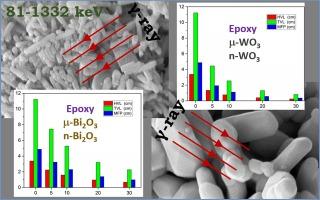
{"title":"The assessment of usage of epoxy based micro and nano-structured composites enriched with Bi2O3 and WO3 particles for radiation shielding","authors":"Yaşar Karabul, Orhan İçelli","doi":"10.1016/j.rinp.2021.104423","DOIUrl":null,"url":null,"abstract":"<div><p>This study has been devoted to investigate the radiation shielding performance of epoxy-based micro and nano Bi<sub>2</sub>O<sub>3</sub> and WO<sub>3</sub> reinforced composites. While the research has been carried out by using experimental data and MCNP6 simulation for the micro-structured composites; the effect of nano Bi<sub>2</sub>O<sub>3</sub> and WO<sub>3</sub> particles addition on the radiation shielding property of epoxy has been discussed by using experimental data. While the gamma-ray spectroscopy experiments have been carried by using NaI(Tl) scintillation detector and Ba-133, Cs-137, and Co-60 sources, the MCNP version 6.2 code has been utilized for the simulation. The experimental and MCNP6 simulation results showed good consistency for both particle reinforcement and different incoming photon energies. Particle size effect investigation also indicated that for both kinds of dopant particles, the nano dopant is more successful in attenuating the intensity of incoming photons than the micro dopant even if they are used in the same percentages. In conclusion, it can be suggested that the micro and nano-structured composites having the highest Bi<sub>2</sub>O<sub>3</sub> and WO<sub>3</sub> contents have a considerable potential to shield the harmful effects of some of the diagnostic radionuclides utilized in nuclear medicine as well as the radiation imaging machines such as roentgen, mammography or PET scans.</p></div>","PeriodicalId":21042,"journal":{"name":"Results in Physics","volume":"26 ","pages":"Article 104423"},"PeriodicalIF":4.6000,"publicationDate":"2021-07-01","publicationTypes":"Journal Article","fieldsOfStudy":null,"isOpenAccess":false,"openAccessPdf":"https://sci-hub-pdf.com/10.1016/j.rinp.2021.104423","citationCount":"48","resultStr":null,"platform":"Semanticscholar","paperid":null,"PeriodicalName":"Results in Physics","FirstCategoryId":"101","ListUrlMain":"https://www.sciencedirect.com/science/article/pii/S2211379721005428","RegionNum":2,"RegionCategory":"物理与天体物理","ArticlePicture":[],"TitleCN":null,"AbstractTextCN":null,"PMCID":null,"EPubDate":"","PubModel":"","JCR":"Q2","JCRName":"MATERIALS SCIENCE, MULTIDISCIPLINARY","Score":null,"Total":0}
引用次数: 48
Abstract
This study has been devoted to investigate the radiation shielding performance of epoxy-based micro and nano Bi2O3 and WO3 reinforced composites. While the research has been carried out by using experimental data and MCNP6 simulation for the micro-structured composites; the effect of nano Bi2O3 and WO3 particles addition on the radiation shielding property of epoxy has been discussed by using experimental data. While the gamma-ray spectroscopy experiments have been carried by using NaI(Tl) scintillation detector and Ba-133, Cs-137, and Co-60 sources, the MCNP version 6.2 code has been utilized for the simulation. The experimental and MCNP6 simulation results showed good consistency for both particle reinforcement and different incoming photon energies. Particle size effect investigation also indicated that for both kinds of dopant particles, the nano dopant is more successful in attenuating the intensity of incoming photons than the micro dopant even if they are used in the same percentages. In conclusion, it can be suggested that the micro and nano-structured composites having the highest Bi2O3 and WO3 contents have a considerable potential to shield the harmful effects of some of the diagnostic radionuclides utilized in nuclear medicine as well as the radiation imaging machines such as roentgen, mammography or PET scans.
Results in PhysicsMATERIALS SCIENCE, MULTIDISCIPLINARYPHYSIC-PHYSICS, MULTIDISCIPLINARY
CiteScore
8.70
自引率
9.40%
发文量
754
审稿时长
50 days
期刊介绍:
Results in Physics is an open access journal offering authors the opportunity to publish in all fundamental and interdisciplinary areas of physics, materials science, and applied physics. Papers of a theoretical, computational, and experimental nature are all welcome. Results in Physics accepts papers that are scientifically sound, technically correct and provide valuable new knowledge to the physics community. Topics such as three-dimensional flow and magnetohydrodynamics are not within the scope of Results in Physics.
Results in Physics welcomes three types of papers:
1. Full research papers
2. Microarticles: very short papers, no longer than two pages. They may consist of a single, but well-described piece of information, such as:
- Data and/or a plot plus a description
- Description of a new method or instrumentation
- Negative results
- Concept or design study
3. Letters to the Editor: Letters discussing a recent article published in Results in Physics are welcome. These are objective, constructive, or educational critiques of papers published in Results in Physics. Accepted letters will be sent to the author of the original paper for a response. Each letter and response is published together. Letters should be received within 8 weeks of the article''s publication. They should not exceed 750 words of text and 10 references.



 京公网安备 11010802042870号
京ICP备2023020795号-1
京公网安备 11010802042870号
京ICP备2023020795号-1

 分享
分享
 求助内容:
求助内容: 应助结果提醒方式:
 扫码关注我们
