2D carbon network arranged into high-order 3D nanotube arrays on a flexible microelectrode: integration into electrochemical microbiosensor devices for cancer detection
Yimin Sun, Xulin Dong, Hu He, Yan Zhang, Kai Chi, Yun Xu, Muhammad Asif, Xuan Yang, Wenshan He, Kin Liao, Fei Xiao
{"title":"2D carbon network arranged into high-order 3D nanotube arrays on a flexible microelectrode: integration into electrochemical microbiosensor devices for cancer detection","authors":"Yimin Sun, Xulin Dong, Hu He, Yan Zhang, Kai Chi, Yun Xu, Muhammad Asif, Xuan Yang, Wenshan He, Kin Liao, Fei Xiao","doi":"10.1038/s41427-022-00458-5","DOIUrl":null,"url":null,"abstract":"In this work, we develop a new type of mesoporous 2D N, B, and P codoped carbon network (NBP-CNW) arranged into high-order 3D nanotube arrays (NTAs), which are wrapped onto a flexible carbon fiber microelectrode, and this microelectrode is employed as a high-performance carbon-based nanocatalyst for electrochemical biosensing. The NBP-CNW-NTAs synthesized by a facile, controllable, ecofriendly and sustainable template strategy using ionic liquids as precursors possess a high structural stability, large surface area, abundant active sites, and effective charge transport pathways, which dramatically improve their electrocatalytic activity and durability in the redox reaction of cancer biomarker H2O2. Benefiting from these unique structural merits, superb electrochemical activity and good biocompatibility, the NBP-CNW-NTAs-modified microelectrode demonstrates excellent sensing performance toward H2O2 and is embedded in a homemade microfluidic electrochemical biosensor chip for the real-time tracking of H2O2 secreted from different live cancer cells with or without radiotherapy treatment, which provides a new strategy for distinguishing the types of cancer cells and evaluating the radiotherapeutic efficacy of cancer cells. Furthermore, the functional microelectrode is integrated into an implantable probe for the in situ detection of surgically resected human specimens to distinguish cancer tissues from normal tissues. These will be of vital significance for cancer diagnoses and therapy in clinical practice. High-order 3D nanotube arrays (NTAs) arranged from mesoporous 2D N, B, P co-doped carbon network (NBP-CNW) were synthesize by a facile, well-controllable, eco-friendly and sustainable strategy using task-specific ionic liquids as precursors. NBP-CNW-NTAs modified flexible microelectrode was embed in microfluidic electrochemical biosensor chip for real-time tracking H2O2 secreted from different cancer cells (i.e., breast cancer cells, hepatoma cells and cervical cancer cells) with or without radiotherapy treatment. Furthermore, the functional microelectrode has been integrated into an implantable probe for in situ minimally invasive detection of surgically resected human breast specimens to identify the tumor tissues from the normal one.","PeriodicalId":19382,"journal":{"name":"Npg Asia Materials","volume":"15 1","pages":"1-11"},"PeriodicalIF":8.3000,"publicationDate":"2023-03-31","publicationTypes":"Journal Article","fieldsOfStudy":null,"isOpenAccess":false,"openAccessPdf":"https://www.nature.com/articles/s41427-022-00458-5.pdf","citationCount":"0","resultStr":null,"platform":"Semanticscholar","paperid":null,"PeriodicalName":"Npg Asia Materials","FirstCategoryId":"88","ListUrlMain":"https://www.nature.com/articles/s41427-022-00458-5","RegionNum":2,"RegionCategory":"材料科学","ArticlePicture":[],"TitleCN":null,"AbstractTextCN":null,"PMCID":null,"EPubDate":"","PubModel":"","JCR":"Q1","JCRName":"MATERIALS SCIENCE, MULTIDISCIPLINARY","Score":null,"Total":0}
引用次数: 0
Abstract
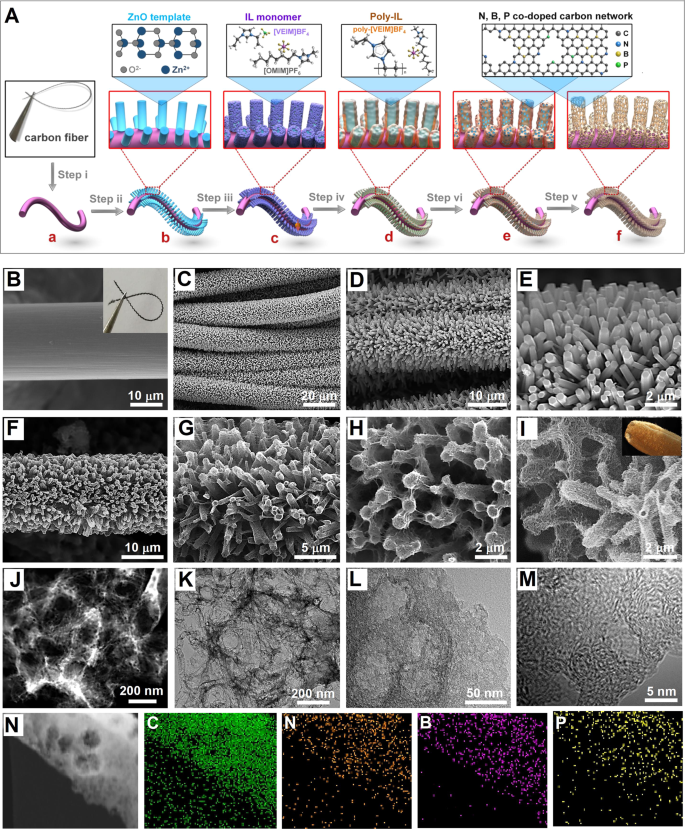
In this work, we develop a new type of mesoporous 2D N, B, and P codoped carbon network (NBP-CNW) arranged into high-order 3D nanotube arrays (NTAs), which are wrapped onto a flexible carbon fiber microelectrode, and this microelectrode is employed as a high-performance carbon-based nanocatalyst for electrochemical biosensing. The NBP-CNW-NTAs synthesized by a facile, controllable, ecofriendly and sustainable template strategy using ionic liquids as precursors possess a high structural stability, large surface area, abundant active sites, and effective charge transport pathways, which dramatically improve their electrocatalytic activity and durability in the redox reaction of cancer biomarker H2O2. Benefiting from these unique structural merits, superb electrochemical activity and good biocompatibility, the NBP-CNW-NTAs-modified microelectrode demonstrates excellent sensing performance toward H2O2 and is embedded in a homemade microfluidic electrochemical biosensor chip for the real-time tracking of H2O2 secreted from different live cancer cells with or without radiotherapy treatment, which provides a new strategy for distinguishing the types of cancer cells and evaluating the radiotherapeutic efficacy of cancer cells. Furthermore, the functional microelectrode is integrated into an implantable probe for the in situ detection of surgically resected human specimens to distinguish cancer tissues from normal tissues. These will be of vital significance for cancer diagnoses and therapy in clinical practice. High-order 3D nanotube arrays (NTAs) arranged from mesoporous 2D N, B, P co-doped carbon network (NBP-CNW) were synthesize by a facile, well-controllable, eco-friendly and sustainable strategy using task-specific ionic liquids as precursors. NBP-CNW-NTAs modified flexible microelectrode was embed in microfluidic electrochemical biosensor chip for real-time tracking H2O2 secreted from different cancer cells (i.e., breast cancer cells, hepatoma cells and cervical cancer cells) with or without radiotherapy treatment. Furthermore, the functional microelectrode has been integrated into an implantable probe for in situ minimally invasive detection of surgically resected human breast specimens to identify the tumor tissues from the normal one.
期刊介绍:
NPG Asia Materials is an open access, international journal that publishes peer-reviewed review and primary research articles in the field of materials sciences. The journal has a global outlook and reach, with a base in the Asia-Pacific region to reflect the significant and growing output of materials research from this area. The target audience for NPG Asia Materials is scientists and researchers involved in materials research, covering a wide range of disciplines including physical and chemical sciences, biotechnology, and nanotechnology. The journal particularly welcomes high-quality articles from rapidly advancing areas that bridge the gap between materials science and engineering, as well as the classical disciplines of physics, chemistry, and biology. NPG Asia Materials is abstracted/indexed in Journal Citation Reports/Science Edition Web of Knowledge, Google Scholar, Chemical Abstract Services, Scopus, Ulrichsweb (ProQuest), and Scirus.




 京公网安备 11010802042870号
京ICP备2023020795号-1
京公网安备 11010802042870号
京ICP备2023020795号-1

 分享
分享
 求助内容:
求助内容: 应助结果提醒方式:
 扫码关注我们
