{"title":"Let them eat virus: exploring how TBK1 (TANK binding kinase 1) enhances autophagic flux to promote autophagic degradation of coxsackievirus B.","authors":"Savannah Sawaged, Jon Sin","doi":"10.1080/27694127.2022.2139332","DOIUrl":null,"url":null,"abstract":"<p><p>Coxsackievirus B (CVB) is a common human enterovirus that can cause an array of systemic inflammatory diseases. We and others have demonstrated that macroautophagy/autophagy is activated during CVB infection leading to viral engulfment within autophagosomes. Interestingly, rather than this mechanism leading to bulk degradation of intracellular virus (also referred to as xenophagy), autophagosome-lysosomal fusion appears to be circumvented, leading to extracellular release of CVB via ejected autophagosomes. In our present study, we have found that TBK1 (TANK binding kinase 1) plays a role in limiting CVB infection by promoting autophagic flux to limit autophagy-based viral egress. This aspect of viral defense also appears to be independent of TBK1's well-characterized involvement in interferon signaling. Indeed, genetic inhibition of <i>TBK1</i> significantly enhances CVB infection <i>in vitro</i> and dramatically increases the amount of vesicle-bound virus being released from the cell. Furthermore, inhibition of TBK1 via amlexanox treatment markedly increases serum levels of infectious extracellular vesicles (EV) and severity of pancreatitis in CVB-infected mice. In all, the identification of TBK1's involvement in the suppression of CVB egress pegs it as a promising therapeutic target for the development of novel antiviral strategies against not only CVB but potentially other viruses that exploit autophagy to promote viral spread.</p>","PeriodicalId":72341,"journal":{"name":"Autophagy reports","volume":" ","pages":"563-566"},"PeriodicalIF":0.0000,"publicationDate":"2022-10-31","publicationTypes":"Journal Article","fieldsOfStudy":null,"isOpenAccess":false,"openAccessPdf":"https://www.ncbi.nlm.nih.gov/pmc/articles/PMC11864632/pdf/","citationCount":"0","resultStr":null,"platform":"Semanticscholar","paperid":null,"PeriodicalName":"Autophagy reports","FirstCategoryId":"1085","ListUrlMain":"https://doi.org/10.1080/27694127.2022.2139332","RegionNum":0,"RegionCategory":null,"ArticlePicture":[],"TitleCN":null,"AbstractTextCN":null,"PMCID":null,"EPubDate":"2022/1/1 0:00:00","PubModel":"eCollection","JCR":"","JCRName":"","Score":null,"Total":0}
引用次数: 0
Abstract
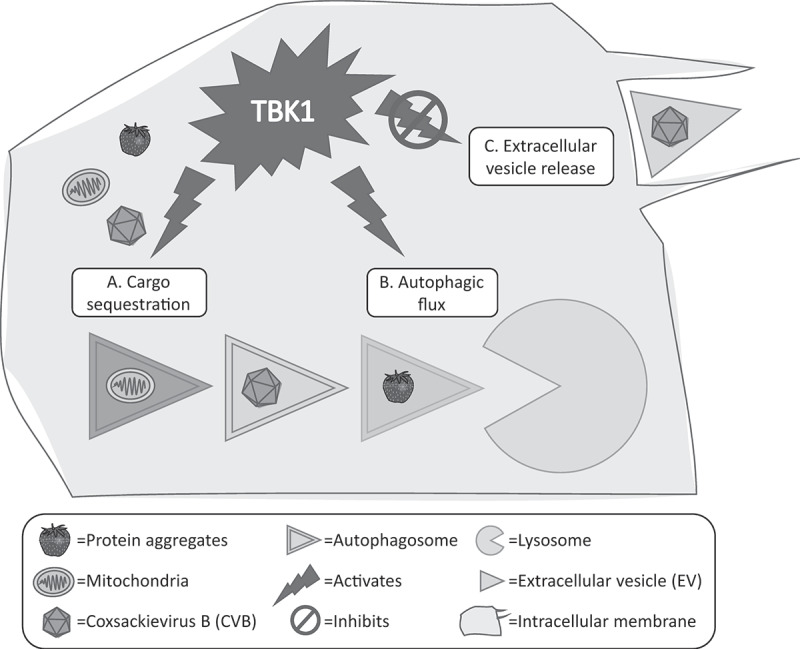
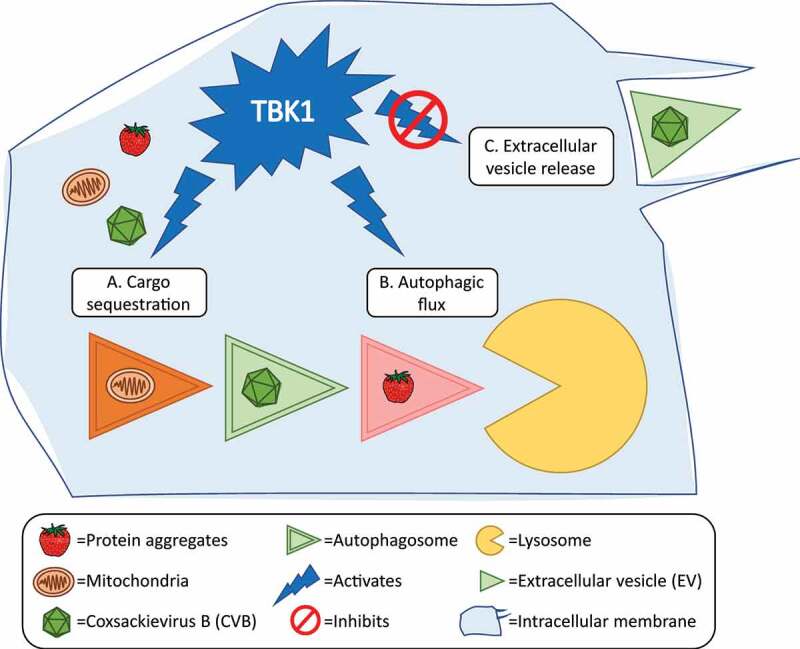
Coxsackievirus B (CVB) is a common human enterovirus that can cause an array of systemic inflammatory diseases. We and others have demonstrated that macroautophagy/autophagy is activated during CVB infection leading to viral engulfment within autophagosomes. Interestingly, rather than this mechanism leading to bulk degradation of intracellular virus (also referred to as xenophagy), autophagosome-lysosomal fusion appears to be circumvented, leading to extracellular release of CVB via ejected autophagosomes. In our present study, we have found that TBK1 (TANK binding kinase 1) plays a role in limiting CVB infection by promoting autophagic flux to limit autophagy-based viral egress. This aspect of viral defense also appears to be independent of TBK1's well-characterized involvement in interferon signaling. Indeed, genetic inhibition of TBK1 significantly enhances CVB infection in vitro and dramatically increases the amount of vesicle-bound virus being released from the cell. Furthermore, inhibition of TBK1 via amlexanox treatment markedly increases serum levels of infectious extracellular vesicles (EV) and severity of pancreatitis in CVB-infected mice. In all, the identification of TBK1's involvement in the suppression of CVB egress pegs it as a promising therapeutic target for the development of novel antiviral strategies against not only CVB but potentially other viruses that exploit autophagy to promote viral spread.



 京公网安备 11010802042870号
京ICP备2023020795号-1
京公网安备 11010802042870号
京ICP备2023020795号-1

 分享
分享

 求助内容:
求助内容: 应助结果提醒方式:
 扫码关注我们
