Zhiwei Zou , Huiying Zhang , Jingyu Lan , Jiahui Luo , Yichao Xie , Yafeng Li , Jian Lü , Rong Cao
{"title":"Unique heterostructures of ZnCdS nanoplates with Bi2S3−terminated edges for optimal CO2−to−CO photoconversion","authors":"Zhiwei Zou , Huiying Zhang , Jingyu Lan , Jiahui Luo , Yichao Xie , Yafeng Li , Jian Lü , Rong Cao","doi":"10.1016/j.nanoms.2022.11.001","DOIUrl":null,"url":null,"abstract":"<div><div>Photocatalytic conversion of chemical fuels has emerged as a most challenging subject in photocatalysis which is considered as one of the sustainable solutions for environmental issues related to the energy shortage and anthropogenic carbon emissions. Herein, unique heterostructures of ZnCdS nanoplates with Bi<sub>2</sub>S<sub>3</sub>−terminated edges were prepared through a facile cation exchange pathway, by which the controlled photocatalytic CO<sub>2</sub> conversion was achieved. The optimized BZCS–NS−5 photocatalyst exhibited an excellent capacity of CO<sub>2</sub> photoreduction with a CO production rate of ca. 513.2 ± 5.1 μmol g<sup>−1</sup> h<sup>−1</sup> and a selectivity of ca. 91.0%, which were among the highest activities for sulfide photocatalysts documented in the literature. The outstanding photocatalytic performance was attributable to the formation of Z−scheme heterostrucutres between Bi<sub>2</sub>S<sub>3</sub> and ZnCdS, in a way the separation and migration of photocarriers were accelerated. This work thus provides a feasible strategy for the construction of heterostructures to enhance the activity and selectivity of CO<sub>2</sub>−to−CO conversion via delicate design and controlled synthesis of photocatalysts.</div></div>","PeriodicalId":33573,"journal":{"name":"Nano Materials Science","volume":"7 6","pages":"Pages 810-817"},"PeriodicalIF":17.9000,"publicationDate":"2025-12-01","publicationTypes":"Journal Article","fieldsOfStudy":null,"isOpenAccess":false,"openAccessPdf":"","citationCount":"0","resultStr":null,"platform":"Semanticscholar","paperid":null,"PeriodicalName":"Nano Materials Science","FirstCategoryId":"1089","ListUrlMain":"https://www.sciencedirect.com/science/article/pii/S2589965122000575","RegionNum":2,"RegionCategory":"材料科学","ArticlePicture":[],"TitleCN":null,"AbstractTextCN":null,"PMCID":null,"EPubDate":"","PubModel":"","JCR":"Q1","JCRName":"Engineering","Score":null,"Total":0}
引用次数: 0
Abstract
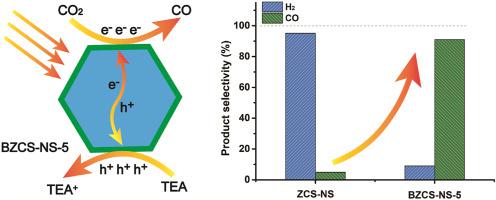
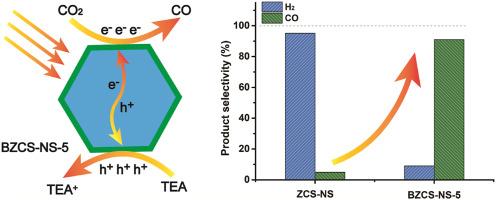
Photocatalytic conversion of chemical fuels has emerged as a most challenging subject in photocatalysis which is considered as one of the sustainable solutions for environmental issues related to the energy shortage and anthropogenic carbon emissions. Herein, unique heterostructures of ZnCdS nanoplates with Bi2S3−terminated edges were prepared through a facile cation exchange pathway, by which the controlled photocatalytic CO2 conversion was achieved. The optimized BZCS–NS−5 photocatalyst exhibited an excellent capacity of CO2 photoreduction with a CO production rate of ca. 513.2 ± 5.1 μmol g−1 h−1 and a selectivity of ca. 91.0%, which were among the highest activities for sulfide photocatalysts documented in the literature. The outstanding photocatalytic performance was attributable to the formation of Z−scheme heterostrucutres between Bi2S3 and ZnCdS, in a way the separation and migration of photocarriers were accelerated. This work thus provides a feasible strategy for the construction of heterostructures to enhance the activity and selectivity of CO2−to−CO conversion via delicate design and controlled synthesis of photocatalysts.
期刊介绍:
Nano Materials Science (NMS) is an international and interdisciplinary, open access, scholarly journal. NMS publishes peer-reviewed original articles and reviews on nanoscale material science and nanometer devices, with topics encompassing preparation and processing; high-throughput characterization; material performance evaluation and application of material characteristics such as the microstructure and properties of one-dimensional, two-dimensional, and three-dimensional nanostructured and nanofunctional materials; design, preparation, and processing techniques; and performance evaluation technology and nanometer device applications.



 京公网安备 11010802042870号
京ICP备2023020795号-1
京公网安备 11010802042870号
京ICP备2023020795号-1

 分享
分享
 求助内容:
求助内容: 应助结果提醒方式:
 扫码关注我们
