Zenghua Wang, Bing Cai, Deyu Xin, Min Zhang, Xiaojia Zheng
{"title":"Modulating J-V hysteresis of planar perovskite solar cells and mini-modules via work function engineering","authors":"Zenghua Wang, Bing Cai, Deyu Xin, Min Zhang, Xiaojia Zheng","doi":"10.1016/j.jechem.2023.05.031","DOIUrl":null,"url":null,"abstract":"<div><p>Commercialization of perovskite solar cells (PSCs) requires the development of high-efficiency devices with none current density-voltage (<em>J-V</em>) hysteresis. Here, electron transport layers (ETLs) with gradual change in work function (WF) are successfully fabricated and employed as an ideal model to investigate the energy barriers, charge transfer and recombination kinetics at ETL/perovskite interface. The energy barrier for electron injection existing at ETL/perovskite is directly assessed by surface photovoltage microscopy, and the results demonstrate the tunable barriers have significant impact on the <em>J-V</em> hysteresis and performance of PSCs. By work function engineering of ETL, PSCs exhibit PCEs over 21% with negligible hysteresis. These results provide a critical understanding of the origin reason for hysteresis effect in planar PSCs, and clear reveal that the <em>J-V</em> hysteresis can be effectively suppressed by carefully tuning the interface features in PSCs. By extending this strategy to a modified formamidinium-cesium-rubidium (FA-Cs-Rb) perovskite system, the PCEs are further boosted to 24.18%. Moreover, 5 cm × 5 cm perovskite mini-modules are also fabricated with an impressive efficiency of 20.07%, demonstrating compatibility and effectiveness of our strategy on upscaled devices.</p></div>","PeriodicalId":15728,"journal":{"name":"Journal of Energy Chemistry","volume":"85 ","pages":"Pages 19-29"},"PeriodicalIF":14.9000,"publicationDate":"2023-10-01","publicationTypes":"Journal Article","fieldsOfStudy":null,"isOpenAccess":false,"openAccessPdf":"","citationCount":"1","resultStr":null,"platform":"Semanticscholar","paperid":null,"PeriodicalName":"Journal of Energy Chemistry","FirstCategoryId":"1085","ListUrlMain":"https://www.sciencedirect.com/science/article/pii/S2095495623003182","RegionNum":1,"RegionCategory":"化学","ArticlePicture":[],"TitleCN":null,"AbstractTextCN":null,"PMCID":null,"EPubDate":"2023/6/7 0:00:00","PubModel":"Epub","JCR":"Q1","JCRName":"Energy","Score":null,"Total":0}
引用次数: 1
Abstract
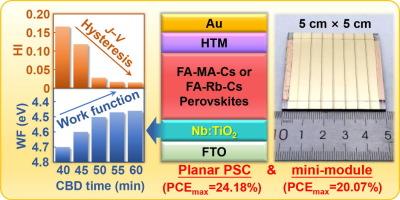
Commercialization of perovskite solar cells (PSCs) requires the development of high-efficiency devices with none current density-voltage (J-V) hysteresis. Here, electron transport layers (ETLs) with gradual change in work function (WF) are successfully fabricated and employed as an ideal model to investigate the energy barriers, charge transfer and recombination kinetics at ETL/perovskite interface. The energy barrier for electron injection existing at ETL/perovskite is directly assessed by surface photovoltage microscopy, and the results demonstrate the tunable barriers have significant impact on the J-V hysteresis and performance of PSCs. By work function engineering of ETL, PSCs exhibit PCEs over 21% with negligible hysteresis. These results provide a critical understanding of the origin reason for hysteresis effect in planar PSCs, and clear reveal that the J-V hysteresis can be effectively suppressed by carefully tuning the interface features in PSCs. By extending this strategy to a modified formamidinium-cesium-rubidium (FA-Cs-Rb) perovskite system, the PCEs are further boosted to 24.18%. Moreover, 5 cm × 5 cm perovskite mini-modules are also fabricated with an impressive efficiency of 20.07%, demonstrating compatibility and effectiveness of our strategy on upscaled devices.
期刊介绍:
The Journal of Energy Chemistry, the official publication of Science Press and the Dalian Institute of Chemical Physics, Chinese Academy of Sciences, serves as a platform for reporting creative research and innovative applications in energy chemistry. It mainly reports on creative researches and innovative applications of chemical conversions of fossil energy, carbon dioxide, electrochemical energy and hydrogen energy, as well as the conversions of biomass and solar energy related with chemical issues to promote academic exchanges in the field of energy chemistry and to accelerate the exploration, research and development of energy science and technologies.
This journal focuses on original research papers covering various topics within energy chemistry worldwide, including:
Optimized utilization of fossil energy
Hydrogen energy
Conversion and storage of electrochemical energy
Capture, storage, and chemical conversion of carbon dioxide
Materials and nanotechnologies for energy conversion and storage
Chemistry in biomass conversion
Chemistry in the utilization of solar energy



 京公网安备 11010802042870号
京ICP备2023020795号-1
京公网安备 11010802042870号
京ICP备2023020795号-1

 分享
分享
 求助内容:
求助内容: 应助结果提醒方式:
 扫码关注我们
