Lu Liu, Evan Lopez, Leonardo Dueñas-Osorio, Lauren Stadler, Yuefeng Xie, Pedro J. J. Alvarez, Qilin Li
{"title":"The importance of system configuration for distributed direct potable water reuse","authors":"Lu Liu, Evan Lopez, Leonardo Dueñas-Osorio, Lauren Stadler, Yuefeng Xie, Pedro J. J. Alvarez, Qilin Li","doi":"10.1038/s41893-020-0518-5","DOIUrl":null,"url":null,"abstract":"Water and wastewater infrastructure worldwide faces unprecedented demand and supply conflicts that require unconventional solutions. In this study, we develop a novel modelling framework to assess the environmental and economic implications of a hybrid water supply system that supplements a centralized surface water supply with distributed direct potable reuse (DPR) of municipal wastewater, as a strategy to address such challenges. The model is tested with real water and wastewater systems data from the City of Houston, Texas. Results show that supplementing the conventional centralized water supply with distributed DPR would reduce water age in the drinking-water distribution network and hence improve water quality; properly designed system configurations attain system-wide net energy savings even with the high energy consumption of existing technologies used for advanced treatment of the wastewater. A target energy efficiency for future advanced treatment technologies is identified to achieve net energy saving with all hybrid system configurations. Furthermore, distributed DPR remains financially competitive compared with other unconventional water supply solutions. The modelling framework and associated databases developed in this study serve an important research need for quantitatively characterizing distributed and hybrid water systems, laying the necessary foundation for rational design of integrated urban water systems. Water and wastewater infrastructure worldwide faces unprecedented challenges. A new model can assess the environmental and economic implications of a hybrid water supply system that provides a centralized surface water supply with distributed direct potable reuse of municipal wastewater.","PeriodicalId":19056,"journal":{"name":"Nature Sustainability","volume":"3 7","pages":"548-555"},"PeriodicalIF":27.1000,"publicationDate":"2020-04-27","publicationTypes":"Journal Article","fieldsOfStudy":null,"isOpenAccess":false,"openAccessPdf":"https://sci-hub-pdf.com/10.1038/s41893-020-0518-5","citationCount":"30","resultStr":null,"platform":"Semanticscholar","paperid":null,"PeriodicalName":"Nature Sustainability","FirstCategoryId":"93","ListUrlMain":"https://www.nature.com/articles/s41893-020-0518-5","RegionNum":1,"RegionCategory":"环境科学与生态学","ArticlePicture":[],"TitleCN":null,"AbstractTextCN":null,"PMCID":null,"EPubDate":"","PubModel":"","JCR":"Q1","JCRName":"ENVIRONMENTAL SCIENCES","Score":null,"Total":0}
引用次数: 30
Abstract
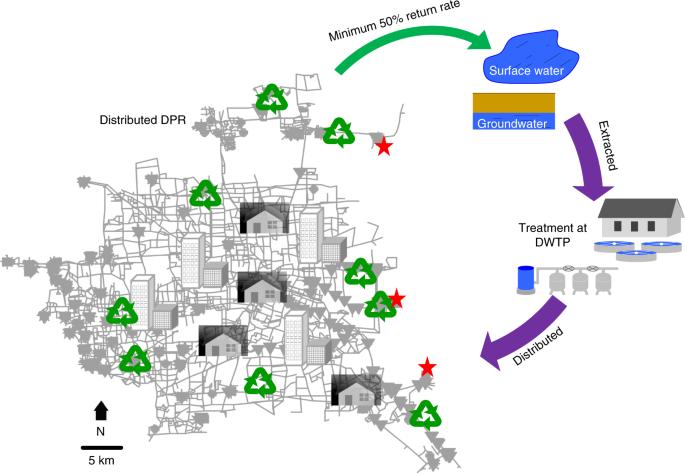
Water and wastewater infrastructure worldwide faces unprecedented demand and supply conflicts that require unconventional solutions. In this study, we develop a novel modelling framework to assess the environmental and economic implications of a hybrid water supply system that supplements a centralized surface water supply with distributed direct potable reuse (DPR) of municipal wastewater, as a strategy to address such challenges. The model is tested with real water and wastewater systems data from the City of Houston, Texas. Results show that supplementing the conventional centralized water supply with distributed DPR would reduce water age in the drinking-water distribution network and hence improve water quality; properly designed system configurations attain system-wide net energy savings even with the high energy consumption of existing technologies used for advanced treatment of the wastewater. A target energy efficiency for future advanced treatment technologies is identified to achieve net energy saving with all hybrid system configurations. Furthermore, distributed DPR remains financially competitive compared with other unconventional water supply solutions. The modelling framework and associated databases developed in this study serve an important research need for quantitatively characterizing distributed and hybrid water systems, laying the necessary foundation for rational design of integrated urban water systems. Water and wastewater infrastructure worldwide faces unprecedented challenges. A new model can assess the environmental and economic implications of a hybrid water supply system that provides a centralized surface water supply with distributed direct potable reuse of municipal wastewater.
期刊介绍:
Nature Sustainability aims to facilitate cross-disciplinary dialogues and bring together research fields that contribute to understanding how we organize our lives in a finite world and the impacts of our actions.
Nature Sustainability will not only publish fundamental research but also significant investigations into policies and solutions for ensuring human well-being now and in the future.Its ultimate goal is to address the greatest challenges of our time.



 京公网安备 11010802042870号
京ICP备2023020795号-1
京公网安备 11010802042870号
京ICP备2023020795号-1

 分享
分享
 求助内容:
求助内容: 应助结果提醒方式:
 扫码关注我们
