Eliška Jiroušková, Radomír Čabala, Romana Sokolová
{"title":"Voltammetric study of new psychoactive substance 3-fluorophenmetrazine","authors":"Eliška Jiroušková, Radomír Čabala, Romana Sokolová","doi":"10.1002/elsa.202100223","DOIUrl":null,"url":null,"abstract":"<p>Electrochemical oxidation of the new psychoactive substance 3-fluorophenmetrazine (FPM) was studied in phosphate buffers by cyclic voltammetry and differential pulse voltammetry (DPV) on a glassy carbon electrode. The redox potential of FPM in buffered solution strongly depends on pH. Cyclic voltammetry behavior shows the partial influence of adsorption on the electrode process not allowing detailed analysis of the individual steps of the reaction scheme, it means the involvement of electron transfer (E) and chemical reaction (C). Nevertheless, the irreversible shape of the cyclic voltammogram is explained by the participation of hydroxylation nucleophilic addition of water (hydroxylation) after two-electron/two-proton oxidation of molecule at the tetrahydro-1,4-oxazine ring. The suggested mechanism leading to hydroxylated derivative 2-(3-fluorophenyl)-3-methyl-5-hydroxymorfolin is supported by the calculated highest occupied molecular orbital spatial distribution and atomic charges calculations for electrochemically formed radical cation. Infrared spectroelectrochemistry performed during oxidation in acetonitrile/water also supported the formation of this product.</p><p>The analytical method of FPM determination on glassy carbon electrode was developed using DPV with an attained limit of detection = 4.7 μmol/L in phosphate buffer of pH 9. The linear range of the calibration curve is from 7.0 to 107.00 μmol/L, correlation coefficient (<i>r</i>) = 0.9988.</p>","PeriodicalId":93746,"journal":{"name":"Electrochemical science advances","volume":"3 5","pages":""},"PeriodicalIF":4.1000,"publicationDate":"2022-05-10","publicationTypes":"Journal Article","fieldsOfStudy":null,"isOpenAccess":false,"openAccessPdf":"https://onlinelibrary.wiley.com/doi/epdf/10.1002/elsa.202100223","citationCount":"0","resultStr":null,"platform":"Semanticscholar","paperid":null,"PeriodicalName":"Electrochemical science advances","FirstCategoryId":"1085","ListUrlMain":"https://onlinelibrary.wiley.com/doi/10.1002/elsa.202100223","RegionNum":0,"RegionCategory":null,"ArticlePicture":[],"TitleCN":null,"AbstractTextCN":null,"PMCID":null,"EPubDate":"","PubModel":"","JCR":"Q2","JCRName":"ELECTROCHEMISTRY","Score":null,"Total":0}
引用次数: 0
Abstract
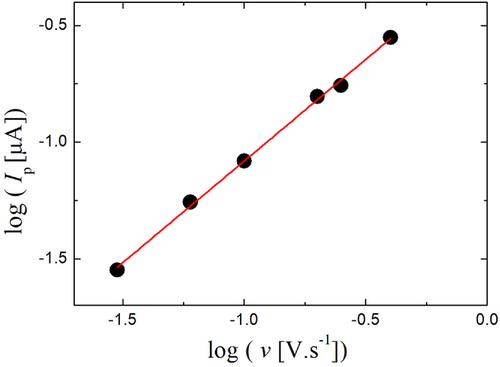
Electrochemical oxidation of the new psychoactive substance 3-fluorophenmetrazine (FPM) was studied in phosphate buffers by cyclic voltammetry and differential pulse voltammetry (DPV) on a glassy carbon electrode. The redox potential of FPM in buffered solution strongly depends on pH. Cyclic voltammetry behavior shows the partial influence of adsorption on the electrode process not allowing detailed analysis of the individual steps of the reaction scheme, it means the involvement of electron transfer (E) and chemical reaction (C). Nevertheless, the irreversible shape of the cyclic voltammogram is explained by the participation of hydroxylation nucleophilic addition of water (hydroxylation) after two-electron/two-proton oxidation of molecule at the tetrahydro-1,4-oxazine ring. The suggested mechanism leading to hydroxylated derivative 2-(3-fluorophenyl)-3-methyl-5-hydroxymorfolin is supported by the calculated highest occupied molecular orbital spatial distribution and atomic charges calculations for electrochemically formed radical cation. Infrared spectroelectrochemistry performed during oxidation in acetonitrile/water also supported the formation of this product.
The analytical method of FPM determination on glassy carbon electrode was developed using DPV with an attained limit of detection = 4.7 μmol/L in phosphate buffer of pH 9. The linear range of the calibration curve is from 7.0 to 107.00 μmol/L, correlation coefficient (r) = 0.9988.



 京公网安备 11010802042870号
京ICP备2023020795号-1
京公网安备 11010802042870号
京ICP备2023020795号-1

 分享
分享

 求助内容:
求助内容: 应助结果提醒方式:
 扫码关注我们
