{"title":"Responds of Bone Cells to Microgravity: Ground-Based Research","authors":"Jian Zhang, Jingbao Li, Huiyun Xu, Pengfei Yang, Li Xie, Airong Qian, Yong Zhao, Peng Shang","doi":"10.1007/s12217-015-9443-z","DOIUrl":null,"url":null,"abstract":"<p>Severe loss of bone occurs due to long-duration spaceflight. Mechanical loading stimulates bone formation, while bone degradation happens under mechanical unloading. Bone remodeling is a dynamic process in which bone formation and bone resorption are tightly coupled. Increased bone resorption and decreased bone formation caused by reduced mechanical loading, generally result in disrupted bone remodeling. Bone remodeling is orchestrated by multiple bone cells including osteoblast, osteocyte, osteoclast and mesenchymal stem cell. It is yet not clear that how these bone cells sense altered gravity, translate physical stimulus into biochemical signals, and then regulate themselves structurally and functionally. In this paper, studies elucidating the bioeffects of microgravity on bone cells (osteoblast, osteocyte, osteoclast, mesenchymal stem cell) using various platforms including spaceflight and ground-based simulated microgravity were summarized. Promising gravity-sensitive signaling pathways and protein molecules were proposed.</p>","PeriodicalId":707,"journal":{"name":"Microgravity Science and Technology","volume":"27 6","pages":"455 - 464"},"PeriodicalIF":1.3000,"publicationDate":"2015-07-15","publicationTypes":"Journal Article","fieldsOfStudy":null,"isOpenAccess":false,"openAccessPdf":"https://sci-hub-pdf.com/10.1007/s12217-015-9443-z","citationCount":"9","resultStr":null,"platform":"Semanticscholar","paperid":null,"PeriodicalName":"Microgravity Science and Technology","FirstCategoryId":"5","ListUrlMain":"https://link.springer.com/article/10.1007/s12217-015-9443-z","RegionNum":4,"RegionCategory":"工程技术","ArticlePicture":[],"TitleCN":null,"AbstractTextCN":null,"PMCID":null,"EPubDate":"","PubModel":"","JCR":"Q2","JCRName":"ENGINEERING, AEROSPACE","Score":null,"Total":0}
引用次数: 9
Abstract
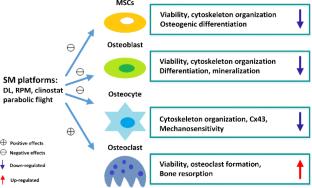
Severe loss of bone occurs due to long-duration spaceflight. Mechanical loading stimulates bone formation, while bone degradation happens under mechanical unloading. Bone remodeling is a dynamic process in which bone formation and bone resorption are tightly coupled. Increased bone resorption and decreased bone formation caused by reduced mechanical loading, generally result in disrupted bone remodeling. Bone remodeling is orchestrated by multiple bone cells including osteoblast, osteocyte, osteoclast and mesenchymal stem cell. It is yet not clear that how these bone cells sense altered gravity, translate physical stimulus into biochemical signals, and then regulate themselves structurally and functionally. In this paper, studies elucidating the bioeffects of microgravity on bone cells (osteoblast, osteocyte, osteoclast, mesenchymal stem cell) using various platforms including spaceflight and ground-based simulated microgravity were summarized. Promising gravity-sensitive signaling pathways and protein molecules were proposed.
期刊介绍:
Microgravity Science and Technology – An International Journal for Microgravity and Space Exploration Related Research is a is a peer-reviewed scientific journal concerned with all topics, experimental as well as theoretical, related to research carried out under conditions of altered gravity.
Microgravity Science and Technology publishes papers dealing with studies performed on and prepared for platforms that provide real microgravity conditions (such as drop towers, parabolic flights, sounding rockets, reentry capsules and orbiting platforms), and on ground-based facilities aiming to simulate microgravity conditions on earth (such as levitrons, clinostats, random positioning machines, bed rest facilities, and micro-scale or neutral buoyancy facilities) or providing artificial gravity conditions (such as centrifuges).
Data from preparatory tests, hardware and instrumentation developments, lessons learnt as well as theoretical gravity-related considerations are welcome. Included science disciplines with gravity-related topics are:
− materials science
− fluid mechanics
− process engineering
− physics
− chemistry
− heat and mass transfer
− gravitational biology
− radiation biology
− exobiology and astrobiology
− human physiology



 京公网安备 11010802042870号
京ICP备2023020795号-1
京公网安备 11010802042870号
京ICP备2023020795号-1

 分享
分享
 求助内容:
求助内容: 应助结果提醒方式:
 扫码关注我们
